Benin Country Profile
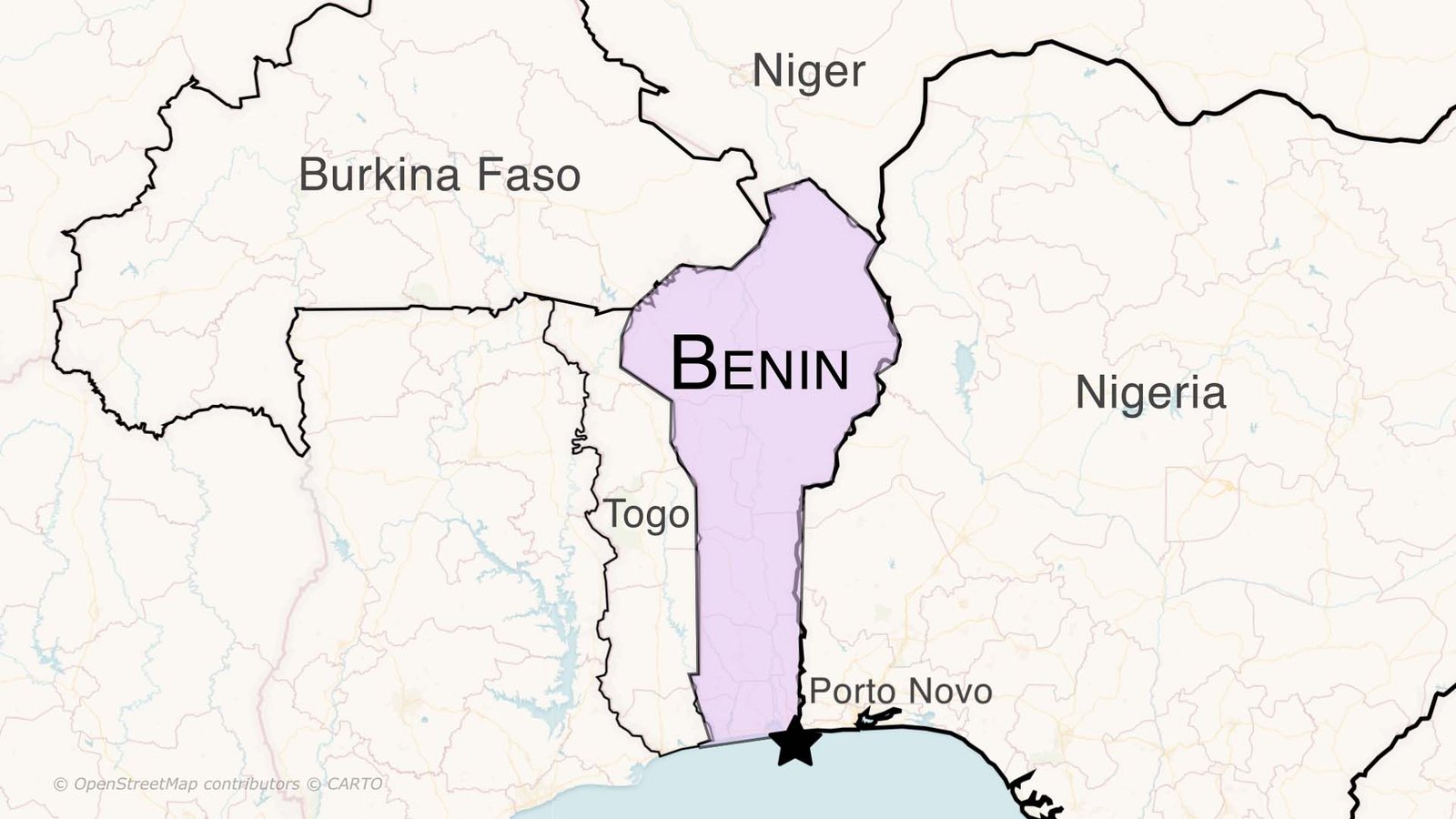
Benin is located in West Africa, bordered by Togo to the west, Burkina Faso and Niger to the north, and Nigeria to the east. To the south lies the Bight of Benin, part of the Gulf of Guinea.
Benin Facts
- OFFICIAL NAME: Republic of Benin
- CAPITAL: Porto-Novo
- POPULATION: 15,170,419 (2026)
- AREA: 114,763 square kilometers
- OFFICIAL LANGUAGE: French
- CURRENCY: West African CFA Franc (XOF)
Benin Flag
The flag of Benin has a vertical green stripe on the hoist side, with two horizontal stripes on the right — yellow on top and red on the bottom. The green represents hope and the country’s agricultural resources, the yellow symbolizes the wealth and savannas of the north, and the red represents the courage and bloodshed of those who fought for independence. The flag’s colors are also associated with the broader Pan-African color scheme shared by many African nations.
Benin Geography
- Located in West Africa, with a coastline along the Bight of Benin, part of the Gulf of Guinea.
- Borders: Togo to the west, Burkina Faso and Niger to the north, Nigeria to the east.
- The country has a narrow, elongated shape, stretching from the coast in the south to the interior in the north.
- The southern region consists of coastal plains, lagoons, and fertile lowlands.
- Central Benin features plateaus and savanna grasslands.
- The Atacora Mountains rise in the northwest, forming the country’s highest terrain.
- Benin has a tropical climate, with a wetter climate in the south and a drier Sahelian climate in the north.
- The Ouémé River is the longest river in the country, flowing southward into Lake Nokoué.
- Pendjari National Park, located in the north, is one of West Africa’s most significant wildlife reserves.
Benin Government
- Benin is a presidential republic.
- The President serves as both head of state and head of government.
- Benin has a unicameral legislature known as the National Assembly.
- The country transitioned to a multi-party democracy in 1991 following a national conference that ended military rule.
- Benin is often cited as one of the more politically stable democracies in West Africa.
History of Benin
- The region was historically home to the powerful Kingdom of Dahomey, which rose to prominence in the 17th century.
- The Kingdom of Dahomey became a major center of the transatlantic slave trade, with the coastal area once known as the “Slave Coast.”
- France established colonial control over the region in the late 19th century, naming it French Dahomey.
- The country gained independence from France on August 1, 1960, taking the name Dahomey.
- Benin experienced political instability and several military coups in the years following independence.
- In 1975, the country was renamed the People’s Republic of Benin under a Marxist-Leninist government.
- Benin transitioned to multi-party democracy in 1990, becoming one of the first African nations to do so peacefully.
- The country has since maintained relative political stability compared to many of its regional neighbors.
People and Culture of Benin
- Benin is home to numerous ethnic groups, with the Fon people forming the largest community.
- Other significant groups include the Adja, Yoruba, and Bariba peoples.
- French is the official language, though numerous indigenous languages are spoken throughout the country.
- Benin is widely regarded as the birthplace of Vodun (Voodoo), a traditional religion with deep historical roots in the region.
- Akassa, a fermented corn dish, along with various stews, is common in Beninese cuisine.
- Traditional festivals celebrating Vodun heritage attract visitors from around the world, particularly in the city of Ouidah.
- Benin’s royal palaces, particularly those of the former Kingdom of Dahomey in Abomey, are recognized as UNESCO World Heritage Sites.
Economy of Benin
- Benin’s economy is largely based on agriculture, with cotton serving as the primary export crop.
- Subsistence farming remains common, with crops including maize, cassava, and yams supporting much of the rural population.
- The Port of Cotonou serves as a major regional trade hub, supporting both Benin’s economy and trade with neighboring landlocked countries.
- The country has been working to diversify its economy beyond cotton through investments in tourism and infrastructure.
- Informal cross-border trade with Nigeria plays a significant role in the local economy.
- Benin continues to face challenges related to poverty reduction and economic development.
Benin Resources
- Benin has limited mineral resources, with small deposits of limestone, marble, and gold.
- Offshore oil exploration has taken place along the coast, though production remains limited.
- Agricultural resources, particularly cotton, palm oil, and cashews, form the backbone of the country’s exports.
- Forested areas in the north provide timber and support local woodland economies.
- The Ouémé River and other waterways provide resources for fishing and irrigation.
Benin Wildlife
- Benin’s northern savannas and protected reserves support a rich variety of wildlife.
- Pendjari National Park is home to lions, elephants, and leopards, making it one of the last strongholds of large mammals in West Africa.
- The West African manatee inhabits some of the country’s coastal lagoons and rivers.
- Numerous bird species can be found throughout Benin’s wetlands and savanna regions.
- Hippopotamuses and various antelope species are also found within the country’s protected wildlife reserves.
- Conservation efforts in Pendjari National Park have helped stabilize populations of several endangered species in the region.