Bhutan Country Profile
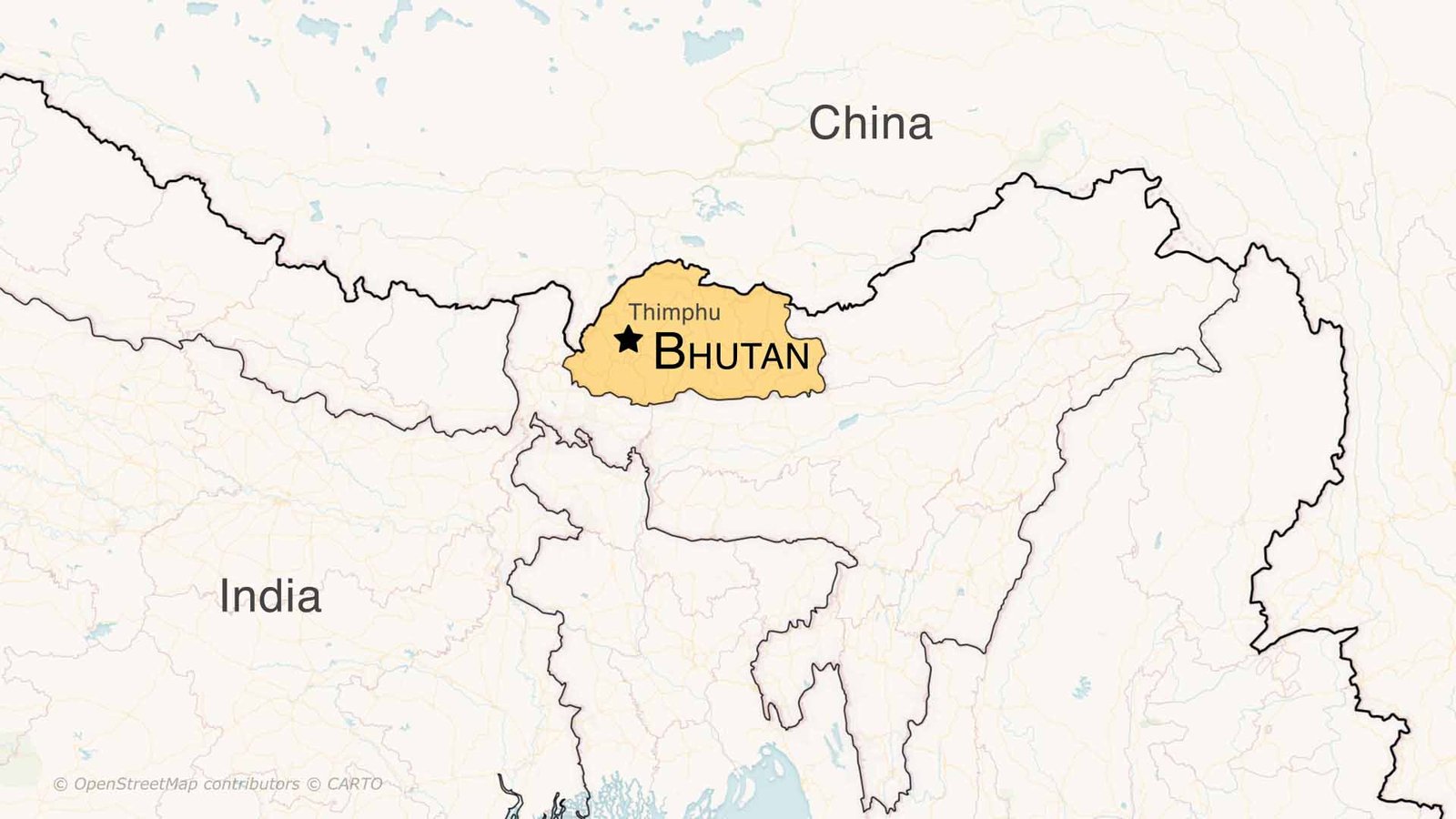
Bhutan is located in the eastern Himalayas in South Asia. It is a landlocked country bordered by China to the north and India to the south, east, and west.
Bhutan Facts
- OFFICIAL NAME: Kingdom of Bhutan
- CAPITAL: Thimphu
- POPULATION: 802,214 (2026)
- AREA: 38,394 square kilometers
- OFFICIAL LANGUAGE: Dzongkha
- CURRENCY: Bhutanese Ngultrum (BTN)
Bhutan Flag
The flag of Bhutan is divided diagonally into two triangular sections — golden yellow on the upper left and orange on the lower right, with a large white dragon positioned in the center. The yellow represents the secular authority and leadership of the King, while the orange symbolizes the Buddhist spiritual tradition and monastic community. The white dragon, known as the Druk, represents Bhutan itself, as the country is known locally as “Druk Yul,” meaning “Land of the Thunder Dragon.” The jewels held in the dragon’s claws symbolize wealth and perfection.
Bhutan Geography
- Located in the eastern Himalayas, completely landlocked with no access to the sea.
- Borders: China to the north, India to the south, east, and west.
- The terrain is extremely mountainous, ranging from subtropical lowlands in the south to high alpine peaks in the north.
- Gangkhar Puensum, the highest peak in Bhutan, rises to 7,570 meters and is among the highest unclimbed mountains in the world.
- The country has a wide range of climates due to its dramatic elevation changes, from humid subtropical to alpine tundra.
- Bhutan is known for being one of the most environmentally protected countries in the world, with significant forest cover mandated by its constitution.
- Numerous rivers originate in the Himalayan glaciers and flow southward into India.
- Bhutan’s mountainous terrain has historically limited large-scale agriculture and made transportation infrastructure development challenging.
- The country is home to a wide range of ecosystems due to its varied altitude, from tropical forests to high-altitude meadows.
Bhutan Government
- Bhutan is a constitutional monarchy.
- The King serves as the head of state, with significant ceremonial and symbolic authority.
- The Prime Minister serves as the head of government.
- Bhutan has a bicameral parliament made up of the National Council and the National Assembly.
- Bhutan transitioned from an absolute monarchy to a democratic constitutional monarchy in 2008.
- Bhutan is internationally known for prioritizing “Gross National Happiness” as a measure of progress alongside economic indicators.
History of Bhutan
- Bhutan’s recorded history dates back to the introduction of Buddhism in the 7th century A.D.
- The country was unified under various local rulers before the establishment of a dual system of religious and civil governance in the 17th century.
- The Wangchuck dynasty was established in 1907, creating Bhutan’s hereditary monarchy.
- Bhutan signed a treaty with British India in 1910, which influenced its foreign relations while preserving its sovereignty.
- Bhutan maintained a policy of isolation for much of the 20th century, limiting foreign influence and tourism.
- The country gradually opened to the outside world beginning in the 1970s, while carefully managing modernization.
- Bhutan transitioned to a parliamentary democracy under a constitutional monarchy in 2008, following reforms initiated by the King.
- Bhutan remains one of the few countries in the world that has never been colonized.
People and Culture of Bhutan
- The majority of the population is ethnically Bhutanese, primarily of Ngalop and Sharchop descent, along with Lhotshampa communities of Nepali origin.
- Dzongkha is the official language, though several other regional languages are spoken throughout the country.
- Vajrayana Buddhism is the state religion and plays a central role in daily life and culture.
- Ema Datshi, a spicy dish made from chili peppers and cheese, is considered the national dish of Bhutan.
- Traditional dress, including the gho for men and kira for women, is commonly worn and even mandated in certain official and educational settings.
- Bhutan limits tourism through a controlled visa and fee system to help preserve its culture and environment.
- Archery is the national sport of Bhutan and holds deep cultural significance.
Economy of Bhutan
- Bhutan has a small but growing economy, with hydropower as one of its most significant exports, primarily to India.
- Agriculture remains an important sector, employing a significant portion of the population, particularly in rural areas.
- Tourism contributes to the economy, though it is carefully managed through high-value, low-impact policies.
- Bhutan places strong emphasis on sustainable development, balancing economic growth with environmental and cultural preservation.
- The country maintains close economic and political ties with India, which is its largest trading partner.
- Bhutan’s constitution mandates that at least 60% of the country’s land remain forested.
Bhutan Resources
- Bhutan’s mountainous rivers provide significant hydropower potential, which is a major source of national revenue through electricity exports.
- Forest resources are extensive, with the country maintaining some of the highest forest coverage in the world.
- Limited mineral resources include dolomite, limestone, and gypsum.
- Agricultural resources include rice, maize, and citrus fruits, primarily grown in the southern lowlands.
- Bhutan’s pristine natural landscapes serve as valuable resources for its carefully managed tourism industry.
Bhutan Wildlife
- Bhutan’s diverse altitude and protected forests support an exceptional range of wildlife.
- The takin, a goat-antelope species, is the national animal of Bhutan and inhabits the high-altitude regions.
- The Bengal tiger and snow leopard both inhabit Bhutan, reflecting the country’s wide range of elevations and ecosystems.
- The black-necked crane, a rare and culturally significant bird, migrates to Bhutan’s Phobjikha Valley each winter.
- Red pandas and various species of langurs are found in Bhutan’s temperate forests.
- Bhutan’s strong conservation policies have resulted in a significant percentage of the country’s land being designated as protected areas.
- The country’s commitment to environmental preservation has helped maintain healthy populations of several endangered species.