Belgium Country Profile
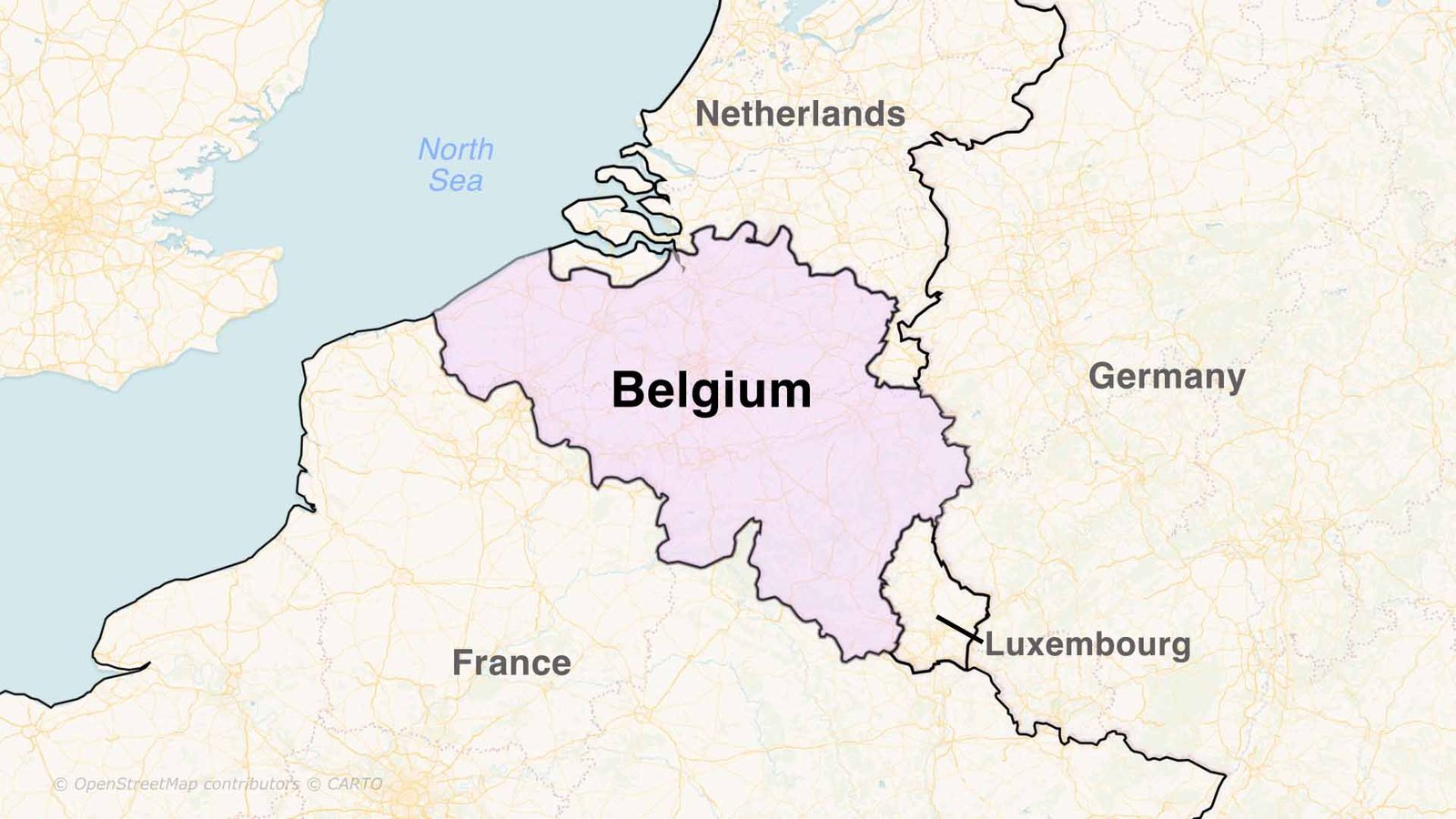
Belgium is located in Western Europe, bordered by the Netherlands to the north, Germany to the east, Luxembourg to the southeast, and France to the south and west. To the northwest lies the North Sea.
Belgium Facts
- OFFICIAL NAME: Kingdom of Belgium
- CAPITAL: Brussels
- POPULATION: 11,774,642 (2026)
- AREA: 30,528 square kilometers
- OFFICIAL LANGUAGES: Dutch, French, German
- CURRENCY: Euro (EUR)
Belgium Flag
The flag of Belgium has three equal vertical stripes — black on the hoist side, yellow in the middle, and red on the outer side. These colors are derived from the coat of arms of the Duchy of Brabant, one of the historic regions that formed modern Belgium. The black represents strength and resilience, the yellow symbolizes prosperity, and the red represents the courage and sacrifice of the Belgian people. The flag was officially adopted shortly after Belgium gained independence in 1830.
Belgium Geography
- Located in Western Europe, with a short coastline along the North Sea to the northwest.
- Borders: The Netherlands to the north, Germany to the east, Luxembourg to the southeast, France to the south and west.
- Belgium is one of the most densely populated countries in Europe.
- The terrain is divided into three main regions — the flat coastal plains in the northwest, the central plateau, and the hilly Ardennes forest region in the southeast.
- The Ardennes, located in the southeastern part of the country, feature forested hills and river valleys.
- Belgium has a temperate maritime climate, with mild temperatures and significant rainfall throughout the year.
- The Meuse and Scheldt rivers are the two most important waterways, both vital for trade and transportation.
- Belgium’s coastal plain is highly developed and includes major ports such as Antwerp, one of the largest in Europe.
Belgium Government
- Belgium is a federal parliamentary democracy under a constitutional monarchy.
- The King serves as the ceremonial head of state.
- The Prime Minister serves as the head of government, holding executive authority.
- Belgium is divided into three regions — Flanders, Wallonia, and the Brussels-Capital Region — each with significant autonomy.
- The country also recognizes three official language communities — Dutch-speaking, French-speaking, and German-speaking.
- Belgium gained independence from the Netherlands in 1830.
History of Belgium
- The region has a long history dating back to Roman times, when it was part of the province of Gallia Belgica.
- During the medieval period, the territory was divided among various duchies and counties, including Flanders and Brabant, which became prosperous centers of trade and textile production.
- The region passed through Burgundian, Habsburg, Spanish, and Austrian rule over several centuries.
- Following the Napoleonic Wars, the territory became part of the United Kingdom of the Netherlands in 1815.
- Belgium gained independence in 1830 following the Belgian Revolution, becoming a constitutional monarchy.
- Belgium was occupied by Germany during both World War I and World War II, suffering significant destruction and loss of life.
- After World War II, Belgium became a founding member of organizations that would later form the European Union.
- Brussels has since become the de facto capital of the European Union, hosting many of its key institutions.
People and Culture of Belgium
- Belgium’s population is divided primarily among Dutch-speaking Flemish, French-speaking Walloons, and a smaller German-speaking community.
- The country recognizes Dutch, French, and German as official languages, reflecting its complex linguistic divisions.
- Roman Catholicism is historically the predominant religion, though religious practice has declined in recent decades.
- Belgium is internationally renowned for its chocolate, waffles, and beer, with a brewing tradition dating back centuries.
- Moules-frites, mussels served with fries, is considered one of Belgium’s signature national dishes.
- Comic strip art holds a significant place in Belgian culture, with characters such as Tintin originating in the country.
- Belgium’s medieval town squares and architecture, particularly in cities like Bruges and Ghent, reflect its rich historical heritage.
Economy of Belgium
- Belgium has a highly developed, export-oriented economy centered on services, manufacturing, and trade.
- The Port of Antwerp is one of the largest and busiest ports in Europe, playing a key role in international trade.
- Belgium is a major producer and exporter of chocolate, beer, and diamonds.
- The chemical and pharmaceutical industries are significant contributors to the country’s exports.
- As host to numerous European Union institutions, Brussels benefits economically from international diplomacy and business activity.
- Belgium maintains close economic ties with its neighboring countries, particularly through EU trade frameworks.
Belgium Resources
- Belgium has limited natural resources, relying heavily on imports for raw materials and energy.
- The country has historically been known for coal mining, though this industry has significantly declined.
- Antwerp serves as one of the world’s leading centers for diamond cutting, polishing, and trade.
- Agricultural land supports crops such as wheat, sugar beets, and potatoes.
- Belgium’s location and port infrastructure serve as key logistical resources for European trade.
Belgium Wildlife
- Belgium’s forests, wetlands, and rural landscapes support a variety of wildlife, particularly in the Ardennes region.
- Red deer and wild boar are commonly found in the forested hills of the Ardennes.
- The country is home to numerous bird species, with wetland areas serving as important habitats for migratory birds.
- The European otter, once nearly extinct in Belgium, has seen population recovery in recent years due to conservation efforts.
- Belgium has several nature reserves dedicated to preserving its remaining forest and wetland ecosystems.
- Urbanization and dense population pose ongoing challenges to wildlife habitats throughout the country.