Argentina Country Profile
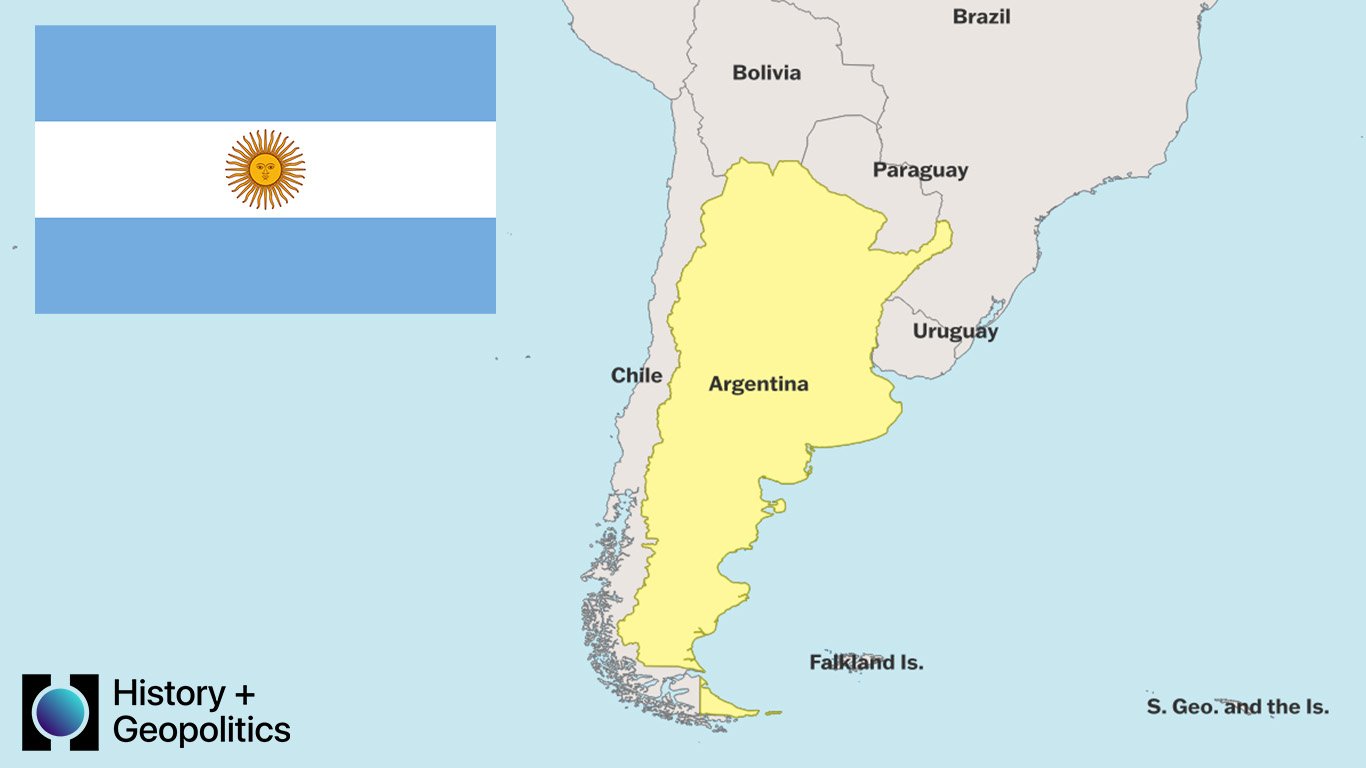
Argentina is located in southern South America, bordered by Chile to the west, Bolivia and Paraguay to the north, and Brazil and Uruguay to the northeast. To the east lies the Atlantic Ocean.
Argentina Facts
- OFFICIAL NAME: Argentine Republic
- CAPITAL: Buenos Aires
- POPULATION: 46,003,734 (2026)
- AREA: 2,780,400 square kilometers
- OFFICIAL LANGUAGE: Spanish
- CURRENCY: Argentine Peso (ARS)
Argentina Flag
The flag of Argentina has three horizontal stripes — light blue on top, white in the middle, and light blue on the bottom. In the center of the white stripe sits the Sun of May, a golden sun symbol with a human face and 32 alternating triangular and wavy rays. The light blue and white colors are believed to represent the sky during the May Revolution of 1810, when clouds parted to reveal a clear blue sky over Buenos Aires. The Sun of May represents the Inca sun god Inti and symbolizes the dawn of a new nation, commemorating Argentina’s first independent government.
Argentina Geography
- Located in southern South America, the second largest country on the continent.
- Borders: Chile to the west, Bolivia and Paraguay to the north, Brazil and Uruguay to the northeast.
- The Atlantic Ocean lies to the east, forming a long coastline.
- The country features extremely diverse geography, from subtropical regions in the north to subpolar regions in the south.
- The Andes Mountains run along the entire western border with Chile.
- Aconcagua, located in the Andes, is the highest peak in the Western Hemisphere at 6,961 meters.
- The Pampas, a vast fertile lowland, covers much of central Argentina and is the agricultural heartland.
- Patagonia, in the south, is a sparsely populated region of plateaus, steppes, and glaciers.
- The Paraná and Uruguay rivers are among the most important rivers, both flowing into the Río de la Plata estuary.
- Argentina has a wide range of climates, including humid subtropical, arid, and cold polar conditions in the far south.
- Tierra del Fuego, at the southern tip, is one of the southernmost inhabited regions in the world.
Argentina Government
- Argentina is a federal presidential republic.
- The President serves as both head of state and head of government.
- The country is divided into 23 provinces and one autonomous city, Buenos Aires.
- Argentina has a bicameral National Congress made up of the Senate and the Chamber of Deputies.
- Argentina returned to democratic governance in 1983 after a period of military dictatorship.
History of Argentina
- The region was originally inhabited by various indigenous peoples, including the Diaguita, Guaraní, and Mapuche.
- Spanish explorers arrived in the early 16th century, and the region became part of the Spanish Empire.
- Buenos Aires was founded in 1580 and gradually grew into an important colonial port city.
- Argentina declared independence from Spain on July 9, 1816, following the May Revolution of 1810.
- The 19th century saw territorial expansion and significant European immigration, particularly from Italy and Spain.
- Argentina experienced periods of strong economic growth in the early 20th century, becoming one of the wealthiest nations in the world at the time.
- The country experienced repeated military coups and periods of instability throughout the 20th century.
- A military dictatorship from 1976 to 1983 was marked by human rights abuses known as the Dirty War.
- Argentina fought the Falklands War with the United Kingdom in 1982 over the disputed Falkland Islands.
- Since 1983, Argentina has maintained a democratic government, though it has faced repeated economic crises.
People and Culture of Argentina
- Argentina has a population largely descended from European immigrants, particularly from Italy and Spain.
- Indigenous and mestizo populations remain significant in northern provinces.
- Spanish is the official language, though Italian influence is strongly present in everyday speech, especially in Buenos Aires.
- Roman Catholicism is the predominant religion in the country.
- Asado, a traditional barbecue of grilled meats, is central to Argentine culture and social gatherings.
- Mate, a traditional caffeinated drink, is consumed daily by most Argentines and holds deep cultural significance.
- Tango, both as music and dance, originated in Buenos Aires and remains one of Argentina’s most iconic cultural exports.
- Football is the most popular sport, and Argentina has produced some of the greatest players in the sport’s history.
Economy of Argentina
- Argentina has one of the largest economies in Latin America, with a diverse industrial and agricultural base.
- Agriculture is a major sector, with the country being one of the world’s top exporters of soybeans, corn, and beef.
- The Pampas region is central to the country’s agricultural production.
- Argentina has significant industries in manufacturing, including automobiles and food processing.
- The country has experienced repeated periods of high inflation and currency instability over recent decades.
- Argentina has substantial shale oil and gas reserves, particularly in the Vaca Muerta formation.
- Tourism contributes to the economy, with visitors drawn to destinations such as Patagonia, Iguazu Falls, and Buenos Aires.
Argentina Resources
- Argentina has extensive natural resources, including fertile agricultural land across the Pampas.
- The Vaca Muerta shale formation holds some of the largest unconventional oil and gas reserves in the world.
- The country has reserves of lithium, located primarily in the northwest, contributing to the growing global demand for battery materials.
- Other mineral resources include copper, gold, and silver, found mainly in the Andean region.
- Argentina’s rivers and waterways support hydroelectric power generation.
- Vast grasslands support one of the world’s largest cattle industries.
Argentina Wildlife
- Argentina’s diverse ecosystems, from the Andes to Patagonia, support a wide variety of wildlife.
- The Andean condor, one of the largest flying birds in the world, soars over the Andes Mountains.
- Patagonia is home to guanacos, a wild relative of the llama, as well as pumas and foxes.
- The coastal waters of Patagonia attract southern right whales, orcas, and large colonies of penguins.
- The Iguazu region in the north supports tropical wildlife, including jaguars, toucans, and capybaras.
- Argentina’s wetlands, such as the Iberá Wetlands, are home to caimans, marsh deer, and giant anteaters.
- Conservation efforts across the country focus on protecting endangered species such as the jaguar and the Andean condor.