Armenia country Profile
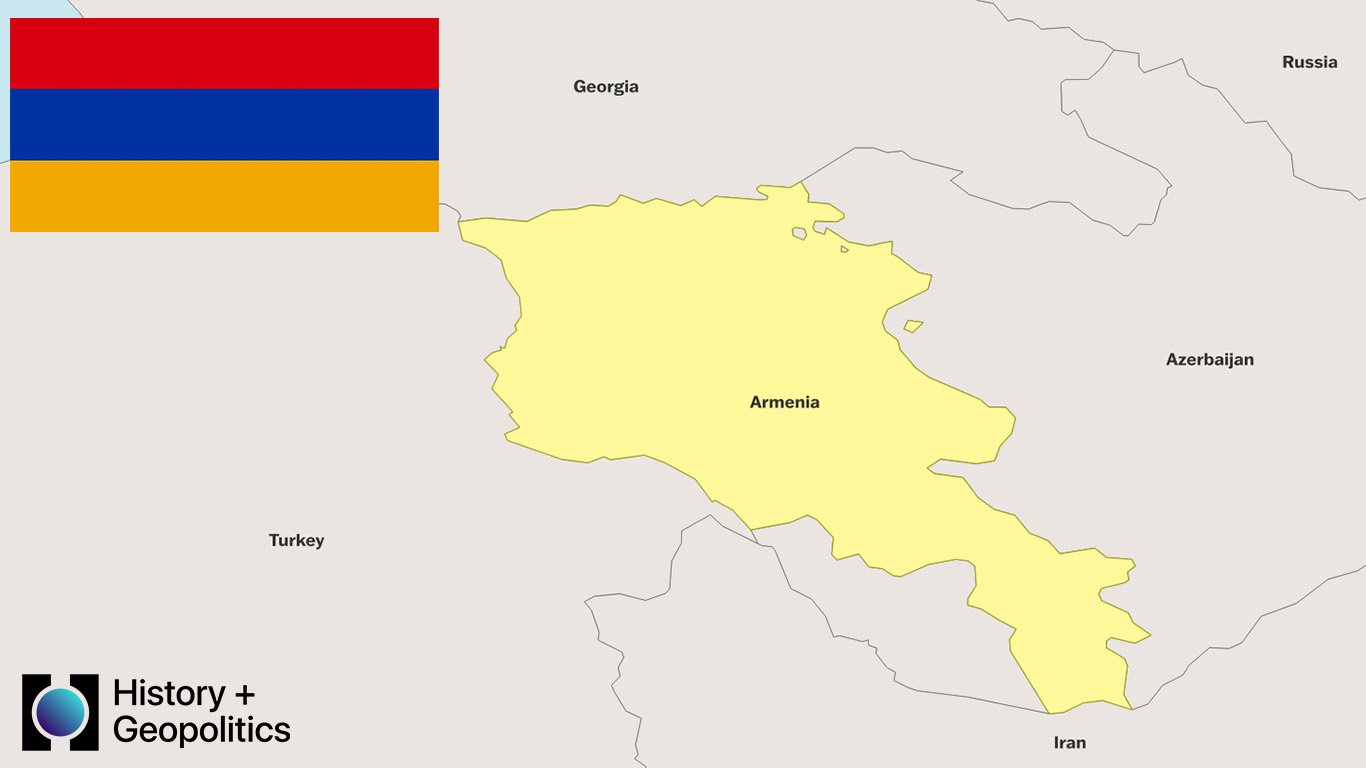
Armenia is located in the South Caucasus region of Eurasia. It is a landlocked country bordered by Georgia to the north, Azerbaijan to the east, Iran to the south, and Turkey to the west.
Armenia Facts
- OFFICIAL NAME: Republic of Armenia
- CAPITAL: Yerevan
- POPULATION: 2,930,915 (2026)
- AREA: 29,743 square kilometers
- OFFICIAL LANGUAGE: Armenian
- CURRENCY: Armenian Dram (AMD)
Armenia Flag
The flag of Armenia has three equal horizontal stripes — red on top, blue in the middle, and orange on the bottom. The red represents the blood shed in the fight for independence as well as Armenia’s Christian faith and resilience. The blue symbolizes the Armenian skies and the country’s aspiration for a peaceful future. The orange represents the creativity, hardworking nature, and talent of the Armenian people. The flag’s design reflects Armenia’s national identity and was officially adopted in 1990.
Armenia Geography
- Located in the South Caucasus region, bridging Europe and Asia.
- Borders: Georgia to the north, Azerbaijan to the east, Iran to the south, Turkey to the west.
- Armenia is a landlocked, mountainous country with no access to the sea.
- The terrain is dominated by the Armenian Highlands, part of the larger Caucasus mountain system.
- Mount Aragats is the highest peak within Armenia, rising to 4,090 meters.
- Mount Ararat, a significant symbol in Armenian culture and history, lies just across the border in Turkey but is visible from much of Armenia.
- Lake Sevan, one of the largest high-altitude lakes in the world, is a major geographic feature.
- Armenia experiences a continental climate, with cold winters and warm, dry summers.
- The country is prone to seismic activity due to its location along active fault lines.
- Forests cover parts of the northern regions, while much of the country consists of semi-desert and steppe terrain.
Armenia Government
- Armenia is a parliamentary republic.
- The President serves as a largely ceremonial head of state.
- The Prime Minister holds executive power and serves as head of government.
- Armenia has a unicameral parliament called the National Assembly.
- The country transitioned from a semi-presidential to a fully parliamentary system through constitutional reforms completed in 2018.
History of Armenia
- Armenia is considered one of the oldest civilizations in the world, with roots tracing back to the ancient Kingdom of Urartu in the 9th century B.C.
- The Kingdom of Armenia emerged around the 6th century B.C. under the Orontid dynasty.
- In 301 A.D., Armenia became the first nation in the world to adopt Christianity as its official state religion.
- The unique Armenian alphabet was created in 405 A.D. by Mesrop Mashtots.
- Throughout the medieval period, Armenia was repeatedly invaded and ruled by various empires, including the Byzantines, Persians, and Ottomans.
- In the early 20th century, the Armenian Genocide resulted in the deaths of an estimated 1.5 million Armenians under the Ottoman Empire.
- Armenia became part of the Soviet Union in 1922 as the Armenian Soviet Socialist Republic.
- Armenia declared independence from the Soviet Union on September 21, 1991.
- Since independence, Armenia has been involved in long-standing territorial disputes with Azerbaijan over the Nagorno-Karabakh region.
People and Culture of Armenia
- Armenians make up the vast majority of the population, making Armenia one of the most ethnically homogeneous countries in the world.
- The Armenian language has its own unique alphabet, unrelated to other writing systems.
- The Armenian Apostolic Church, one of the oldest Christian churches in the world, is the dominant religious institution.
- Khorovats, a traditional barbecue of grilled meats, is a centerpiece of Armenian cuisine and social gatherings.
- Lavash, a soft thin bread, is a staple food and recognized as part of Armenia’s intangible cultural heritage by UNESCO.
- Armenian culture places strong emphasis on hospitality, family ties, and historic monastic traditions.
- Armenia is home to numerous ancient monasteries and churches, many dating back over a thousand years.
Economy of Armenia
- Armenia has a developing market economy with sectors including agriculture, mining, and services.
- The information technology sector has grown rapidly in recent years, becoming an important part of the economy.
- Agriculture remains significant, with crops including grapes, fruits, and vegetables.
- Armenia is known for its wine and brandy production, with a winemaking tradition dating back thousands of years.
- Mining, particularly of copper and molybdenum, contributes to export revenue.
- Remittances from Armenians living abroad play an important role in supporting the domestic economy.
- The country continues to work on diversifying its economy and improving regional trade relationships.
Armenia Resources
- Armenia has notable mineral resources, including copper, molybdenum, gold, and zinc.
- The country has limited fossil fuel resources and relies on imports for much of its energy needs.
- Armenia operates a nuclear power plant, which provides a significant share of domestic electricity.
- Forested areas in the north provide timber resources.
- Lake Sevan serves as an important resource for fishing, irrigation, and hydroelectric power.
- The mountainous terrain limits large-scale agricultural land but supports viticulture in fertile valleys.
Armenia Wildlife
- Armenia’s diverse terrain, from mountains to semi-desert regions, supports a variety of wildlife.
- The Armenian mouflon, a wild sheep species, is native to the mountainous regions of the country.
- The Caucasian leopard, an extremely rare and endangered subspecies, is occasionally found in remote areas of Armenia.
- Brown bears, wolves, and lynx inhabit the forested and mountainous regions.
- Lake Sevan is home to several fish species, including the endemic Sevan trout.
- Armenia has established several protected areas and national parks, including Khosrov Forest State Reserve, to conserve its native wildlife.
- Conservation efforts continue to focus on protecting endangered species such as the Caucasian leopard and the Armenian mouflon.