Bahamas Country Profile
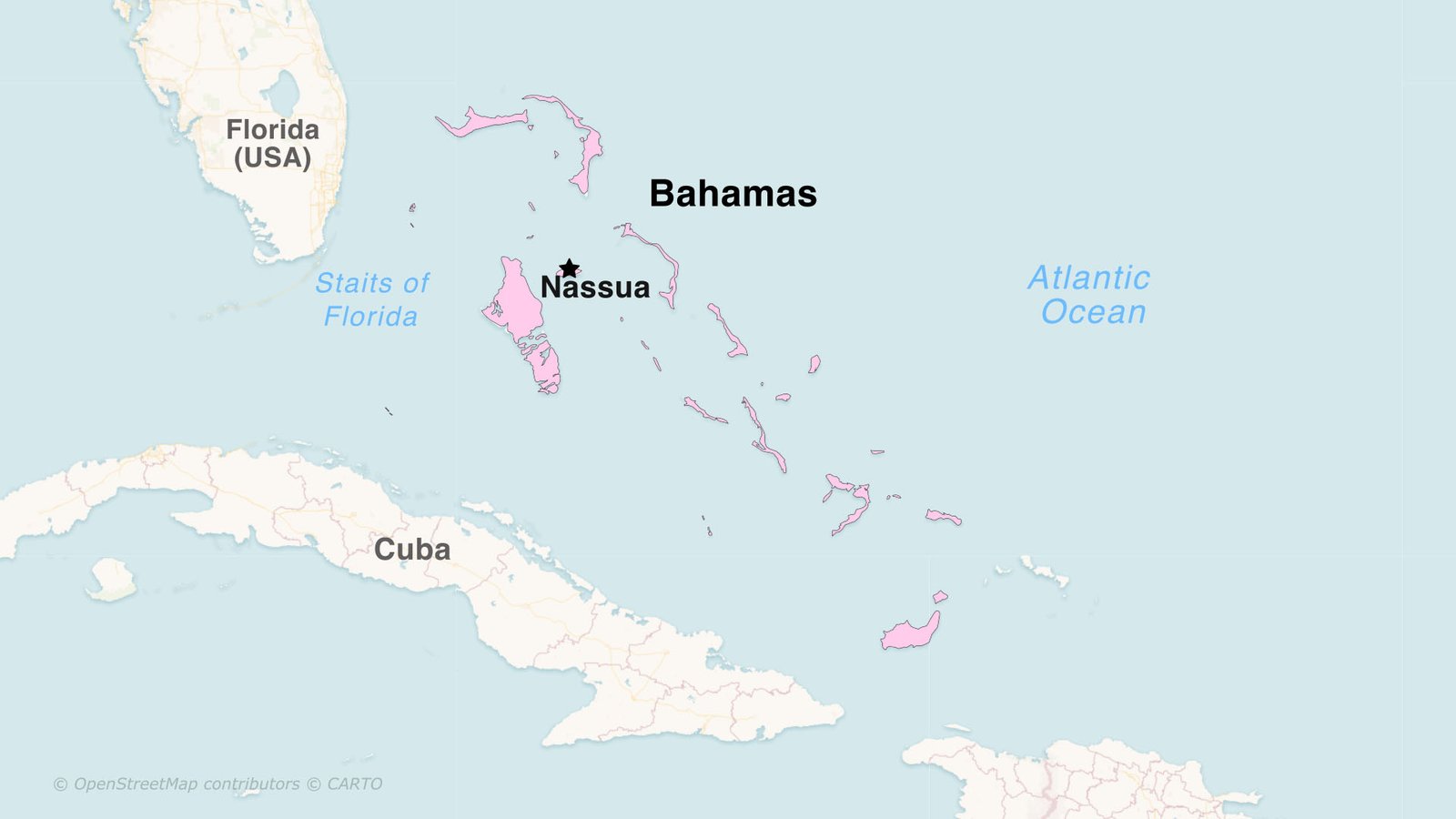
The Bahamas is located in the Caribbean region, made up of an archipelago of about 700 islands and cays. It lies off the southeastern coast of Florida, with the Atlantic Ocean surrounding the islands and the Caribbean Sea to the south.
Bahamas Facts
- OFFICIAL NAME: Commonwealth of the Bahamas
- CAPITAL: Nassau
- POPULATION: 404,628 (2026)
- AREA: 13,943 square kilometers
- OFFICIAL LANGUAGE: English
- CURRENCY: Bahamian Dollar (BSD)
Bahamas Flag
The flag of the Bahamas has three horizontal stripes — aquamarine on top, gold in the middle, and aquamarine on the bottom, with a black triangle pointing inward from the mast side. The aquamarine represents the surrounding waters of the Caribbean Sea and Atlantic Ocean, while the gold symbolizes the golden sands of the islands’ beaches. The black triangle represents the unity and strength of the Bahamian people, as well as their African heritage, drawing on the energy of the sun to develop the natural resources of the sea and land.
Bahamas Geography
- Located in the Caribbean region, just off the southeastern coast of Florida.
- An archipelago made up of approximately 700 islands and over 2,000 cays, though only about 30 are inhabited.
- Surrounded by the Atlantic Ocean, with the Caribbean Sea bordering to the south.
- The terrain is generally low-lying, with the highest point, Mount Alvernia, rising to only 63 meters.
- The islands are composed largely of limestone and coral, formed from ancient coral reefs.
- The Bahamas has a tropical climate, moderated by ocean breezes, with a wet season and a dry season.
- The region lies within the Atlantic hurricane belt and is frequently affected by tropical storms.
- The Bahama Banks, extensive shallow underwater plateaus, surround much of the archipelago.
- Andros Island is the largest island in the Bahamas by land area, home to extensive pine forests and wetlands.
Bahamas Government
- The Bahamas is a parliamentary democracy and a Commonwealth realm.
- The British monarch is the head of state, represented locally by a Governor-General.
- The Prime Minister serves as the head of government.
- The country has a bicameral parliament consisting of the House of Assembly and the Senate.
- The Bahamas gained independence from the United Kingdom in 1973.
History of the Bahamas
- The islands were originally inhabited by the Lucayan people, a branch of the Arawak-speaking Taino.
- Christopher Columbus made his first landfall in the Americas on a Bahamian island in 1492.
- The Lucayan population was largely wiped out within decades of European contact due to disease and forced labor.
- The English established the first permanent settlement on the islands in the 17th century.
- The Bahamas became a haven for pirates during the early 18th century before British colonial control was firmly established.
- The islands developed a plantation economy reliant on enslaved African labor during British colonial rule.
- The Bahamas gained internal self-government in 1964 and full independence on July 10, 1973.
- Since independence, tourism and offshore finance have driven much of the nation’s economic growth.
People and Culture of the Bahamas
- The majority of the population is of African descent, reflecting the legacy of the colonial slave trade.
- English is the official language, though Bahamian Creole is widely spoken in everyday conversation.
- Christianity, particularly Protestant denominations, is the predominant religion.
- Conch is central to Bahamian cuisine, used in dishes such as conch salad and cracked conch.
- Junkanoo, a vibrant street parade featuring music, dance, and elaborate costumes, is the Bahamas’ most iconic cultural festival, held around Christmas and New Year.
- Goombay music and rake-and-scrape are traditional musical styles rooted in African and Caribbean influences.
- Bahamian culture reflects a blend of African, British, and broader Caribbean traditions.
Economy of the Bahamas
- Tourism is the dominant sector of the Bahamian economy, accounting for the majority of GDP and employment.
- The islands attract millions of visitors annually, drawn to their beaches, resorts, and clear waters.
- Offshore banking and financial services form a significant part of the economy due to favorable tax policies.
- Agriculture and manufacturing play a relatively small role due to limited arable land.
- The economy is vulnerable to global economic conditions and natural disasters, particularly hurricanes.
- The Bahamas has worked to diversify its economy through investment in technology and renewable energy.
Bahamas Resources
- The Bahamas has limited natural resources due to its small land area and lack of significant mineral deposits.
- The surrounding waters provide valuable fishing resources, including spiny lobster, conch, and various reef fish.
- Salt production has historically been an important resource industry on certain islands, such as Great Inagua.
- The islands’ beaches, coral reefs, and clear waters are among the country’s most valuable economic resources, underpinning the tourism industry.
- Limited freshwater resources require reliance on rainwater collection and desalination in many areas.
Bahamas Wildlife
- The surrounding waters support diverse marine life, including coral reefs, sea turtles, and a variety of tropical fish species.
- The Bahamas is home to one of the largest populations of rock iguanas in the Caribbean, found on several of the islands.
- Flamingos are found in large numbers on Great Inagua Island, home to one of the largest breeding colonies in the world.
- The waters around the islands attract numerous shark species, leading to a strong dive tourism industry focused on shark conservation.
- Andros Island’s extensive pine forests and wetlands support a variety of native bird species.
- Conservation efforts focus on protecting coral reefs and marine ecosystems from the impacts of tourism and climate change.