Bangladesh Country Profile
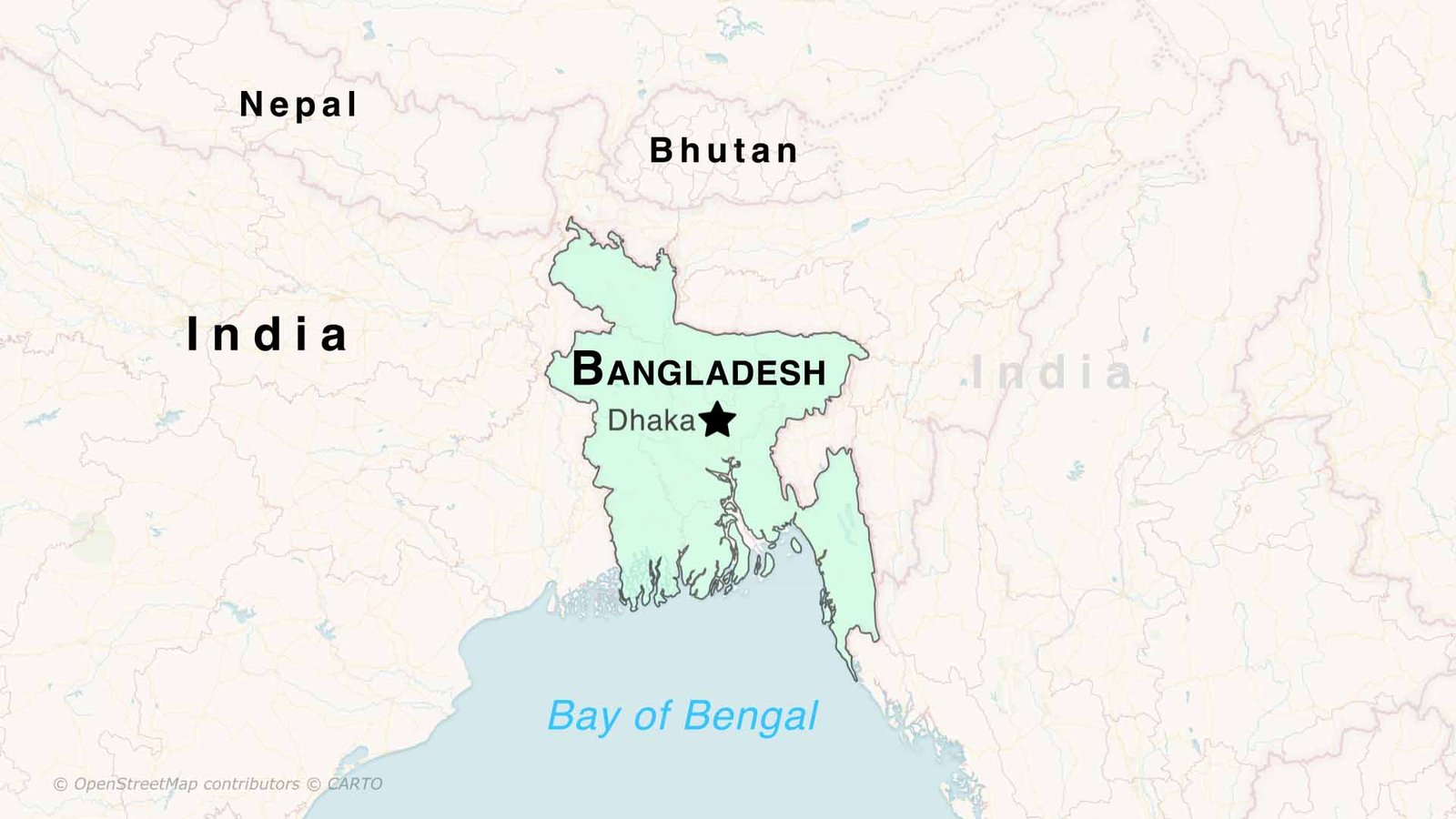
Bangladesh is located in South Asia, bordered almost entirely by India to the west, north, and east, with a short border with Myanmar to the southeast. To the south lies the Bay of Bengal.
Bangladesh Facts
- OFFICIAL NAME: People’s Republic of Bangladesh
- CAPITAL: Dhaka
- POPULATION: 177,818,044 (2026)
- AREA: 148,460 square kilometers
- OFFICIAL LANGUAGE: Bengali
- CURRENCY: Bangladeshi Taka (BDT)
Bangladesh Flag
The flag of Bangladesh has a dark green background with a red circle slightly off-center toward the hoist side. The green represents the lush landscape of Bangladesh and its agricultural identity, as well as the youthfulness and vitality of the nation. The red circle symbolizes the rising sun and the bloodshed during the country’s struggle for independence in 1971. The circle is positioned slightly off-center so that it appears centered when the flag flutters in the wind.
Bangladesh Geography
- Located in South Asia, on the Bengal Delta where the Ganges, Brahmaputra, and Meghna rivers meet.
- Borders: India to the west, north, and east, with a smaller border with Myanmar to the southeast.
- The Bay of Bengal lies to the south, forming the country’s coastline.
- Bangladesh is one of the most densely populated countries in the world.
- The country is largely low-lying and flat, formed mostly of fertile river delta land.
- The Sundarbans, the largest mangrove forest in the world, lies along the southwestern coast, shared with India.
- Bangladesh experiences a tropical monsoon climate, with a distinct rainy season from June to October.
- The country is highly vulnerable to flooding, cyclones, and rising sea levels due to its low elevation and river systems.
- The Chittagong Hill Tracts in the southeast are the only significant hilly region in the country.
- Numerous rivers and tributaries crisscross the country, making waterways essential for transportation.
Bangladesh Government
- Bangladesh is a parliamentary republic.
- The President serves as a largely ceremonial head of state.
- The Prime Minister holds executive power and serves as head of government.
- Bangladesh has a unicameral legislature called the Jatiya Sangsad, or National Parliament.
- Bangladesh achieved independence from Pakistan in 1971 following the Bangladesh Liberation War.
History of Bangladesh
- The region has a long history as part of the larger Bengal region, with ancient and medieval kingdoms dating back over two thousand years.
- Bengal became an important center under various Hindu and Buddhist dynasties before the arrival of Islam in the 13th century.
- The region came under Mughal rule and later British colonial control as part of British India.
- In 1947, the partition of British India created Pakistan, with the Bengal region split into West Bengal (India) and East Bengal, which became East Pakistan.
- Political and cultural tensions between East and West Pakistan grew over language, governance, and economic disparities.
- The Bangladesh Liberation War broke out in 1971, resulting in immense loss of life and widespread displacement.
- Bangladesh achieved independence from Pakistan on December 16, 1971, with support from India.
- Since independence, Bangladesh has worked to develop its economy and reduce poverty despite facing significant natural disaster risks.
People and Culture of Bangladesh
- The vast majority of the population is ethnically Bengali, with smaller indigenous communities residing mainly in the Chittagong Hill Tracts.
- Bengali (Bangla) is the official language and a central part of national identity.
- Islam is the predominant religion, with a significant Hindu minority and smaller Buddhist and Christian communities.
- Rice and fish form the foundation of Bangladeshi cuisine, with dishes like hilsa fish curry holding cultural significance.
- Bengali New Year, known as Pohela Boishakh, is one of the most widely celebrated cultural festivals in the country.
- Traditional textiles, including jamdani and muslin weaving, have a centuries-old heritage in Bangladesh.
- Folk music and literature, including the works of Nobel laureate Rabindranath Tagore, hold deep cultural importance.
Economy of Bangladesh
- Bangladesh has one of the fastest-growing economies in South Asia, driven significantly by its garment manufacturing industry.
- The ready-made garment sector is the largest source of export earnings and employs millions of workers.
- Agriculture remains important, with rice, jute, and tea among the key crops produced.
- Remittances from Bangladeshi workers abroad play a significant role in supporting the national economy.
- The country has made notable progress in reducing poverty and improving social development indicators in recent decades.
- Climate change and natural disasters, including flooding and cyclones, pose ongoing challenges to economic stability.
Bangladesh Resources
- Bangladesh has natural gas reserves, which are an important domestic energy resource.
- Fertile alluvial soil from river deltas supports extensive agricultural production, particularly rice and jute.
- Bangladesh is one of the world’s leading producers of jute, historically known as the “Golden Fiber.”
- The country’s river systems are vital for fishing, irrigation, and inland transportation.
- Limited mineral resources exist, though some coal deposits have been identified in the northwest.
- The Sundarbans mangrove forest provides timber and supports a significant fishing industry.
Bangladesh Wildlife
- Bangladesh’s diverse ecosystems, particularly its rivers and mangrove forests, support a wide range of wildlife.
- The Sundarbans is home to the Royal Bengal tiger, one of the most iconic and endangered big cats in the world.
- The Ganges river dolphin, a freshwater species, inhabits the country’s major river systems.
- Various species of crocodiles, including the saltwater crocodile, are found in the mangrove regions of the Sundarbans.
- Bangladesh hosts numerous migratory bird species that visit its wetlands during the winter months.
- Deforestation, habitat loss, and climate change pose significant threats to the country’s wildlife.
- Conservation programs focus on protecting the Royal Bengal tiger and preserving the Sundarbans ecosystem.