Barbados Country Profile
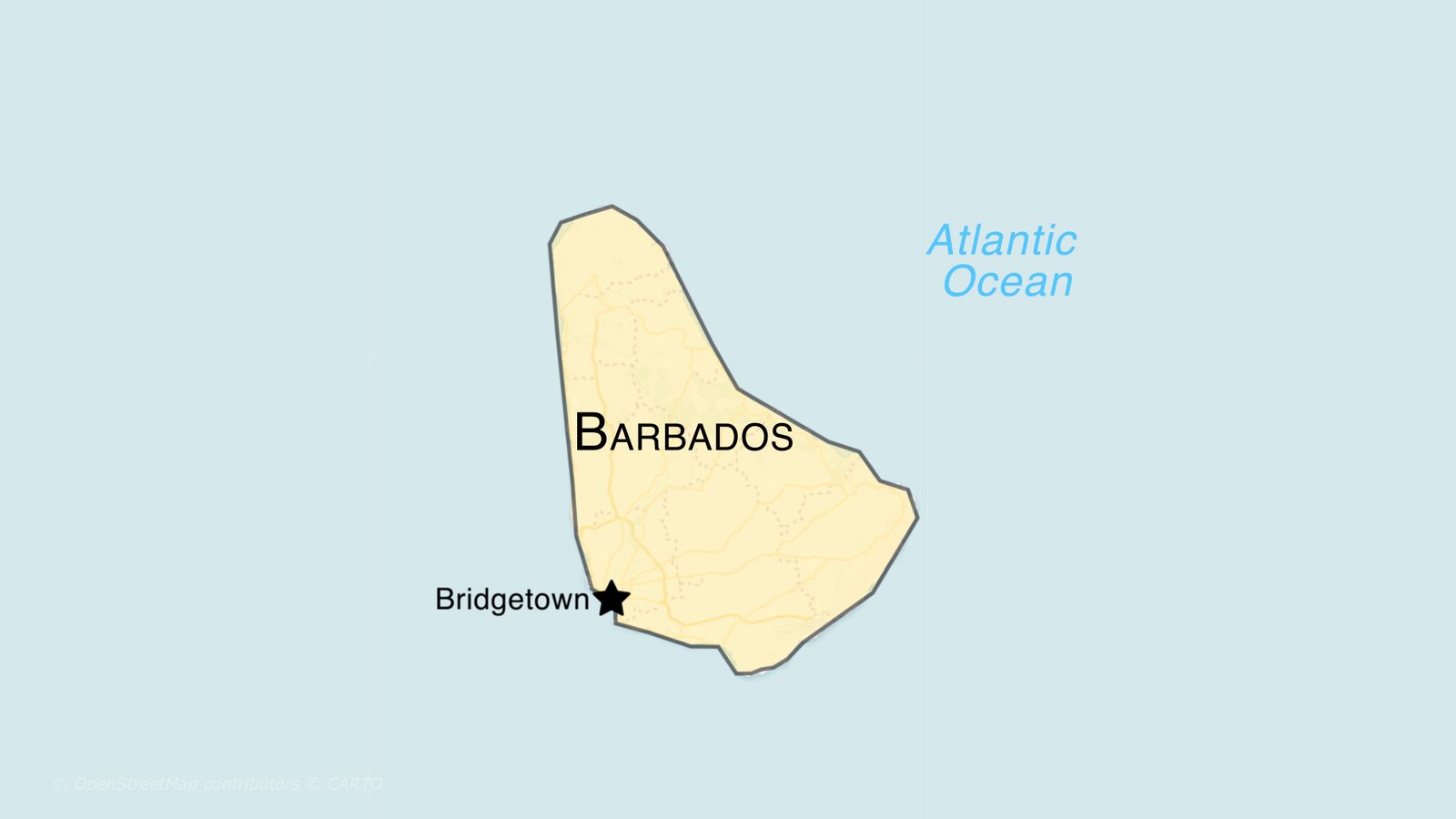
Barbados is located in the Caribbean, the easternmost island in the Lesser Antilles. It lies in the Atlantic Ocean, just outside the main Caribbean island chain, with the Caribbean Sea to its west.
Barbados Facts
- OFFICIAL NAME: Barbados
- CAPITAL: Bridgetown
- POPULATION: 282,724 (2026)
- AREA: 430 square kilometers
- OFFICIAL LANGUAGE: English
- CURRENCY: Barbadian Dollar (BBD)
Barbados Flag
The flag of Barbados has three vertical stripes — ultramarine blue on the outer sides and gold in the middle, with a black trident head positioned in the center of the gold stripe. The blue stripes represent the sea and sky surrounding the island, while the gold represents the golden sand of its beaches. The broken trident symbolizes a break from Barbados’ colonial past, as the original trident was part of the British colonial badge that depicted Britannia holding a complete trident. The broken shaft represents Barbados’ independence.
Barbados Geography
- Located in the Caribbean Sea, the easternmost island in the Lesser Antilles.
- Surrounded by the Atlantic Ocean to the east and the Caribbean Sea to the west.
- Barbados is a relatively flat island, formed mostly of coral limestone rather than volcanic rock like many neighboring islands.
- The highest point, Mount Hillaby, rises to only 336 meters.
- The island has a tropical climate, with a wet season and a dry season influenced by trade winds.
- Barbados lies within the Atlantic hurricane belt, though it is located slightly outside the main hurricane path compared to other Caribbean islands.
- The island’s coastline features a mix of calm Caribbean beaches on the west and rougher Atlantic surf on the east.
- There are no permanent rivers, and the island relies on underground aquifers for fresh water.
Barbados Government
- Barbados is a parliamentary republic.
- The President serves as the ceremonial head of state.
- The Prime Minister serves as the head of government, holding executive authority.
- Barbados has a bicameral parliament made up of the House of Assembly and the Senate.
- Barbados transitioned from a Commonwealth realm to a republic in 2021, removing the British monarch as head of state.
- The country gained independence from the United Kingdom in 1966.
History of Barbados
- The island was originally inhabited by Indigenous peoples, including the Arawak and later the Kalinago (Carib).
- Spanish and Portuguese sailors visited the island in the early 16th century, though neither established permanent settlements.
- The English established the first permanent settlement on Barbados in 1627.
- Barbados quickly became one of the wealthiest British colonies due to its sugar cane plantations, which relied heavily on enslaved African labor.
- The island remained under continuous British rule for over 300 years, longer than most other Caribbean territories.
- Barbados gained independence from the United Kingdom on November 30, 1966.
- In November 2021, Barbados became a republic, removing the British monarch as its head of state while remaining a member of the Commonwealth.
People and Culture of Barbados
- The majority of the population is of African descent, reflecting the legacy of the sugar plantation era and slavery.
- English is the official language, with a distinctive Barbadian English Creole, known locally as Bajan, widely spoken.
- Christianity, particularly Anglican and other Protestant denominations, is the predominant religion.
- Cou-cou and flying fish, a cornmeal dish served with a seasoned fish stew, is considered the national dish of Barbados.
- Crop Over, a festival with roots in the historic sugar cane harvest, is the island’s largest cultural celebration, featuring music, parades, and costumes.
- Cricket holds deep cultural significance, and Barbados has produced some of the sport’s most celebrated players.
- Rum production has a centuries-long history on the island, with Barbados often credited as the birthplace of rum.
Economy of Barbados
- Tourism is the largest sector of the Barbadian economy, drawing visitors with its beaches and resorts.
- Financial and business services contribute significantly to the economy, supported by the island’s offshore banking sector.
- Sugar production, once the backbone of the economy, has declined but remains culturally and historically significant.
- Rum production and export remain an important industry tied to the island’s sugar heritage.
- The economy is heavily dependent on tourism, making it vulnerable to global travel disruptions.
- The government has promoted renewable energy initiatives, aiming to reduce dependence on imported fossil fuels.
Barbados Resources
- Barbados has limited natural resources due to its small size and lack of significant mineral deposits.
- Small reserves of natural gas and petroleum exist, though they are not extensively developed for export.
- The surrounding waters support a fishing industry, particularly for flying fish, a staple of Barbadian cuisine.
- Fertile soil historically supported large-scale sugar cane cultivation, which remains present today on a smaller scale.
- The island’s beaches and coral reefs serve as significant economic resources for the tourism sector.
Barbados Wildlife
- Barbados has a mix of native and introduced wildlife due to its long history of agricultural development.
- The green monkey, introduced centuries ago, is now a common sight across the island.
- Sea turtles, including hawksbill and leatherback turtles, nest along Barbados’ beaches.
- The island is home to various seabird species, particularly along its rugged Atlantic coastline.
- Coral reefs surrounding Barbados support diverse marine life, including numerous species of tropical fish.
- Conservation efforts focus on protecting sea turtle nesting sites and preserving the island’s coral reef ecosystems.