Bolivia Country Profile
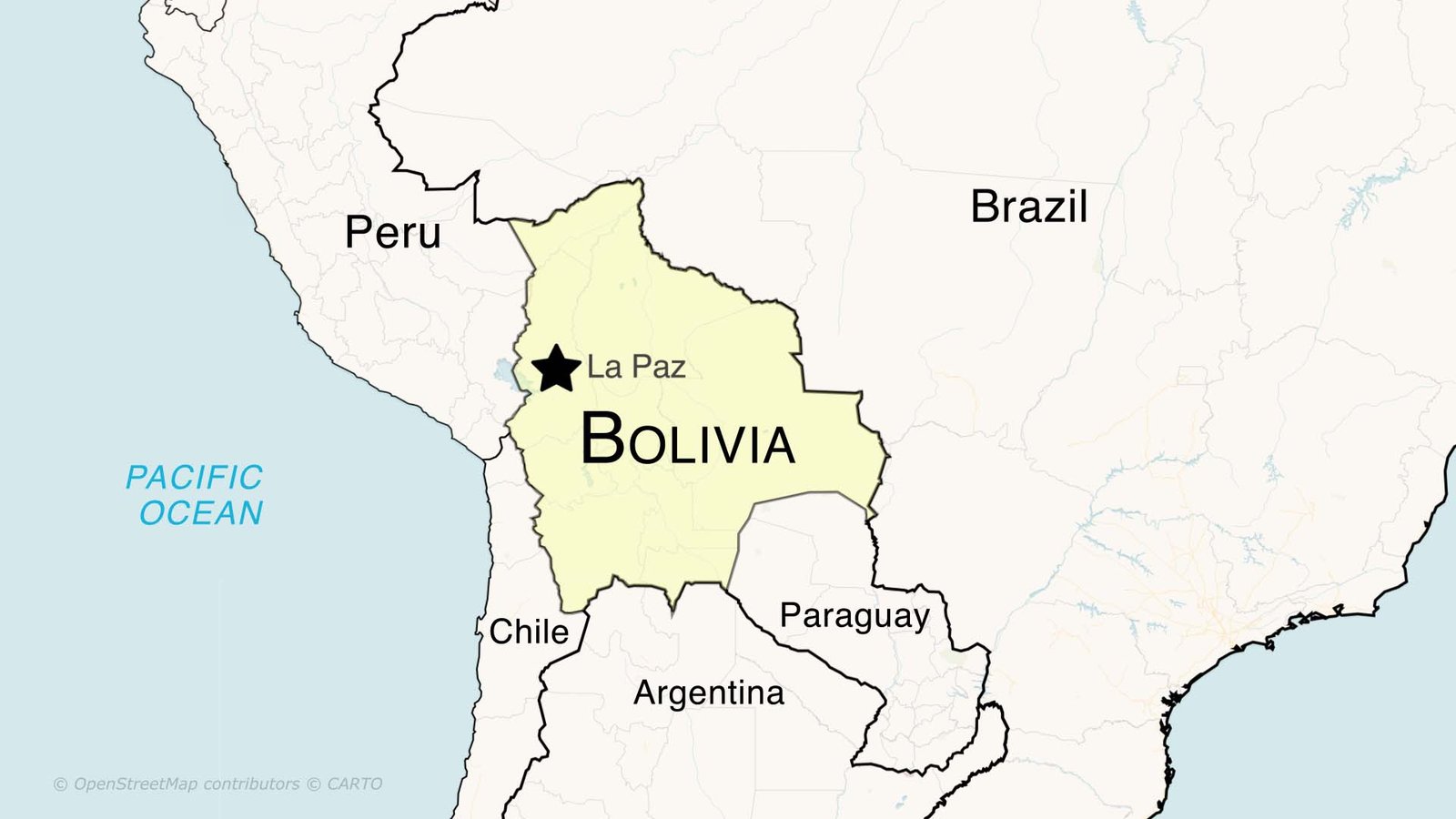
Bolivia is located in central South America. It is a landlocked country bordered by Brazil to the north and east, Paraguay to the southeast, Argentina to the south, Chile to the southwest, and Peru to the west.
Bolivia Facts
- OFFICIAL NAME: Plurinational State of Bolivia
- CAPITAL: Sucre (constitutional), La Paz (seat of government)
- POPULATION: 12,749,291 (2026)
- AREA: 1,098,581 square kilometers
- OFFICIAL LANGUAGES: Spanish, along with 36 recognized Indigenous languages including Quechua and Aymara
- CURRENCY: Bolivian Boliviano (BOB)
Bolivia Flag
The flag of Bolivia has three equal horizontal stripes — red on top, yellow in the middle, and green on the bottom, with the national coat of arms centered on the yellow stripe in official state use. The red represents the bravery and bloodshed of Bolivian soldiers, the yellow symbolizes the country’s rich mineral resources, and the green represents the fertility of the land and natural wealth. The coat of arms, used in the state version of the flag, features a condor, a mountain representing Cerro Rico in Potosí, and tools symbolizing Bolivia’s mining heritage.
Bolivia Geography
- Located in central South America, completely landlocked with no access to the sea.
- Borders: Brazil to the north and east, Paraguay to the southeast, Argentina to the south, Chile to the southwest, Peru to the west.
- Bolivia is one of only two landlocked countries in South America.
- The terrain ranges dramatically from high Andean plateaus to tropical lowland rainforests.
- La Paz, the seat of government, is the highest capital city in the world, situated at an elevation of around 3,500 meters.
- The Altiplano, a high plateau region in the west, is home to much of Bolivia’s population and Lake Titicaca, one of the largest lakes in South America.
- The Salar de Uyuni, located in the southwest, is the largest salt flat in the world.
- Eastern Bolivia consists of vast lowland plains and tropical rainforest, part of the larger Amazon basin.
- Bolivia has a wide range of climates due to its dramatic elevation changes, from alpine cold in the highlands to tropical heat in the lowlands.
Bolivia Government
- Bolivia is a presidential republic, officially structured as a plurinational state recognizing its many Indigenous nations.
- The President serves as both head of state and head of government.
- Bolivia has a bicameral legislature called the Plurinational Legislative Assembly, consisting of the Chamber of Deputies and the Chamber of Senators.
- The country’s 2009 constitution formally recognized the rights and autonomy of its numerous Indigenous peoples.
- Bolivia has experienced periods of significant political change and social movements advocating for Indigenous representation.
History of Bolivia
- The region was home to advanced pre-Columbian civilizations, including the Tiwanaku culture, which thrived near Lake Titicaca over a thousand years ago.
- Bolivia later became part of the Inca Empire before Spanish colonization in the 16th century.
- The Spanish established significant silver mining operations at Potosí, which became one of the wealthiest cities in the world during colonial times.
- Bolivia declared independence from Spain on August 6, 1825.
- The country lost significant territory in wars with neighboring countries during the 19th and early 20th centuries, including its access to the Pacific coast.
- Bolivia experienced numerous periods of political instability and military rule throughout the 20th century.
- In 2006, Evo Morales became Bolivia’s first Indigenous president, ushering in significant social and constitutional reforms.
- Bolivia continues to navigate complex political and economic challenges while emphasizing Indigenous rights and resource nationalization.
People and Culture of Bolivia
- Bolivia has one of the largest Indigenous populations in South America, including the Quechua, Aymara, and numerous lowland Indigenous groups.
- Spanish is the official language alongside dozens of recognized Indigenous languages.
- Roman Catholicism is the predominant religion, often practiced alongside Indigenous spiritual traditions.
- Salteñas, a baked pastry filled with meat, vegetables, and spices, are a popular Bolivian snack food.
- Traditional festivals, such as the Carnival of Oruro, blend Indigenous and Catholic traditions and are recognized by UNESCO as part of humanity’s cultural heritage.
- Traditional textiles and clothing, including brightly colored woven garments, remain an important part of Indigenous Bolivian identity.
- Coca leaf chewing has deep cultural and historical roots, particularly among Indigenous communities in the highlands.
Economy of Bolivia
- Bolivia’s economy is heavily dependent on natural gas exports, mining, and agriculture.
- The country holds some of the world’s largest known lithium reserves, located in the Salar de Uyuni salt flats.
- Mining of tin, silver, and zinc has historically been a major part of the Bolivian economy.
- Agriculture, including soybeans, coca, and quinoa production, plays a significant role in rural livelihoods.
- Bolivia has worked to nationalize key industries, particularly in the energy and mining sectors.
- The country faces ongoing challenges related to poverty reduction and economic diversification.
Bolivia Resources
- Bolivia possesses one of the largest lithium reserves in the world, a resource of increasing global importance for battery production.
- The country has significant natural gas reserves, which are a major source of export revenue.
- Bolivia has a long history of silver, tin, and zinc mining, particularly in the Potosí region.
- Fertile lowland areas in the east support agricultural production, including soybeans and sugar cane.
- The Amazon rainforest region in northern Bolivia provides significant timber and biodiversity resources.
Bolivia Wildlife
- Bolivia’s diverse ecosystems, from the Andes to the Amazon, support an extraordinary range of wildlife.
- The Andean condor, one of the largest flying birds in the world, soars over Bolivia’s highland regions.
- The Amazon rainforest in the north is home to jaguars, giant otters, and numerous primate species.
- Flamingos can be found in the high-altitude lagoons of the Bolivian Altiplano, including those near the Salar de Uyuni.
- The Andean spectacled bear, the only bear species native to South America, inhabits Bolivia’s cloud forests.
- Lake Titicaca is home to unique aquatic species, including the endangered Titicaca water frog.
- Bolivia has established numerous national parks and reserves to protect its rich biodiversity across multiple ecosystems.