Colombia Country Profile
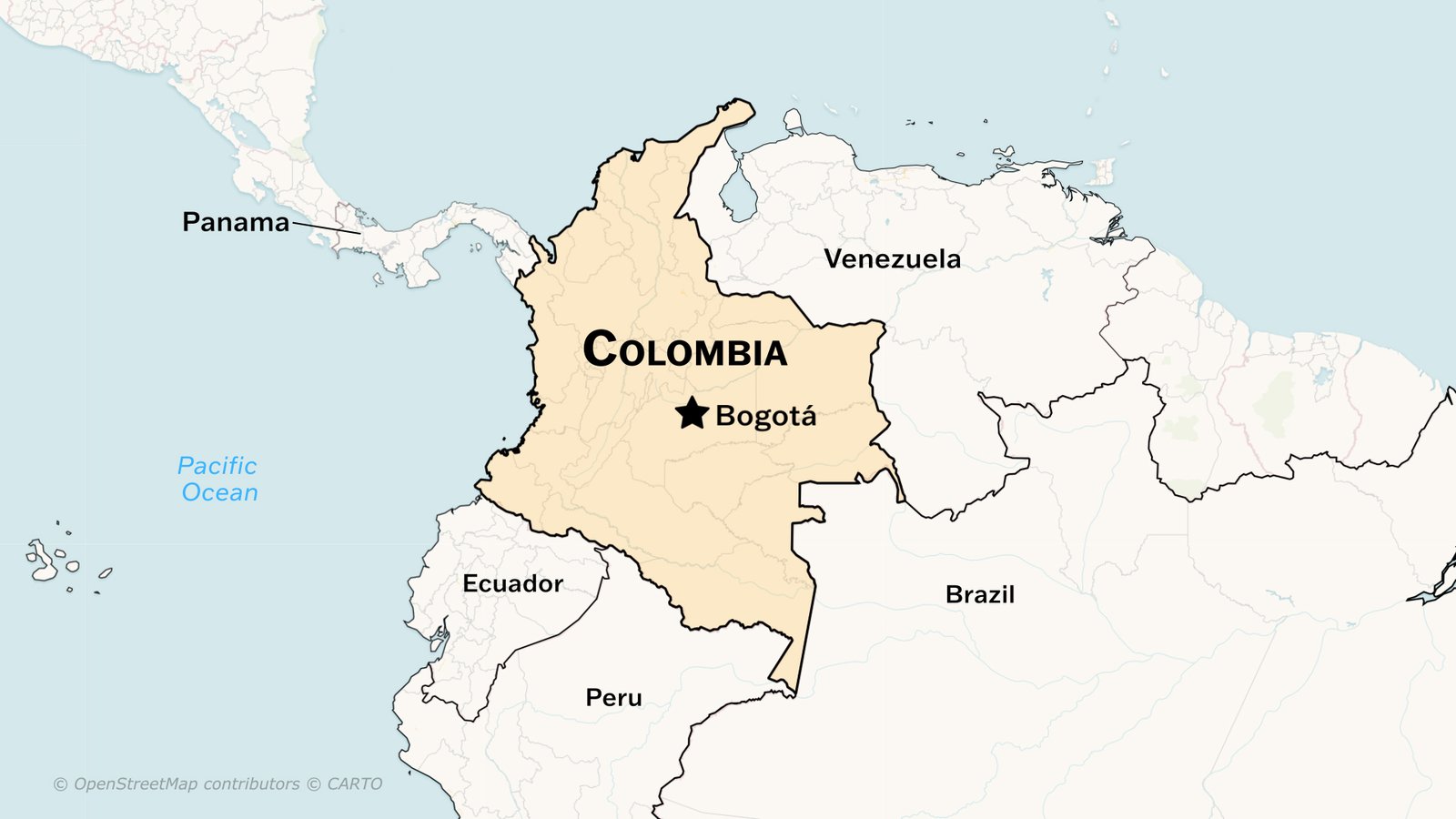
Colombia is located in northwestern South America, the only country on the continent with coastlines on both the Pacific Ocean to the west and the Caribbean Sea to the north. It is bordered by Venezuela to the east, Brazil to the southeast, Peru and Ecuador to the south, and Panama to the northwest.
Colombia Facts
- OFFICIAL NAME: Republic of Colombia
- CAPITAL: Bogotá
- POPULATION: 53,936,226 (2026)
- AREA: 1,141,748 square kilometers
- OFFICIAL LANGUAGE: Spanish
- CURRENCY: Colombian Peso (COP)
Colombia Flag
The flag of Colombia has three horizontal stripes — yellow on top covering half the flag, blue in the middle, and red on the bottom, each of equal width in the lower half. The yellow represents the gold and natural wealth of the country as well as the sovereignty of the Colombian people. The blue represents the seas that border Colombia on both the Pacific and Caribbean coasts. The red represents the blood shed by those who fought for independence and the courage of the Colombian people. The flag design is shared with Ecuador and Venezuela, reflecting their common origins as part of Gran Colombia, the federation founded by Simón Bolívar.
Colombia Geography
- Located in northwestern South America, the only country in South America with coastlines on both the Pacific Ocean and the Caribbean Sea.
- Borders: Venezuela to the east, Brazil to the southeast, Peru and Ecuador to the south, Panama to the northwest.
- The Andes Mountains run through the western half of the country in three parallel ranges — the Western, Central, and Eastern Cordilleras.
- The Amazon rainforest covers the southeastern part of the country, making up a significant portion of the Colombian territory.
- The Llanos, vast tropical grasslands, extend across the eastern interior toward Venezuela.
- The Caribbean coast in the north features beaches, mangroves, and the Sierra Nevada de Santa Marta, the world’s highest coastal mountain range.
- The Magdalena River is the most important river in Colombia, flowing northward through the Andean valleys to the Caribbean Sea.
- Colombia has a tropical climate, with temperatures varying dramatically by altitude rather than season.
- The country is one of the most biodiverse in the world due to its varied terrain and equatorial location.
Colombia Government
- Colombia is a presidential republic.
- The President serves as both head of state and head of government.
- Colombia has a bicameral Congress consisting of the Senate and the House of Representatives.
- Gustavo Petro has served as President since 2022, becoming Colombia’s first left-wing president.
- Colombia has faced decades of internal conflict involving guerrilla groups, paramilitary organizations, and drug trafficking organizations.
- A landmark peace agreement with the FARC guerrilla group was signed in 2016, though violence from other armed groups continues.
History of Colombia
- The region was home to advanced pre-Columbian civilizations, including the Muisca people, who developed sophisticated goldworking traditions.
- Spanish conquistadors arrived in the early 16th century, establishing the colony of New Granada.
- Simón Bolívar led the independence movement, and Colombia declared independence from Spain in 1810, with full independence achieved in 1819.
- Gran Colombia, a federation including present-day Colombia, Venezuela, Ecuador, and Panama, dissolved in 1830.
- Panama separated from Colombia in 1903 with US support to allow the construction of the Panama Canal.
- The 20th century was marked by periods of intense political violence, including La Violencia in the 1940s and 1950s.
- The rise of powerful drug cartels, particularly the Medellín Cartel led by Pablo Escobar in the 1980s and 1990s, caused widespread violence and instability.
- The government has worked since the 1990s to dismantle cartels and negotiate peace with armed groups.
- The 2016 peace agreement with the FARC represented a significant milestone in Colombia’s long struggle for peace.
People and Culture of Colombia
- Colombia’s population is diverse, with mestizo and white Colombians forming the majority, alongside significant Afro-Colombian and Indigenous communities.
- Spanish is the official language, spoken throughout the country, with numerous Indigenous languages also recognized.
- Roman Catholicism is the predominant religion, practiced by the vast majority of the population.
- Bandeja paisa, a hearty platter of rice, beans, ground meat, chicharrón, egg, plantain, and avocado, is one of Colombia’s most iconic dishes.
- Colombia is the world’s third largest coffee producer and Colombian coffee is internationally renowned for its quality.
- The Carnival of Barranquilla, one of the largest carnivals in the world, is a UNESCO-recognized cultural celebration.
- Gabriel García Márquez, Colombia’s most celebrated literary figure and Nobel Prize winner, gave the world the literary style of magical realism.
Economy of Colombia
- Colombia has one of the largest economies in Latin America, with significant oil, mining, agriculture, and services sectors.
- Oil is the largest export commodity, followed by coal and coffee.
- Colombia is the world’s largest producer of emeralds and a significant producer of gold and coal.
- The flower industry is a major agricultural export, with Colombia being the second largest cut flower exporter in the world after the Netherlands.
- Tourism has grown significantly in recent years as security has improved, with visitors drawn to Cartagena, the Amazon, and the Coffee Region.
- Colombia faces ongoing challenges including income inequality, rural poverty, and the economic impact of continued armed conflict.
Colombia Resources
- Colombia has significant oil and natural gas reserves, particularly in the Llanos and Putumayo regions.
- The country holds the world’s largest emerald deposits, found primarily in the Boyacá and Cundinamarca departments.
- Coal reserves in the Cerrejón region of La Guajira are among the largest open-pit coal mines in the world.
- Colombia’s rivers provide significant hydropower potential, supporting a large share of domestic electricity generation.
- The Amazon region and Andean forests contain extraordinary biodiversity resources, including numerous plant species with medicinal potential.
Colombia Wildlife
- Colombia is the most biodiverse country in the world per square kilometer and the second most biodiverse overall, after Brazil.
- The country has more bird species than any other country on Earth, with over 1,900 recorded species.
- Jaguars and tapirs inhabit the Amazon and Pacific rainforests of Colombia.
- The Andean condor, Colombia’s national bird, soars over the high Andes mountain ranges.
- The pink river dolphin, also known as the boto, inhabits the rivers and flooded forests of the Colombian Amazon.
- Sea turtles nest along both the Pacific and Caribbean coastlines.
- Colombia’s extraordinary biodiversity is under increasing threat from deforestation, coca cultivation, and illegal wildlife trade, making conservation a critical priority.