Democratic Republic of the Congo Country Profile
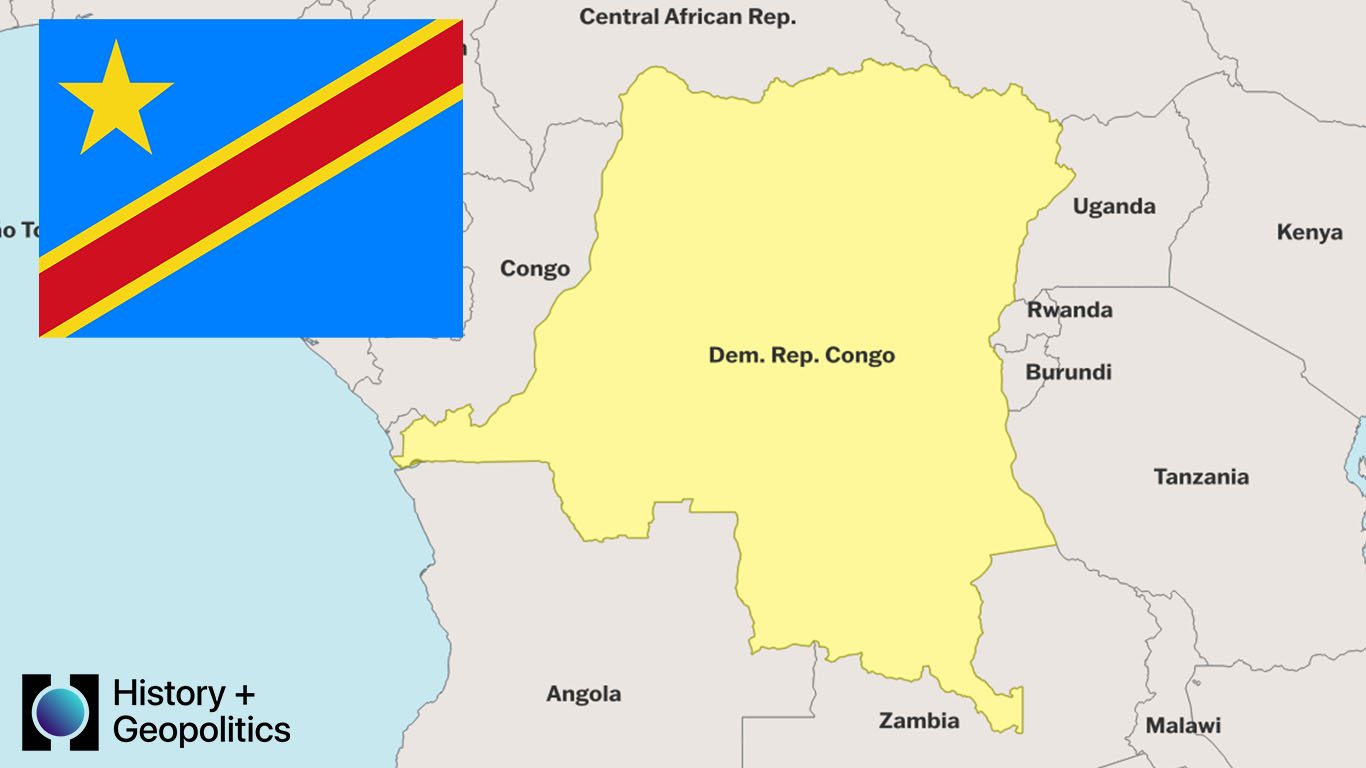
The Democratic Republic of the Congo is located in Central Africa, the second largest country on the African continent. It is bordered by the Republic of the Congo to the northwest, the Central African Republic and South Sudan to the north, Uganda, Rwanda, Burundi, and Tanzania to the east, Zambia and Angola to the south, and the Atlantic Ocean forms a narrow coastline to the west.
Democratic Republic of the Congo Facts
- OFFICIAL NAME: Democratic Republic of the Congo
- CAPITAL: Kinshasa
- POPULATION: 116,452,162 (2026)
- AREA: 2,344,858 square kilometers
- OFFICIAL LANGUAGE: French
- CURRENCY: Congolese Franc (CDF)
Democratic Republic of the Congo Flag
The flag of the Democratic Republic of the Congo has a sky blue background with a yellow-edged red diagonal stripe running from the lower left to the upper right, and a yellow five-pointed star in the upper left corner. The blue represents peace, the red symbolizes the blood of the country’s martyrs, the yellow represents the country’s mineral wealth, and the star represents unity and a radiant future for the country. The diagonal stripe divides the flag dynamically, symbolizing the country’s revolutionary spirit and the energy of its people.
Democratic Republic of the Congo Geography
- Located in Central Africa, the second largest country on the African continent and the eleventh largest in the world.
- Borders: Republic of the Congo to the northwest, Central African Republic and South Sudan to the north, Uganda, Rwanda, Burundi, and Tanzania to the east, Zambia and Angola to the south.
- Has a narrow strip of coastline along the Atlantic Ocean in the far west near the mouth of the Congo River.
- The Congo River, the deepest river in the world and the second largest by water volume after the Amazon, runs through the heart of the country.
- The Congo Basin rainforest, the second largest tropical rainforest in the world, covers much of the central and northern regions.
- The eastern part of the country is dominated by the Great Rift Valley, featuring mountain ranges, volcanoes, and large lakes including Lake Tanganyika, Lake Kivu, and Lake Albert.
- The Ruwenzori Mountains, also known as the Mountains of the Moon, rise along the eastern border with Uganda.
- The country has a largely equatorial climate with high rainfall and humidity throughout the year.
- The vast river system of the Congo Basin provides one of the most extensive waterway networks in the world.
Democratic Republic of the Congo Government
- The Democratic Republic of the Congo is a semi-presidential republic.
- The President serves as head of state and commander-in-chief, with significant executive authority.
- The Prime Minister serves as head of government.
- The country has a bicameral parliament consisting of the National Assembly and the Senate.
- Félix Tshisekedi has served as President since 2019 and was re-elected in 2023.
- The eastern regions of the country have been affected by decades of armed conflict involving numerous militia groups and foreign-backed forces.
History of the Democratic Republic of the Congo
- The region has been home to advanced kingdoms for centuries, including the powerful Kingdom of Kongo, which flourished from the 14th century onward.
- Portuguese explorers arrived in the late 15th century and established trading relationships, including in enslaved people.
- Belgian King Leopold II established personal control over the territory in 1885, naming it the Congo Free State and subjecting the population to brutal exploitation.
- International outcry over atrocities led Belgium to take over the colony in 1908, renaming it the Belgian Congo.
- The Democratic Republic of the Congo gained independence from Belgium on June 30, 1960, with Patrice Lumumba as the first Prime Minister.
- Lumumba was assassinated in 1961 in a crisis involving Cold War rivalry and foreign intervention.
- Mobutu Sese Seko seized power in 1965 and renamed the country Zaire, ruling as a dictator for over three decades.
- The First and Second Congo Wars in the 1990s and early 2000s resulted in millions of deaths and remain among the deadliest conflicts since World War II.
- The country has faced ongoing armed conflict in its eastern regions since the end of the official wars.
People and Culture of the Democratic Republic of the Congo
- The DRC is home to over 200 distinct ethnic groups, with the Mongo, Luba, Kongo, and Mangbetu-Azandeamong the largest.
- French is the official language used in government and education, while Lingala, Swahili, Kikongo, and Tshiluba serve as recognized national languages.
- Christianity is the predominant religion, practiced by the vast majority of the population across various denominations.
- Pondu, a dish made from cassava leaves cooked with palm oil, fish, and spices, is one of the most widely eaten traditional dishes.
- Congolese music, particularly soukous and rumba, has had a profound influence on popular music across Africa and beyond.
- The DRC’s cultural diversity is reflected in its rich traditions of mask-making, sculpture, weaving, and storytelling.
- Kinshasa, the capital and largest city, is one of the largest French-speaking cities in the world.
Economy of the Democratic Republic of the Congo
- The DRC has one of the largest economies in sub-Saharan Africa in terms of natural resource potential, yet remains one of the poorest countries in the world due to conflict and mismanagement.
- Cobalt is the most significant export, with the DRC producing approximately 70% of the world’s supply, essential for electric vehicle batteries.
- Copper, gold, diamonds, and coltan are other major mineral exports.
- Agriculture employs the majority of the population, with cassava, plantains, and maize as staple crops.
- The ongoing conflict in the east has severely disrupted economic activity and displaced millions of people.
- Timber from the Congo Basin rainforest represents a significant but increasingly threatened resource.
Democratic Republic of the Congo Resources
- The DRC holds some of the world’s largest and most diverse mineral reserves, including cobalt, copper, coltan, gold, diamonds, and uranium.
- The Congo River system provides enormous hydropower potential, with the Inga Dam site capable of generating more electricity than any other location in the world.
- The Congo Basin rainforest is among the most biodiverse and carbon-rich ecosystems on Earth.
- Vast agricultural land and fertile soils support subsistence and commercial farming across the country.
- The country’s river systems provide extensive fishery resources vital for local food security.
Democratic Republic of the Congo Wildlife
- The DRC is one of the most biodiverse countries in the world, home to an extraordinary range of endemic species found nowhere else on Earth.
- The mountain gorilla, one of the world’s most endangered primates, inhabits the Virunga Mountains in the east, shared with Rwanda and Uganda.
- The okapi, a forest-dwelling relative of the giraffe unique to the Congo Basin, is one of the most distinctive mammals in Africa.
- The bonobo, the closest living relative to humans alongside the chimpanzee, is found only in the forests of the DRC.
- The Congo peacock, an endemic bird species, inhabits the dense rainforests of the central basin.
- The ongoing conflict in the east has severely threatened wildlife habitats, including Virunga National Park, Africa’s oldest national park.
- Conservation efforts focus on protecting the mountain gorilla, bonobo, and okapi amid persistent challenges from armed groups and poaching.