Costa Rica Country Profile
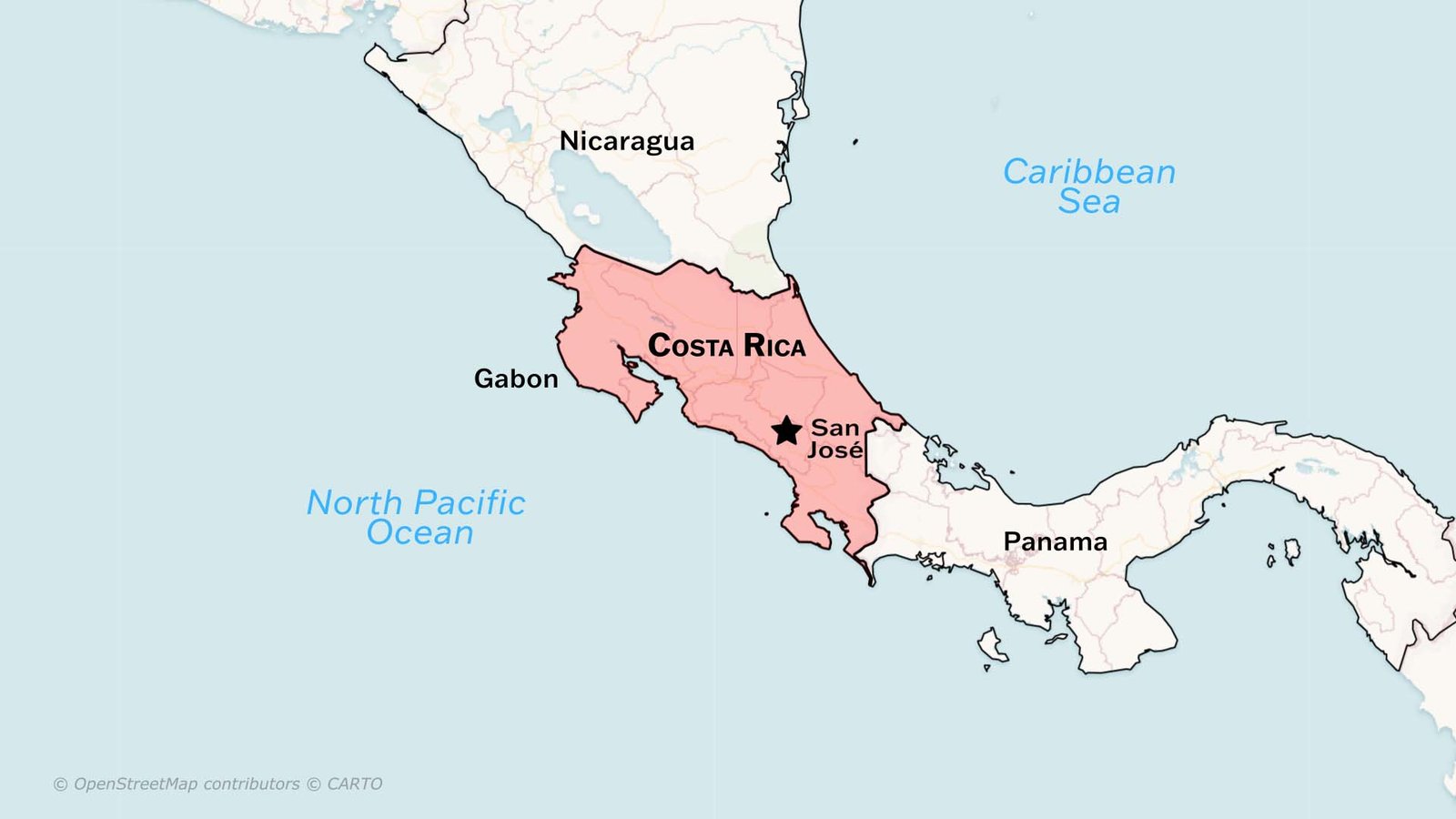
Costa Rica is located in Central America, bordered by Nicaragua to the north and Panama to the southeast. To the west lies the Pacific Ocean and to the east the Caribbean Sea, giving the country coastlines on both sides.
Costa Rica Facts
- OFFICIAL NAME: Republic of Costa Rica
- CAPITAL: San José
- POPULATION: 5,174,789 (2026)
- AREA: 51,100 square kilometers
- OFFICIAL LANGUAGE: Spanish
- CURRENCY: Costa Rican Colón (CRC)
Costa Rica Flag
The flag of Costa Rica has five horizontal stripes — blue on top, white, red in the wider middle band, white, and blue on the bottom. The blue represents the sky, opportunities, and the idealism of the Costa Rican people. The white symbolizes peace, wisdom, and happiness. The red represents the warmth of the people, the blood shed by defenders of the country, and the vibrancy of Costa Rican life. The coat of arms is placed on the left side of the red stripe in the official state version of the flag, depicting three volcanoes, two oceans, a merchant ship, and a rising sun. The flag’s design shares similarities with those of other Central American nations, reflecting their shared history as part of the Federal Republic of Central America.
Costa Rica Geography
- Located in Central America, one of the smallest countries in the region.
- Borders: Nicaragua to the north, Panama to the southeast.
- The Pacific Ocean lies to the west and the Caribbean Sea to the east.
- The terrain is dominated by a central mountain range running through the interior of the country.
- The Central Valley, sitting at an elevation of around 1,000 to 1,500 meters, is the most densely populated and economically active region.
- Chirripó, the highest peak, rises to 3,821 meters and is the highest point in Central America outside of Guatemala.
- The Pacific coast features dry seasonal forests and some of the country’s most popular beach destinations.
- The Caribbean coast is wetter and more heavily forested, with a distinct tropical climate.
- Costa Rica is located along the Pacific Ring of Fire and has several active volcanoes, including Arenal and Poás.
- The country is prone to earthquakes and occasional volcanic activity due to its tectonic position.
Costa Rica Government
- Costa Rica is a presidential republic and one of the oldest and most stable democracies in Latin America.
- The President serves as both head of state and head of government.
- Costa Rica has a unicameral Legislative Assembly.
- The country famously abolished its military in 1948, making it one of the few nations in the world with no standing army.
- Costa Rica is internationally recognized for its democratic governance, political stability, and environmental policies.
History of Costa Rica
- The region was inhabited by various indigenous peoples for thousands of years before European contact.
- Christopher Columbus arrived on the Caribbean coast of Costa Rica in 1502 during his fourth voyage to the Americas.
- Spanish colonization began in the early 16th century, though the lack of large indigenous labor populations and mineral wealth made Costa Rica one of Spain’s poorer colonies.
- Costa Rica declared independence from Spain in 1821 as part of a broader Central American independence movement.
- The country was briefly part of the First Mexican Empire and then the Federal Republic of Central America before becoming fully independent in 1838.
- A brief but significant civil war in 1948 led by José Figueres Ferrer resulted in the abolition of the military and the drafting of a new constitution in 1949.
- Since 1949, Costa Rica has maintained an uninterrupted democratic government, an achievement rare in the region.
- The country has developed a reputation as an environmental leader and a model of sustainable development.
People and Culture of Costa Rica
- The majority of Costa Ricans, known as Ticos, are of Spanish descent with varying degrees of indigenous and African heritage.
- Afro-Caribbean communities, descended from Jamaican workers brought to build the railroad, are concentrated along the Caribbean coast.
- Spanish is the official and universally spoken language, with a distinctive local dialect and expressions.
- Roman Catholicism is the official state religion and historically the most widely practiced faith, though its influence has been declining.
- Gallo pinto, a dish of rice and black beans cooked together with spices, is the national dish and a staple eaten at virtually every meal.
- Costa Ricans are known internationally for the phrase “Pura Vida”, meaning “pure life,” which reflects the country’s relaxed and optimistic cultural attitude.
- Football is the most popular sport, and Costa Rica has achieved notable success in international competitions including the FIFA World Cup.
Economy of Costa Rica
- Costa Rica has one of the most developed and stable economies in Central America.
- Tourism is the largest single industry, driven by the country’s biodiversity, national parks, and ecotourism reputation.
- High-technology manufacturing, particularly medical devices and electronics, has grown significantly and is now a major export sector.
- Agriculture remains important, with bananas, pineapples, and coffee among the leading export crops.
- Costa Rica generates nearly all of its electricity from renewable sources, including hydroelectric, wind, and geothermal power.
- The country has attracted significant foreign investment due to its stable political environment and educated workforce.
Costa Rica Resources
- Costa Rica has significant hydroelectric potential from its numerous rivers flowing from the central mountains.
- Geothermal energy resources, derived from the country’s volcanic activity, contribute to renewable electricity generation.
- Fertile agricultural land supports banana, pineapple, coffee, and sugarcane production.
- The country’s extraordinary biodiversity, concentrated in numerous national parks and reserves, is one of its most valuable resources for ecotourism.
- Coastal waters on both the Pacific and Caribbean sides support fishing industries and marine tourism.
Costa Rica Wildlife
- Costa Rica is one of the most biodiverse countries in the world relative to its size, containing approximately 5% of the world’s known species despite covering less than 0.03% of the Earth’s surface.
- The resplendent quetzal, one of the most spectacular birds in the Americas, inhabits the cloud forests of the Monteverde and Chirripó regions.
- Jaguars, tapirs, and ocelots roam the protected rainforests of the Osa Peninsula and the Caribbean lowlands.
- Four species of sea turtles, including leatherbacks and green turtles, nest on Costa Rica’s beaches, with Tortuguero National Park being one of the most important nesting sites in the world.
- Poison dart frogs, tree frogs, and numerous reptile species inhabit the country’s rainforests and wetlands.
- Costa Rica has protected approximately 25% of its land area in national parks and reserves, making it a global leader in conservation relative to its size.