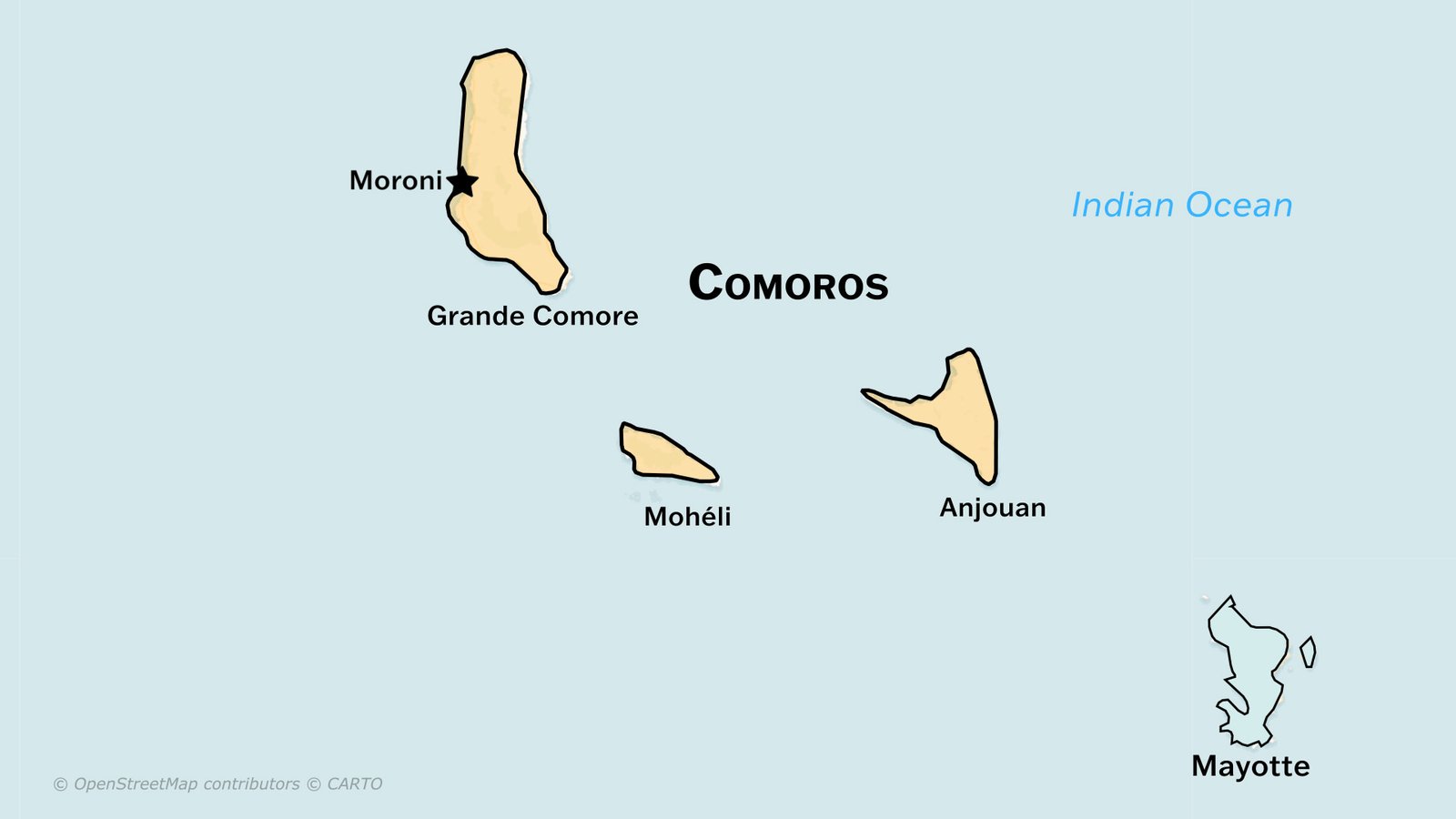
Comoros is located in the Indian Ocean off the eastern coast of Africa, an island nation situated between the northern tip of Madagascar and the northeastern coast of Mozambique. It has no land borders, surrounded entirely by the warm waters of the Indian Ocean.
Comoros Facts
- OFFICIAL NAME: Union of the Comoros
- CAPITAL: Moroni
- POPULATION: 899,010 (2026)
- AREA: 1,861 square kilometers
- OFFICIAL LANGUAGES: Comorian (Shikomori), Arabic, French
- CURRENCY: Comorian Franc (KMF)
Comoros Flag
The flag of Comoros has four horizontal stripes of equal width — yellow, white, red, and blue from top to bottom — with a green triangle on the hoist side containing a white crescent moon and four white five-pointed stars arranged vertically. The four stripes and four stars each represent one of the four islands of the archipelago — Grande Comore, Mohéli, Anjouan, and Mayotte, though Mayotte remains under French administration. The green and crescent symbolize Islam, the dominant religion of the islands. The crescent opening faces away from the triangle, a distinctive feature of the Comorian flag.
Comoros Geography
- Located in the Indian Ocean, off the eastern coast of Africa between Madagascar and Mozambique.
- An archipelago of four main volcanic islands — Grande Comore, Mohéli, Anjouan, and Mayotte.
- Comoros has no land borders, surrounded entirely by the Indian Ocean.
- The islands are volcanic in origin, with rugged terrain and steep hillsides.
- Mount Karthala on Grande Comore is one of the world’s largest active volcanoes and the highest point in the country at 2,361 meters.
- The islands have a tropical marine climate, with a hot and humid season and a cooler dry season.
- The region is occasionally affected by tropical cyclones during the rainy season.
- Coral reefs surround much of the coastline, supporting diverse marine ecosystems.
- Comoros is one of the most densely populated countries in Africa despite its small land area.
Comoros Government
- Comoros is a federal presidential republic.
- The President serves as both head of state and head of government.
- Each of the three self-governing islands — Grande Comore, Mohéli, and Anjouan — has its own governor and administration.
- The country has a unicameral Assembly of the Union as its national legislature.
- Comoros has experienced significant political instability since independence, including numerous coups and secessionist crises.
- Azali Assoumani has served as President since 2019 following a controversial constitutional referendum that extended presidential term limits.
History of Comoros
- The islands were settled by successive waves of Bantu, Arab, and Malay peoples over many centuries.
- Arab traders brought Islam to the islands around the 9th century, and the faith has remained central to Comorian identity ever since.
- Portuguese explorers encountered the islands in the early 16th century.
- France established colonial control over the islands in the 19th century.
- Comoros declared independence from France on July 6, 1975, though Mayotte voted to remain under French administration.
- The island of Mayotte continues to be administered by France and is claimed by Comoros as part of its territory.
- Since independence, Comoros has experienced over 20 coups or attempted coups, making it one of the most politically unstable countries in the world.
- The three islands were granted greater autonomy through a new constitution in 2001, creating the Union of the Comoros.
People and Culture of Comoros
- The population is of mixed African, Arab, and Malay descent, reflecting the islands’ diverse settlement history.
- Comorian, also known as Shikomori, is the most widely spoken language, with Arabic and French serving as additional official languages.
- Sunni Islam is practiced by approximately 98% of the population and is deeply embedded in daily life, customs, and governance.
- Langouste à la vanille, a dish of lobster cooked with vanilla, represents the islands’ unique blend of local seafood and prized spices.
- Comoros is one of the world’s leading producers of ylang-ylang, a fragrant flower used extensively in the perfume industry.
- The islands are also known for producing cloves and vanilla, giving Comoros the nickname the “Perfume Islands.”
- Traditional music, poetry, and Islamic scholarship are important parts of Comorian cultural life.
Economy of Comoros
- Comoros is one of the poorest countries in the world, with a largely subsistence-based economy.
- Agriculture and fishing are the primary livelihoods for much of the population.
- Ylang-ylang, vanilla, and cloves are the most significant agricultural exports, contributing to the country’s reputation as a producer of luxury spices and perfume ingredients.
- Remittances from the large Comorian diaspora, particularly in France, are a critical source of income for many families.
- Tourism has potential but remains underdeveloped due to limited infrastructure and political instability.
- The country relies heavily on foreign aid and international assistance for development and basic services.
Comoros Resources
- Comoros has limited natural resources, with no significant mineral deposits identified.
- The surrounding Indian Ocean waters provide fishing resources, including tuna and other marine species.
- Ylang-ylang, vanilla, and cloves represent the country’s most commercially valuable agricultural resources.
- The volcanic soils support tropical agriculture, including coconuts, bananas, and cassava.
- Coral reefs and marine biodiversity represent a potential ecotourism resource that remains largely undeveloped.
Comoros Wildlife
- Comoros hosts remarkable endemic wildlife due to its island isolation in the Indian Ocean.
- The Livingstone’s fruit bat, one of the world’s largest bats with a wingspan of up to 1.4 meters, is found only in Comoros and is critically endangered.
- The Comoros olive pigeon and several endemic bird species are found exclusively on the islands.
- The coelacanth, a prehistoric fish once thought to be extinct for 65 million years, was discovered alive in the waters near Comoros in 1938 and remains one of the most significant zoological discoveries of the 20th century.
- Hawksbill and green sea turtles nest on the beaches of the islands, particularly on Mohéli.
- Mohéli Marine Park was established to protect the islands’ coral reefs, sea turtles, and marine biodiversity.
- Conservation efforts face significant challenges from poverty, overfishing, and habitat destruction across the islands.