Republic of the Congo Country Profile
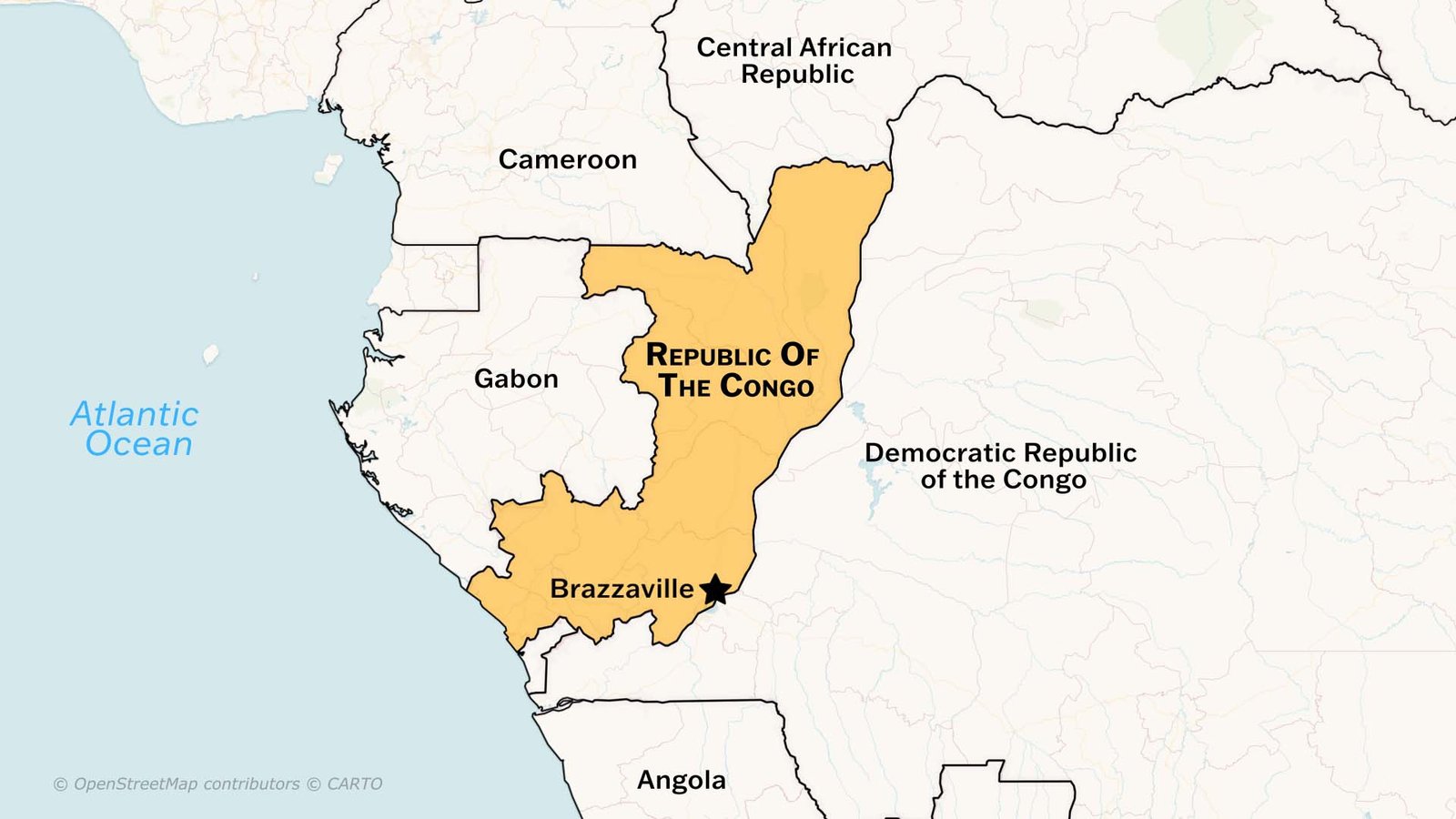
The Republic of the Congo is located in Central Africa, bordered by Cameroon and the Central African Republic to the north, the Democratic Republic of the Congo to the east and south, Angola’s Cabinda exclave to the southwest, Gabon to the west, and the Atlantic Ocean to the southwest.
Republic of the Congo Facts
- OFFICIAL NAME: Republic of the Congo
- CAPITAL: Brazzaville
- POPULATION: 6,637,785 (2026)
- AREA: 342,000 square kilometers
- OFFICIAL LANGUAGE: French
- CURRENCY: Central African CFA Franc (XAF)
Republic of the Congo Flag
The flag of the Republic of the Congo has three diagonal stripes running from the lower left to the upper right — green on the upper left, yellow in the middle, and red on the lower right. The green represents the forests and agriculture of the country, the yellow symbolizes friendship and the country’s mineral wealth, and the red represents the sacrifice and blood of those who fought for independence. The diagonal design distinguishes it from many other African flags that use horizontal stripes, while the Pan-African colors reflect the country’s unity with the broader African independence movement.
Republic of the Congo Geography
- Located in Central Africa, straddling the equator.
- Borders: Cameroon and the Central African Republic to the north, Democratic Republic of the Congo to the east and south, Angola’s Cabinda exclave to the southwest, Gabon to the west.
- Has a short coastline along the Atlantic Ocean in the southwest.
- The Congo River forms much of the border with the Democratic Republic of the Congo to the east.
- The terrain consists of a narrow coastal plain rising to a central plateau and then descending into the Congo River Basin.
- The northern half of the country is covered by dense tropical rainforest, forming part of the Congo Basin.
- The southern regions include plateaus, valleys, and the Bateke Plateau.
- The country has an equatorial climate, hot and humid throughout the year with heavy rainfall.
- The Sangha and Likouala river systems flow through the forested north, supporting vast wetlands and swamps.
Republic of the Congo Government
- The Republic of the Congo is a presidential republic.
- The President serves as both head of state and head of government, holding extensive executive authority.
- Denis Sassou Nguesso has dominated Congolese politics for most of the period since 1979, serving as President for the majority of that time.
- The country has a bicameral parliament consisting of the National Assembly and the Senate.
- The Republic of the Congo has experienced periods of civil conflict, most notably in the late 1990s.
History of the Republic of the Congo
- The region has been inhabited for thousands of years, with Bantu-speaking peoples settling the area over many centuries.
- The powerful Kingdom of Kongo once extended into the southwestern region of what is now the Republic of the Congo.
- Portuguese explorers arrived along the coast in the late 15th century, establishing trade relationships including in enslaved people.
- France established colonial control over the territory in the late 19th century, naming it French Congo and later Middle Congo.
- The territory was part of French Equatorial Africa, administered together with Chad, the Central African Republic, and Gabon.
- The Republic of the Congo gained independence from France on August 15, 1960.
- Following independence, the country experienced a series of coups and political instability.
- A Marxist government ruled from 1969 to 1991, making the country one of Africa’s few officially communist states.
- Civil wars in 1993 and 1997 caused significant destruction and loss of life before Sassou Nguesso consolidated power.
- The country has maintained relative stability since the late 1990s, supported largely by oil revenues.
People and Culture of the Republic of the Congo
- The Kongo are the largest ethnic group, making up over 40% of the population, followed by the Teke and the Mboshi.
- The Aka people, a Pygmy group, are among the oldest inhabitants of the forested north and are known for their rich musical traditions.
- French is the official language, while Lingala and Munukutuba serve as widely spoken national languages.
- Christianity, including Roman Catholicism and various Protestant and independent denominations, is the predominant religion.
- Poulet à la moambe, a chicken dish cooked in palm butter with spices, is considered the national dish of the Republic of the Congo.
- Congolese rumba music has deep cultural roots, shared with the broader Congo Basin musical tradition.
- The Aka people’s polyphonic vocal music is recognized by UNESCO as intangible cultural heritage.
Economy of the Republic of the Congo
- The Republic of the Congo has an economy heavily dependent on oil production, which accounts for the vast majority of government revenue and export earnings.
- The country is a significant oil producer in sub-Saharan Africa, with offshore fields in the Atlantic Ocean.
- Timber from the northern rainforests is another important export commodity.
- Agriculture employs a significant portion of the rural population, with cassava, plantains, and maize as staple crops.
- Despite oil wealth, poverty remains widespread and income inequality is significant.
- The government has been working to diversify the economy and develop infrastructure beyond the oil sector.
Republic of the Congo Resources
- The country has significant offshore oil and natural gas reserves, concentrated in the Atlantic coastal zone.
- Potash deposits have been identified and are being developed as a potential future export resource.
- Vast tropical rainforests in the north provide timber resources, though sustainable management remains a challenge.
- The Congo River and its tributaries provide freshwater fishery resources important for local food security.
- Fertile agricultural land exists in the southern regions, supporting smallholder farming communities.
Republic of the Congo Wildlife
- The Republic of the Congo’s northern rainforests and wetlands support extraordinary biodiversity, including many rare and endangered species.
- Western lowland gorillas and chimpanzees inhabit the dense forests of the north, with the Nouabalé-Ndoki National Park being one of the most important gorilla habitats in Africa.
- Forest elephants roam the rainforest in significant numbers, with the Congo Basin supporting one of Africa’s most important elephant populations.
- The Odzala-Kokoua National Park is one of Africa’s oldest and most biodiverse national parks, home to bongo antelope, forest buffalo, and numerous primate species.
- The northern swamp forests and Likouala wetlands are home to some of the most remote and least explored ecosystems in Africa.
- Conservation efforts have focused on protecting the country’s great ape populations and vast rainforest ecosystems from logging and poaching.