Ecuador Country Profile
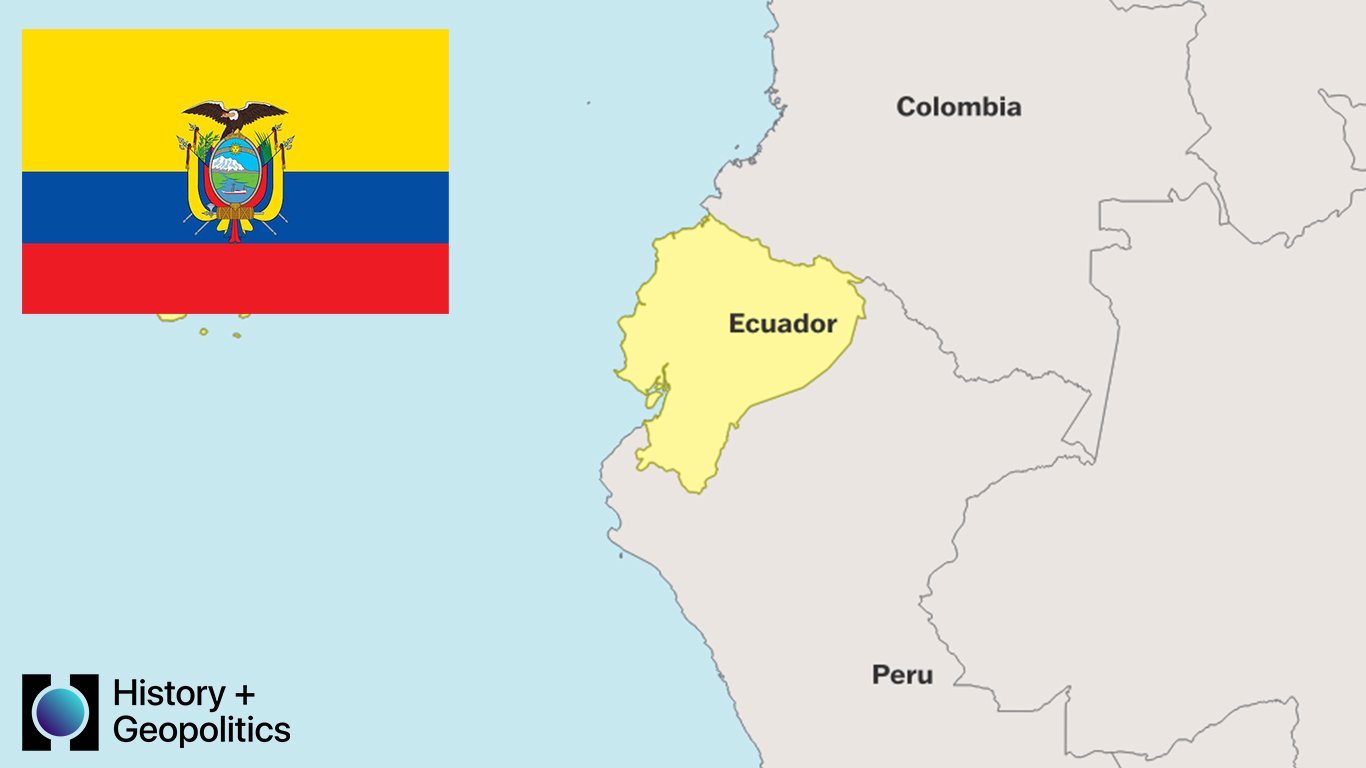
Ecuador is located in northwestern South America, bordered by Colombia to the north, Peru to the east and south, and the Pacific Ocean to the west. Ecuador also administers the Galápagos Islands, located approximately 1,000 kilometers off its Pacific coast.
Ecuador Facts
- OFFICIAL NAME: Republic of Ecuador
- CAPITAL: Quito
- POPULATION: 18,444,506 (2026)
- AREA: 283,561 square kilometers
- OFFICIAL LANGUAGE: Spanish
- CURRENCY: United States Dollar (USD)
Ecuador Flag
The flag of Ecuador has three horizontal stripes — yellow on top covering half the flag, blue in the middle, and red on the bottom — with the national coat of arms centered on the flag. The yellow represents the country’s fertile land, abundant crops, and gold resources. The blue represents the ocean and the clear Andean skies. The red represents the blood shed by Ecuador’s heroes in the fight for independence. The coat of arms features Mount Chimborazo, a river, a steamship, a condor, and laurel and palm branches. The flag shares the same colors as Colombia and Venezuela, reflecting their common origin as part of Simón Bolívar’s Gran Colombia.
Ecuador Geography
- Located in northwestern South America, straddling the equator, from which the country takes its name.
- Borders: Colombia to the north, Peru to the east and south.
- The Pacific Ocean forms the entire western coastline.
- Ecuador also administers the Galápagos Islands, approximately 1,000 kilometers off the Pacific coast.
- The country is divided into four distinct geographic regions — the coastal lowlands, the Andean highlands, the Amazon jungle, and the Galápagos Islands.
- The Andes Mountains run through the center of the country from north to south, with two parallel ranges enclosing a fertile highland valley known as the Avenue of the Volcanoes.
- Ecuador has more volcanoes per square kilometer than almost any other country, including the active Cotopaxi and Tungurahua.
- Mount Chimborazo, though not the highest by elevation above sea level, is the farthest point from the Earth’s center due to the equatorial bulge.
- The Amazon Basin covers the eastern third of the country, known as the Oriente.
- Ecuador has a varied climate depending on region, from tropical on the coast to cold and alpine in the high Andes.
Ecuador Government
- Ecuador is a presidential republic.
- The President serves as both head of state and head of government.
- Ecuador has a unicameral National Assembly.
- Daniel Noboa has served as President since 2023, becoming one of the youngest presidents in Ecuador’s history.
- Ecuador has experienced significant political instability in recent years, including the assassination of presidential candidate Fernando Villavicencio in 2023 and a declaration of internal armed conflict against criminal gangs.
History of Ecuador
- The region has been inhabited for thousands of years, with the Valdivia culture among the oldest known civilizations in the Americas, dating back to around 3500 B.C.
- Various indigenous kingdoms existed before the Inca Empire expanded northward and incorporated present-day Ecuador in the 15th century.
- Spanish conquistador Francisco Pizarro arrived in the region in the 1530s and Spanish colonial rule was established.
- Quito became one of the most important cities in the Spanish colonial empire.
- Ecuador gained independence from Spain on May 24, 1822, following the decisive Battle of Pichincha.
- Ecuador initially joined Simón Bolívar’s Gran Colombia federation before becoming a fully independent republic in 1830.
- The country experienced repeated political instability throughout the 19th and 20th centuries, including numerous coups.
- Ecuador and Peru fought a border war in 1941, with a definitive peace agreement settling the boundary only in 1998.
- Oil was discovered in the Amazon region in the 1960s, transforming the country’s economy.
People and Culture of Ecuador
- The population is predominantly mestizo, of mixed Spanish and indigenous descent, with significant indigenous, Afro-Ecuadorian, and white communities.
- The Kichwa are the largest indigenous group, with significant communities in both the highlands and the Amazon region.
- Spanish is the official language, with Kichwa and other indigenous languages also recognized.
- Roman Catholicism is the predominant religion, practiced by the majority of the population.
- Ceviche, fresh seafood marinated in citrus juice with onions and peppers, is one of Ecuador’s most iconic dishes, particularly along the Pacific coast.
- Llapingachos, potato and cheese pancakes, are a beloved highland staple.
- Ecuador is one of the world’s largest producers and exporters of roses, with its highland climate producing some of the most prized blooms in the global flower market.
Economy of Ecuador
- Ecuador has a middle-income economy, with oil, agriculture, and remittances as the primary drivers.
- Oil exports from the Amazon region are the largest source of government revenue and foreign exchange.
- Ecuador is the world’s largest exporter of bananas and a significant producer of shrimp, cocoa, and cut flowers.
- The country uses the US dollar as its official currency, having dollarized its economy in 2000 following a severe financial crisis.
- Tourism, particularly to the Galápagos Islands and the Amazon, is an important and growing sector.
- Ecuador faces ongoing challenges related to security, poverty reduction, and economic diversification beyond oil.
Ecuador Resources
- Ecuador has significant oil reserves in the Amazon Basin, which have been central to the economy since the 1970s.
- The country has rich agricultural resources, supporting large-scale banana, cocoa, shrimp, and flower production.
- Gold, silver, and copper deposits are found in the Andean region, with mining becoming an increasingly significant sector.
- Hydropower potential is substantial, with numerous rivers flowing from the Andes providing renewable energy generation.
- The Galápagos Islands and Amazon rainforest represent extraordinary biodiversity resources of global scientific and ecotourism importance.
Ecuador Wildlife
- Ecuador is one of the most biodiverse countries in the world relative to its size, containing an extraordinary variety of species across its four geographic regions.
- The Galápagos Islands, a UNESCO World Heritage Site, are home to iconic endemic species including the Galápagos giant tortoise, marine iguana, and blue-footed booby.
- The Amazon region supports jaguars, giant otters, pink river dolphins, and thousands of bird and insect species.
- Ecuador has more bird species than any country in North America, with over 1,600 recorded species.
- The Andean condor soars over the highland regions, while spectacled bears inhabit the cloud forests.
- The marine iguana, the only sea-going lizard in the world, is found exclusively in the Galápagos Islands.
- Conservation of the Galápagos Islands and the Amazon remains a critical priority, with both ecosystems under pressure from tourism, development, and resource extraction.