Eswatini Country Profile
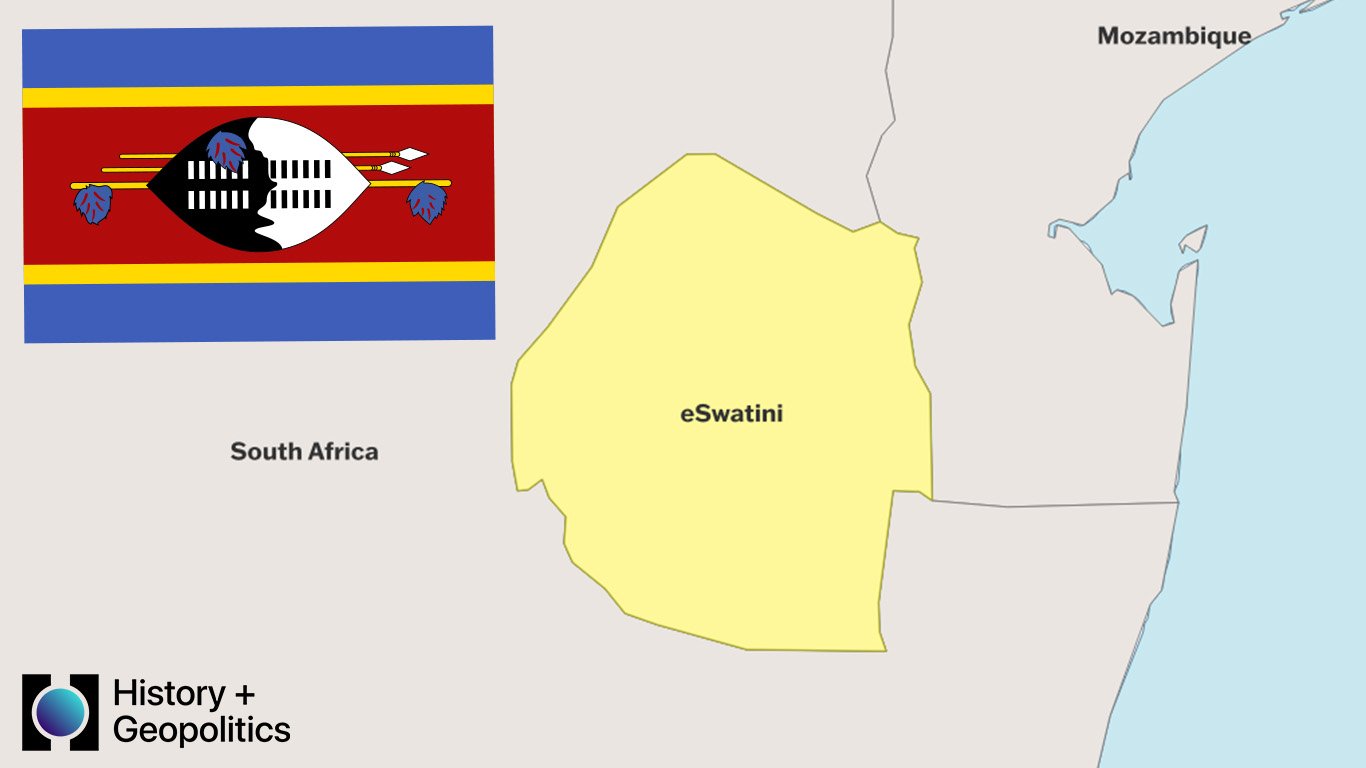
Eswatini is located in Southern Africa, a small landlocked kingdom bordered by South Africa to the north, west, and south, and Mozambique to the east.
Eswatini Facts
- OFFICIAL NAME: Kingdom of Eswatini
- CAPITAL: Mbabane (administrative), Lobamba (royal and legislative)
- POPULATION: 1,269,859 (2026)
- AREA: 17,364 square kilometers
- OFFICIAL LANGUAGES: Swati, English
- CURRENCY: Swazi Lilangeni (SZL)
Eswatini Flag
The flag of Eswatini has three horizontal stripes — blue on top, crimson red in the wide middle, and blue on the bottom — with two thin yellow stripes bordering the red section. In the center of the red stripe sits a traditional Swazi shield and two spears overlaid with a staff decorated with feathers. The blue represents peace and stability, the red represents past battles and the country’s warrior heritage, and the yellow represents the mineral wealth of the nation. The Swazi warrior shield and spears represent protection from the country’s enemies, while the staff with feathers is a symbol of royalty and the King’s authority.
Eswatini Geography
- Located in Southern Africa, one of the smallest countries on the continent.
- Completely landlocked, bordered by South Africa on three sides and Mozambique to the east.
- Despite its small size, Eswatini has a varied landscape ranging from mountains in the west to lowlands in the east.
- The Highveld in the west is the most mountainous region, with Emlembe Peak rising to 1,862 meters as the highest point.
- The Middleveld is the central region, with fertile valleys suited to agriculture.
- The Lowveld in the east is hot and flat, used mainly for sugarcane cultivation and cattle grazing.
- The Lubombo Plateau borders the country along the eastern edge near Mozambique.
- Eswatini has a subtropical climate, with significant variation between the cooler highlands and the hotter lowlands.
- The Usuthu and Komati rivers are the most important waterways flowing through the country.
Eswatini Government
- Eswatini is an absolute monarchy, the last of its kind in Africa.
- The King serves as head of state and government with supreme executive, legislative, and judicial authority.
- King Mswati III has ruled since 1986, one of the longest-reigning monarchs in the world.
- Political parties are banned in Eswatini, making it one of the few countries in the world with no legal political parties.
- The country renamed itself from Swaziland to Eswatini in 2018, with the King announcing the change on the 50th anniversary of independence.
- Eswatini has faced growing calls for democratic reform, with pro-democracy protests becoming increasingly prominent in recent years.
History of Eswatini
- The Swazi people migrated to the present-day territory in the early 18th century and established a unified kingdom under King Ngwane III.
- The Swazi kingdom consolidated its power and identity under a series of strong kings throughout the 18th and 19th centuries.
- Eswatini came under British protection in 1903 following the Anglo-Boer War, becoming a High Commission Territory administered separately from South Africa.
- Unlike its neighbors, Eswatini was never incorporated into South Africa, preserving its status as a distinct territory.
- Eswatini gained independence from Britain on September 6, 1968, restoring the monarchy under King Sobhuza II.
- King Sobhuza II suspended the constitution in 1973 and banned political parties, establishing the absolute monarchy that continues today.
- Mswati III became King in 1986 at age 18 following the death of his father.
- The country was officially renamed the Kingdom of Eswatini in 2018.
People and Culture of Eswatini
- The Swazi people make up approximately 97% of the population, making Eswatini one of the most ethnically homogeneous countries in Africa.
- Swati and English are both official languages, with Swati spoken by the vast majority of the population in daily life.
- Christianity is the predominant religion, practiced by approximately 90% of the population, often alongside traditional Swazi beliefs.
- Sishwala, a thick porridge made from maize or sorghum served with meat or vegetable stew, is a traditional staple food of Eswatini.
- The Incwala ceremony, a sacred first fruits ritual, and the Umhlanga or Reed Dance, a ceremony in which young women present reeds to the Queen Mother, are the two most important annual cultural celebrations.
- The Reed Dance, in which thousands of young Swazi women participate, is one of the most visually spectacular cultural events in Africa.
- Eswatini has a rich tradition of handicrafts, including weaving, woodcarving, and the production of distinctive colorful textiles.
Economy of Eswatini
- Eswatini has a lower-middle-income economy closely tied to South Africa, with which it shares a common monetary area and customs union.
- Sugarcane cultivation in the Lowveld is the most important agricultural industry and a major source of export revenue.
- Soft drink concentrate manufacturing, particularly for major international brands, is a significant industrial export sector.
- Textiles and wood pulp are other important exports.
- The country receives a significant share of its government revenue from the Southern African Customs Union, which distributes customs revenues among member states.
- Eswatini has one of the highest HIV/AIDS prevalence rates in the world, which significantly impacts the workforce, life expectancy, and healthcare costs.
Eswatini Resources
- Eswatini has deposits of coal, asbestos, diamonds, and quarry stone, though mining is not as significant as agriculture in the economy.
- Fertile agricultural land in the Middleveld and Lowveld supports sugar, citrus, and cotton production.
- The Usuthu River provides hydroelectric power and water resources for irrigation.
- Forests planted in the Highveld support a timber and wood pulp industry.
- The country’s scenic landscapes, wildlife reserves, and cultural festivals represent growing resources for tourism.
Eswatini Wildlife
- Eswatini’s varied terrain supports a range of wildlife across its highland and lowland ecosystems.
- Hlane Royal National Park and Mkhaya Game Reserve are the most important protected areas, home to white and black rhinos, elephants, lions, and leopards.
- Mkhaya Game Reserve is internationally recognized for its conservation of black rhinos, one of the most endangered large mammals in Africa.
- Hippos and crocodiles inhabit the rivers flowing through the Lowveld.
- The Malolotja Nature Reserve in the Highveld protects rare plant species and provides habitat for raptors and other mountain wildlife.
- Despite its small size, Eswatini has made significant contributions to African wildlife conservation, particularly in rhino protection.