Fiji Country Profile
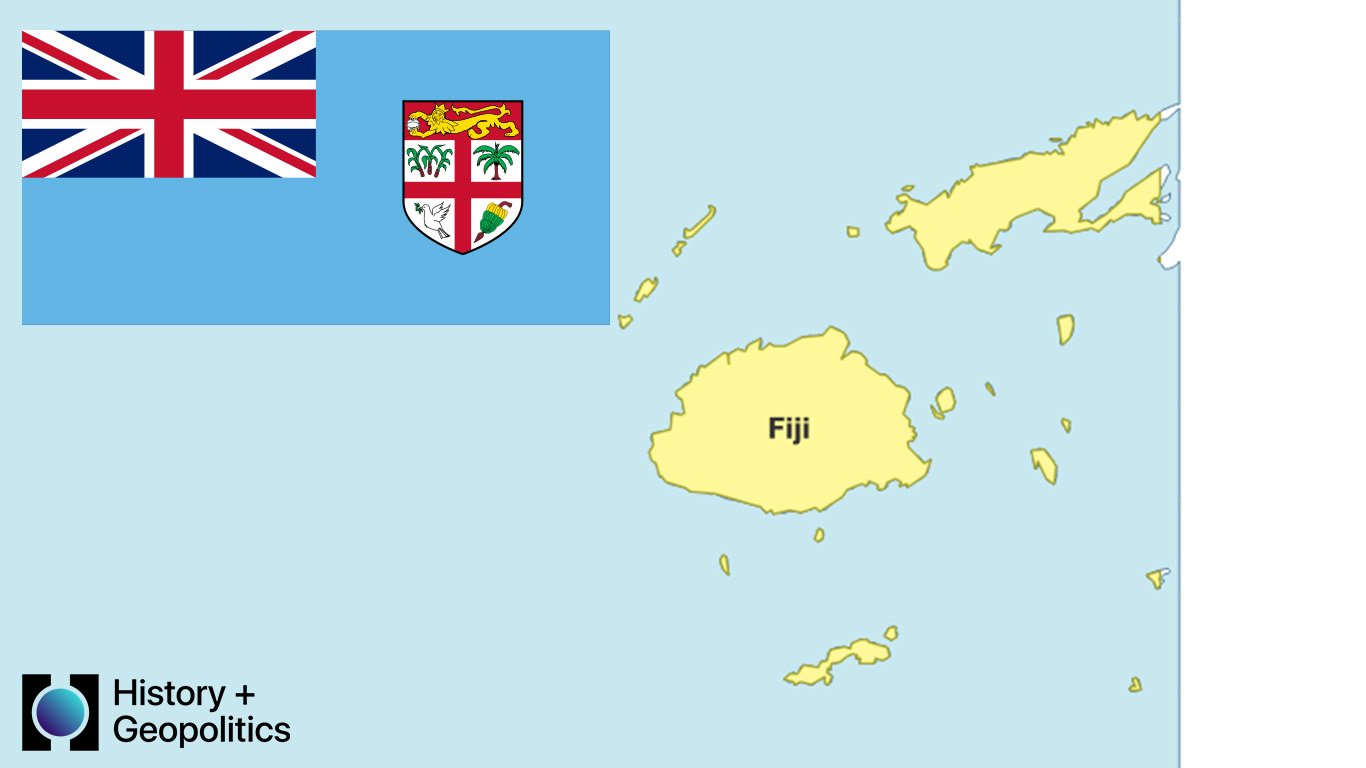
Fiji is located in the South Pacific Ocean, an island nation in Melanesia. It lies approximately 1,100 kilometers north of New Zealand and about 2,000 kilometers northeast of Australia, surrounded entirely by the Pacific Ocean with no land borders.
Fiji Facts
- OFFICIAL NAME: Republic of Fiji
- CAPITAL: Suva
- POPULATION: 937,282 (2026)
- AREA: 18,274 square kilometers
- OFFICIAL LANGUAGES: English, Fijian, Hindi
- CURRENCY: Fijian Dollar (FJD)
Fiji Flag
The flag of Fiji has a light blue background with the Union Jack in the upper left corner and the Fijian coat of arms on the right side. The light blue represents the Pacific Ocean surrounding the islands. The Union Jack reflects Fiji’s historical ties to the United Kingdom as a former British colony. The coat of arms features a British lion holding a cocoa pod at the top, divided into four quadrants showing sugar cane, a coconut palm, a dove of peace, and a bunch of bananas, with a British ship across the top. The shield is supported by two Fijian warriors, and the national motto “Rerevaka na Kalou ka Doka na Tui,” meaning “Fear God and Honor the King,” appears on a ribbon below.
Fiji Geography
- Located in the South Pacific Ocean, part of the Melanesia region.
- An archipelago of over 330 islands and 500 islets, of which approximately 110 are inhabited.
- Surrounded entirely by the Pacific Ocean with no land borders.
- The two largest islands, Viti Levu and Vanua Levu, account for the majority of the land area and population.
- Suva, the capital, is located on the southeastern coast of Viti Levu, the largest island.
- The terrain is predominantly mountainous and volcanic, with dense tropical forest in the interior.
- The highest peak, Mount Tomanivi on Viti Levu, rises to 1,324 meters.
- Fiji has a tropical marine climate with warm temperatures year-round, a wet season and a dry season.
- The country lies within the Pacific cyclone belt and is periodically affected by tropical cyclones.
- Fiji’s waters contain some of the most biodiverse coral reef systems in the world, part of the Coral Triangle region.
Fiji Government
- Fiji is a parliamentary republic.
- The President serves as head of state with largely ceremonial duties.
- The Prime Minister serves as head of government, holding executive authority.
- Fiji has a unicameral Parliament.
- Sitiveni Rabuka has served as Prime Minister since 2022, returning to leadership decades after previously serving as Prime Minister in the 1990s.
- Fiji has experienced significant political instability since independence, including four military coups in 1987, 1999, 2000, and 2006.
- A new democratic constitution was adopted in 2013, and elections held in 2014 and 2018 were widely regarded as credible.
History of Fiji
- The islands have been inhabited for approximately 3,500 years, with Melanesian and later Polynesian peoples settling across the archipelago.
- European explorers, including Abel Tasman and James Cook, visited the islands in the 17th and 18th centuries.
- Sandalwood traders and Christian missionaries arrived in the early 19th century, bringing significant changes to Fijian society.
- After a period of inter-tribal conflict and requests from Fijian chiefs for British protection, Fiji was formally ceded to Britain in 1874.
- Between 1879 and 1916, the British colonial government brought approximately 60,000 indentured laborers from India to work on sugar plantations, fundamentally shaping the country’s demographic and cultural character.
- Fiji gained independence from the United Kingdom on October 10, 1970.
- Ethnic tensions between indigenous Fijians and Indo-Fijians led to military coups in 1987, undermining democratic governance.
- Further coups in 2000 and 2006 continued the pattern of political instability before a new constitutional framework was established.
People and Culture of Fiji
- Fiji has a diverse population consisting of indigenous Fijians, known as iTaukei, who make up approximately 57% of the population, and Indo-Fijians descended from indentured laborers, making up around 38%.
- English, Fijian, and Hindi are all official languages, reflecting the country’s multicultural heritage.
- Christianity, particularly Methodism, is the predominant religion among indigenous Fijians, while Hinduism and Islam are practiced by much of the Indo-Fijian community.
- Kokoda, a dish of raw fish marinated in citrus juice and mixed with coconut cream and vegetables, is one of Fiji’s most popular traditional foods.
- Lovo, a feast cooked in an underground earth oven, is central to indigenous Fijian ceremonial and social gatherings.
- The kava ceremony, involving the communal drinking of a traditional mildly sedative drink made from the kava root, is one of the most important cultural rituals in Fijian society.
- Rugby sevens is a national passion, with Fiji being one of the dominant forces in the sport at international level, having won multiple Olympic gold medals.
Economy of Fiji
- Fiji has one of the most developed economies in the Pacific Islands, with tourism, sugar, and remittances as the main pillars.
- Tourism is the largest single contributor to GDP, with visitors attracted to the islands’ beaches, resorts, and marine environments.
- Sugar cane production and refining have historically been central to the economy, particularly among Indo-Fijian farming communities.
- Remittances from Fijians working abroad, particularly in Australia, New Zealand, and as military personnel, are a significant source of income.
- Fiji serves as a regional hub for the Pacific, hosting numerous international organizations and providing services to neighboring island nations.
- The economy is vulnerable to natural disasters, particularly cyclones, which can cause extensive damage to infrastructure and agriculture.
Fiji Resources
- Fiji has fertile agricultural land supporting sugar cane, ginger, coconut, and tropical fruit production.
- Gold and silver deposits have been mined in Fiji, with the Emperor Gold Mine on Viti Levu historically significant.
- The surrounding Pacific waters provide fishery resources, including tuna and other deep-sea species.
- Fiji’s forests provide timber resources, though logging has raised environmental concerns in recent decades.
- The country’s beaches, coral reefs, and tropical marine environment are among its most valuable resources for the tourism industry.
Fiji Wildlife
- Fiji’s islands and surrounding waters support a rich range of endemic and native wildlife shaped by millions of years of island isolation.
- The Fiji petrel, one of the rarest seabirds in the world, was long considered extinct before being rediscovered in 1984.
- The crested iguana, a large and striking lizard found only on several small Fijian islands, is critically endangered due to habitat loss and introduced predators.
- Fiji has numerous endemic bird species, including the orange dove and the silktail, found nowhere else on Earth.
- The coral reefs surrounding the islands support extraordinary marine biodiversity, including sharks, manta rays, sea turtles, and hundreds of fish species.
- Invasive species, habitat destruction, and climate change, particularly rising sea temperatures that cause coral bleaching, pose the greatest threats to Fiji’s wildlife.
- Conservation efforts focus on protecting the crested iguana, endemic birds, and the coral reef ecosystems that surround the islands.