Estonia Country Profile
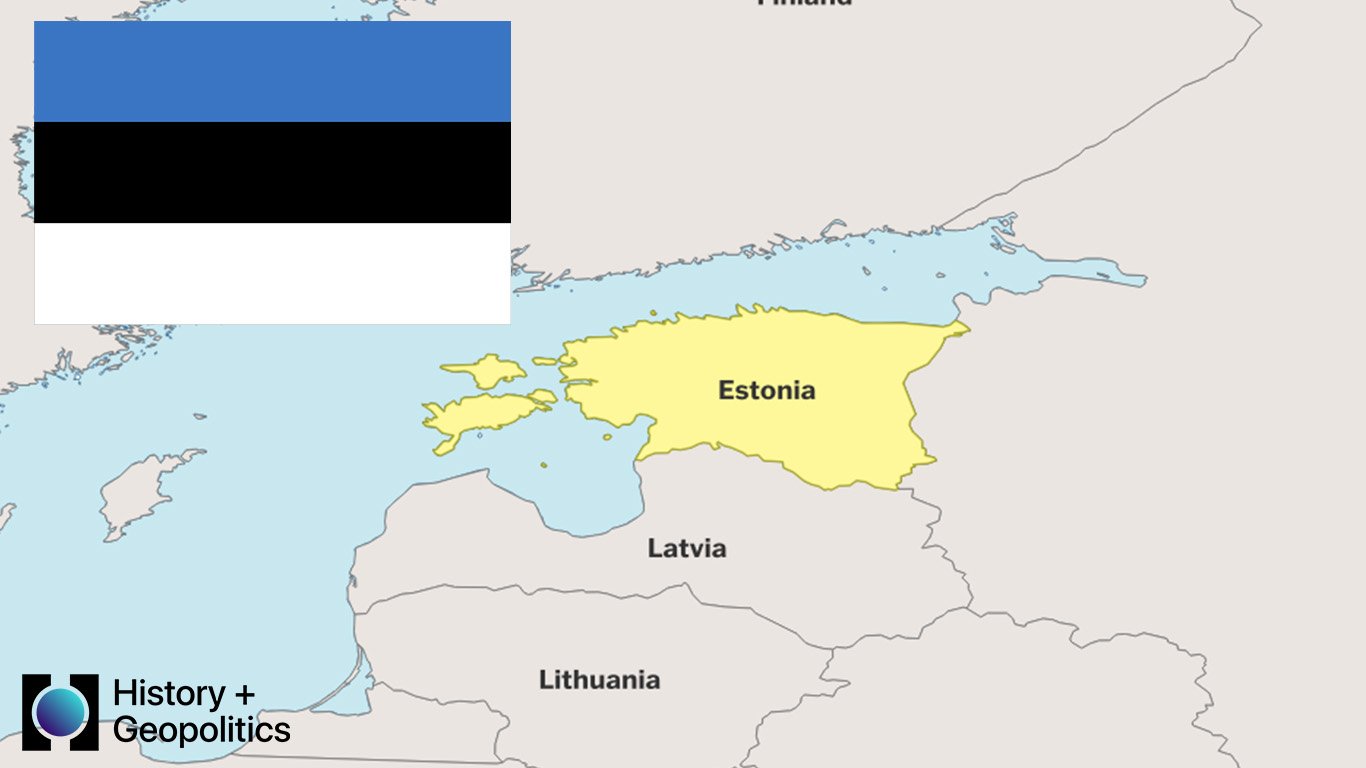
Estonia is located in Northern Europe, a Baltic state bordered by Latvia to the south and Russia to the east. To the north lies the Gulf of Finland, separating it from Finland, and to the west lies the Baltic Sea.
Estonia Facts
- OFFICIAL NAME: Republic of Estonia
- CAPITAL: Tallinn
- POPULATION: 1,331,062 (2026)
- AREA: 45,228 square kilometers
- OFFICIAL LANGUAGE: Estonian
- CURRENCY: Euro (EUR)
Estonia Flag
The flag of Estonia has three equal horizontal stripes — blue on top, black in the middle, and white on the bottom. The blue represents the sky, the sea, and the aspirations of the Estonian people for freedom. The black represents the dark soil of Estonia and the suffering endured through centuries of foreign occupation. The white represents purity, hard work, and the bright future the Estonian people strive for. The flag was adopted in 1881 as the symbol of the Estonian national movement and officially restored as the national flag when Estonia regained independence in 1991 after Soviet occupation.
Estonia Geography
- Located in Northern Europe, the northernmost of the three Baltic states.
- Borders: Latvia to the south, Russia to the east.
- The Gulf of Finland lies to the north, separating Estonia from Finland.
- The Baltic Sea lies to the west, with the islands of Saaremaa and Hiiumaa forming Estonia’s largest islands.
- Estonia has over 2,000 islands and islets in the Baltic Sea, adding significantly to its total territory.
- The terrain is mostly flat, low-lying, and heavily forested, with numerous lakes, rivers, and wetlands.
- The highest point, Suur Munamägi, rises to only 318 meters above sea level.
- Estonia has a temperate climate, influenced by its proximity to the Baltic Sea and the North Atlantic.
- The country has a large number of lakes, with Lake Peipus on the Russian border being the fourth largest lake in Europe.
- Forests cover approximately half of Estonia’s total land area.
Estonia Government
- Estonia is a parliamentary republic.
- The President serves as head of state with largely ceremonial duties.
- The Prime Minister serves as head of government, holding executive authority.
- Estonia has a unicameral parliament called the Riigikogu.
- Estonia joined both NATO and the European Union in 2004.
- Estonia is widely recognized as one of the world’s most advanced digital societies, having pioneered e-governance, digital identity, and internet voting.
History of Estonia
- The region has been inhabited since prehistoric times, with Finno-Ugric peoples settling the area thousands of years ago.
- Estonia came under Danish and then German control during the medieval period, with the Teutonic Knights establishing dominance over much of the territory.
- Sweden controlled Estonia from the early 17th century until the Great Northern War, when Russia gained control in 1710.
- Estonia declared independence on February 24, 1918, following the collapse of the Russian Empire.
- The country maintained independence throughout the interwar period before being forcibly annexed by the Soviet Union in 1940 under the Molotov-Ribbentrop Pact.
- Germany occupied Estonia from 1941 to 1944 during World War II, before Soviet forces reoccupied the country.
- Estonia remained part of the Soviet Union until the Singing Revolution, a peaceful independence movement characterized by mass gatherings and song, restored its independence on August 20, 1991.
- Since independence, Estonia has transformed rapidly into a modern, digitally advanced European democracy.
People and Culture of Estonia
- Ethnic Estonians make up approximately 68% of the population, with a significant Russian minority of around 25% concentrated mainly in the northeast and Tallinn.
- Estonian is the official language, a Finno-Ugric language closely related to Finnish and more distantly to Hungarian.
- Estonia is one of the least religious countries in the world, with the majority of the population identifying as non-religious.
- Verivorst, a traditional blood sausage typically served with sauerkraut and potatoes, is a beloved national dish particularly associated with Christmas.
- Mulgipuder, a thick porridge of potatoes and barley groats served with pork and sour cream, is one of Estonia’s most traditional everyday dishes.
- The Song and Dance Festival, held every five years in Tallinn, is one of the largest choral events in the world and is recognized by UNESCO as intangible cultural heritage.
- Estonia’s medieval old town of Tallinn is one of the best-preserved in Europe and is a UNESCO World Heritage Site.
Economy of Estonia
- Estonia has a highly developed market economy, consistently ranked among the most competitive and innovative in Europe.
- The technology and digital sectors are particularly strong, with Estonia being the birthplace of Skype and Transferwise, and home to numerous successful tech startups.
- Manufacturing, logistics, and financial services also contribute significantly to the economy.
- Estonia adopted the Euro in 2011 and has maintained strong fiscal discipline and low public debt.
- The country has a flat income tax system, introduced after independence, which has been widely studied as a model of tax reform.
- Estonia faces demographic challenges, including a declining and aging population, which poses long-term economic concerns.
Estonia Resources
- Estonia has significant deposits of oil shale, one of the world’s largest, which has historically been used for energy production and chemical manufacturing.
- Peat and timber are important natural resources, with forests covering approximately half the country.
- Estonia has limestone deposits used in construction and manufacturing.
- The Baltic Sea and inland lakes provide fishing resources, including herring, sprat, and pike-perch.
- Wind energy potential is significant along the Baltic coastline and islands, supporting Estonia’s transition toward renewable energy.
Estonia Wildlife
- Estonia’s extensive forests, wetlands, and coastal areas support a rich variety of northern European wildlife.
- Brown bears, wolves, lynx, and wild boar inhabit the country’s forests, with Estonia having some of the healthiest populations of large carnivores in the European Union.
- The white stork is a beloved symbol of Estonian rural life and nests in large numbers across the countryside.
- The Baltic Sea supports harbor seals and grey seals, with several protected breeding areas on Estonian islands.
- Lake Peipus and the country’s many wetlands are important habitats for migratory birds, including cranes and various waterfowl species.
- Estonia has established numerous protected areas, including Lahemaa National Park, the oldest national park in the former Soviet Union, to conserve its natural heritage.