Equatorial Guinea Country Profile
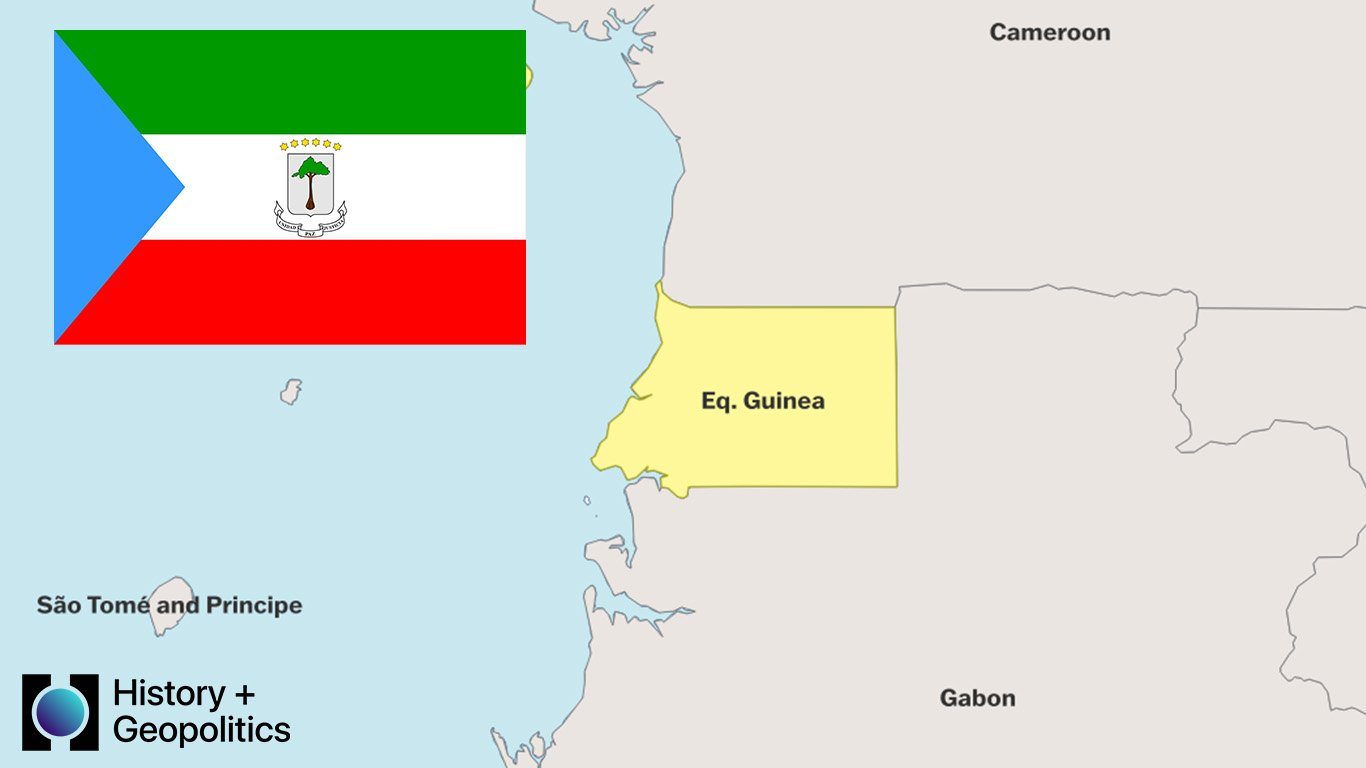
Equatorial Guinea is located in Central Africa, consisting of a mainland territory called Río Muni, bordered by Cameroon to the north and Gabon to the south and east, and several islands in the Gulf of Guinea, the largest of which is Bioko, where the capital is located.
Equatorial Guinea Facts
- OFFICIAL NAME: Republic of Equatorial Guinea
- CAPITAL: Malabo (on Bioko Island; Oyala is being developed as a new capital on the mainland)
- POPULATION: 1,984,468 (2026)
- AREA: 28,051 square kilometers
- OFFICIAL LANGUAGES: Spanish, French, Portuguese
- CURRENCY: Central African CFA Franc (XAF)
Equatorial Guinea Flag
The flag of Equatorial Guinea has three equal horizontal stripes — green on top, white in the middle, and red on the bottom — with a blue triangle on the hoist side and the national coat of arms centered on the white stripe. The green represents the country’s natural resources and forests, the white symbolizes peace, and the red represents the blood shed by those who fought for independence. The blue triangle represents the sea connecting the mainland to the islands. The coat of arms features a silk cotton tree, also known as the God tree, which holds deep cultural significance for the Bubi people of Bioko Island, surrounded by six yellow stars representing the mainland and the five islands, with the national motto “Unidad, Paz, Justicia” meaning “Unity, Peace, Justice.”
Equatorial Guinea Geography
- Located in Central Africa, consisting of a mainland region and several islands in the Gulf of Guinea.
- The mainland territory, Río Muni, is bordered by Cameroon to the north and Gabon to the south and east.
- Bioko Island, located in the Gulf of Guinea off the coast of Cameroon, is the most important island and home to the capital, Malabo.
- Other islands include Annobón, located far to the southwest in the Atlantic Ocean.
- Equatorial Guinea is the only country in Africa where Spanish is an official language.
- The terrain of the mainland is mostly coastal plains rising to interior hills and plateaus.
- Bioko Island is volcanic in origin, with Mount Basile rising to 3,011 meters as the highest point in the country.
- The country has a hot and humid equatorial climate with heavy rainfall throughout the year.
- Dense tropical rainforest covers much of both the mainland and the islands.
Equatorial Guinea Government
- Equatorial Guinea is a presidential republic in practice functioning as an authoritarian state.
- The President holds extensive executive power with virtually no checks on authority.
- Teodoro Obiang Nguema Mbasogo has been President since 1979, making him one of the longest-serving heads of state in the world.
- The country has a bicameral parliament consisting of the Senate and the Chamber of Deputies, though both function with limited independence.
- Equatorial Guinea has been widely criticized by international human rights organizations for corruption and lack of political freedoms.
History of Equatorial Guinea
- The Bubi people were the original inhabitants of Bioko Island, while various Bantu peoples, including the Fang, inhabited the mainland.
- Portugal claimed the islands in the late 15th century and established a presence on the island then known as Formosa.
- Spain gained control of the territory through the Treaty of El Pardo in 1778, exchanging it with Portugal.
- The territory became the Spanish colony of Spanish Guinea and was administered as such for nearly two centuries.
- Equatorial Guinea gained independence from Spain on October 12, 1968.
- Francisco Macías Nguema became the first president and quickly established a brutal dictatorship, overseeing a reign of terror that killed or exiled a significant portion of the population.
- Teodoro Obiang Nguema Mbasogo overthrew and executed his uncle Macías Nguema in a coup in 1979 and has ruled ever since.
- The discovery of offshore oil in the 1990s transformed the country’s economic fortunes dramatically.
- Despite oil wealth, the benefits have not been widely shared, and poverty remains widespread.
People and Culture of Equatorial Guinea
- The Fang are the largest ethnic group, making up the majority of the mainland population.
- The Bubi are the main ethnic group on Bioko Island and have distinct cultural traditions from the mainland peoples.
- Spanish, French, and Portuguese are all official languages, making Equatorial Guinea one of the few countries with three official languages.
- A local Portuguese-based creole called Fang and the Bubi language are widely spoken alongside the official languages.
- Roman Catholicism is the predominant religion, practiced by the majority of the population as a legacy of Spanish colonization.
- Traditional ceremonies and mask dances, particularly the Balélé dance of the Bubi people, are important parts of cultural life.
- Succotash, a dish of mixed vegetables and fish or meat cooked in palm oil, is a common traditional food.
Economy of Equatorial Guinea
- Equatorial Guinea’s economy is dominated by oil and natural gas production, which transformed the country from one of Africa’s poorest to one of its highest per capita income nations.
- Offshore oil production began in the 1990s and quickly made Equatorial Guinea the third largest oil producer in sub-Saharan Africa at its peak.
- Despite high per capita income figures, wealth is extremely unevenly distributed, and the majority of the population lives in poverty.
- The government has invested oil revenues in infrastructure development, including roads, buildings, and a new planned capital city called Oyala on the mainland.
- Agriculture and fishing play a role in the subsistence economy, particularly outside the capital.
- Oil production has been declining in recent years as reserves mature, creating economic pressure to diversify.
Equatorial Guinea Resources
- Equatorial Guinea has significant offshore oil and natural gas reserves in the Gulf of Guinea, which have driven the economy since the 1990s.
- Timber resources from the mainland’s tropical rainforests have historically been an important export, though logging has raised environmental concerns.
- The country has potential for ecotourism based on its biodiversity, though this remains largely undeveloped.
- Agricultural resources include cocoa, coffee, and subsistence crops grown in the fertile volcanic soils of Bioko Island.
- The surrounding waters provide fishing resources, though the industry remains small scale.
Equatorial Guinea Wildlife
- Equatorial Guinea’s tropical rainforests and island ecosystems support remarkable biodiversity, including several endangered species.
- Bioko Island is one of the most important habitats for primates in Africa, home to several species of drills and other monkeys found nowhere else.
- The drill monkey, one of Africa’s most endangered primates, has one of its most significant remaining populations on Bioko Island.
- Western lowland gorillas and chimpanzees inhabit the mainland rainforests of Río Muni.
- Leatherback and other sea turtles nest on the beaches of Bioko Island, which hosts one of the most important sea turtle nesting sites in West Africa.
- The waters around Annobón Island support humpback whales and various dolphin species.
- Conservation efforts focus on protecting the unique primate populations of Bioko Island and the sea turtle nesting beaches from hunting and habitat destruction.