Eritrea Country Profile
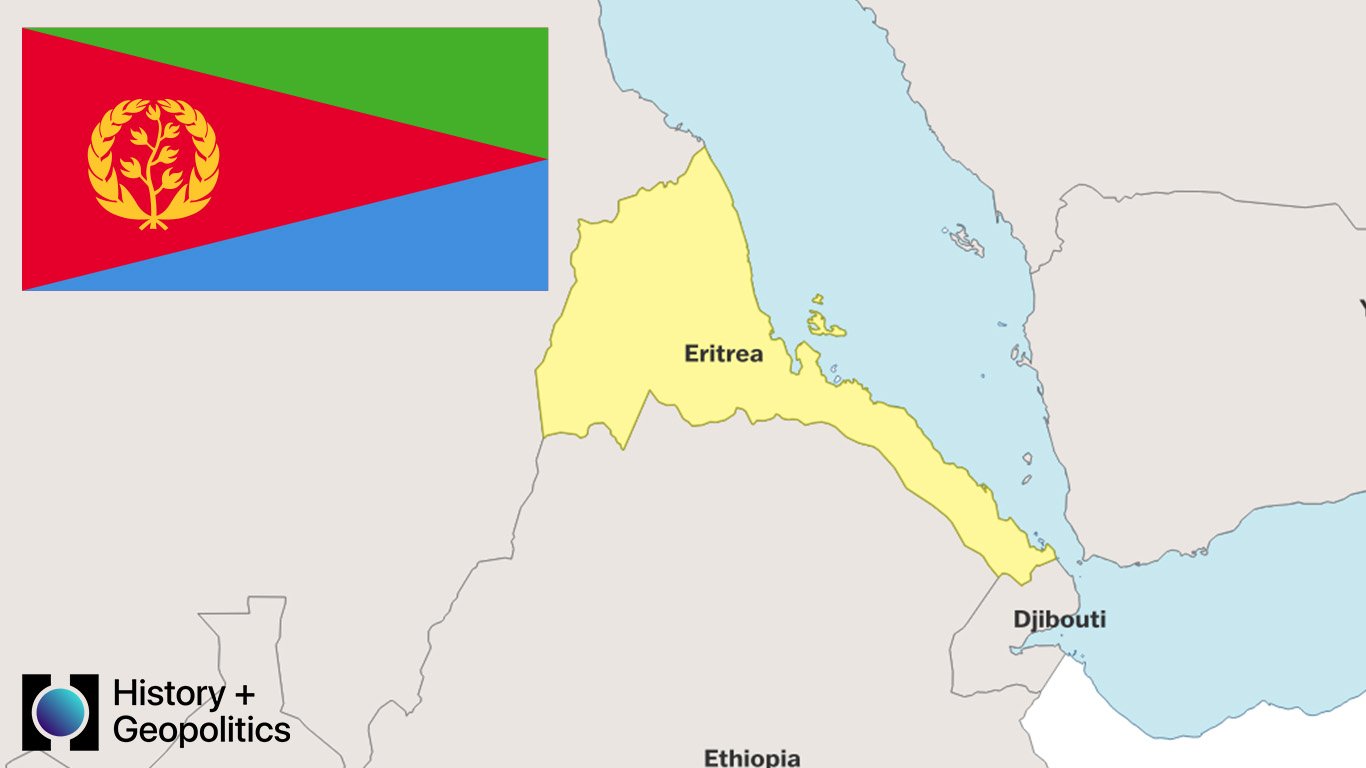
Eritrea is located in the Horn of Africa, bordered by Sudan to the north and west, Ethiopia to the south, and Djibouti to the southeast. To the northeast and east lies the Red Sea, which forms the country’s entire eastern coastline.
Eritrea Facts
- OFFICIAL NAME: State of Eritrea
- CAPITAL: Asmara
- POPULATION: 3,682,669 (2026)
- AREA: 117,600 square kilometers
- OFFICIAL LANGUAGES: Tigrinya, Arabic, English
- CURRENCY: Eritrean Nakfa (ERN)
Eritrea Flag
The flag of Eritrea has three triangular sections — a large red triangle on the hoist side extending to the right, with a green triangle in the upper portion and a blue triangle in the lower portion. In the center of the red triangle sits a golden olive wreath encircling a golden olive branch pointing upward. The green represents the agricultural and pastoral wealth of the country. The blue represents the bounty of the Red Sea. The red represents the blood shed during the long struggle for independence. The olive wreath and branch symbolize peace and the proclamation of Eritrean independence. The flag’s design reflects the banner of the Eritrean People’s Liberation Front, which led the country to independence.
Eritrea Geography
- Located in the Horn of Africa, with a long coastline along the Red Sea to the northeast and east.
- Borders: Sudan to the north and west, Ethiopia to the south, Djibouti to the southeast.
- Eritrea also administers the Dahlak Archipelago, a large group of islands in the Red Sea.
- The terrain varies dramatically from the hot, arid coastal plains along the Red Sea to the cooler central highlands.
- The central highlands, where the capital Asmara is located, sit at an elevation of around 2,300 meters above sea level.
- The western lowlands slope gradually toward Sudan and consist of dry savanna and semi-arid plains.
- The Danakil Depression in the south is one of the hottest and most inhospitable places on Earth.
- Eritrea has a varied climate, with the coastal areas extremely hot and dry, the highlands temperate, and the western lowlands hot and seasonally rainy.
- The country has limited fresh water resources, with no permanent major rivers flowing year-round.
Eritrea Government
- Eritrea is a single-party state governed by the People’s Front for Democracy and Justice (PFDJ).
- The President serves as head of state and head of government with absolute authority.
- Isaias Afwerki has served as President since independence in 1993 and has ruled without elections or a functioning legislature.
- Eritrea has no independent judiciary, free press, or functioning civil society organizations.
- The country is widely regarded as one of the most repressive and closed states in the world, often referred to as the “North Korea of Africa.”
- Eritrea maintains a system of indefinite national service that has driven significant emigration.
History of Eritrea
- The region has been inhabited since ancient times and was part of early Aksumite civilization and Red Sea trading networks.
- The Ottoman Empire controlled parts of the Eritrean coast from the 16th century.
- Italy colonized the territory in 1890, naming it Eritrea after the Latin name for the Red Sea, Mare Erythraeum.
- Italian Eritrea was used as a base for Italy’s invasion of Ethiopia in 1935.
- British forces defeated the Italians in 1941 and administered Eritrea until 1952.
- The United Nations federated Eritrea with Ethiopia in 1952 under a compromise arrangement.
- Ethiopia formally annexed Eritrea in 1962, triggering a decades-long independence struggle.
- The Eritrean People’s Liberation Front fought a 30-year war for independence against Ethiopian rule.
- Eritrea gained independence from Ethiopia on May 24, 1991, following the collapse of the Derg regime, with formal independence recognized on May 24, 1993.
- A devastating border war with Ethiopia from 1998 to 2000 caused tens of thousands of casualties and left the border disputed for two decades.
- A peace agreement was finally signed between Eritrea and Ethiopia in 2018, ending the state of war between the two countries.
People and Culture of Eritrea
- The Tigrinya are the largest ethnic group, making up approximately 55% of the population, followed by the Tigre at around 30%.
- Other ethnic groups include the Saho, Afar, Bilen, Kunama, Nara, Hedareb, and Rashaida peoples.
- Tigrinya, Arabic, and English are the three official working languages, though nine languages are recognized across Eritrea’s ethnic communities.
- Eritrea is almost evenly split between Christianity and Islam, with Tigrinya speakers predominantly Orthodox Christian and many lowland communities predominantly Muslim.
- Injera, a sourdough flatbread made from teff flour, is a staple food eaten with stews of lentils, vegetables, and meat, shared with neighboring Ethiopia.
- Eritrean coffee ceremony is an important social ritual, particularly among highland communities.
- Asmara, the capital, is known for its remarkably well-preserved Italian colonial modernist architecture and has been recognized as a UNESCO World Heritage Site.
Economy of Eritrea
- Eritrea has one of the least developed and most isolated economies in the world due to its political system and international isolation.
- Agriculture employs the majority of the population, with subsistence farming of sorghum, millet, and barley in the highlands.
- Mining, particularly of gold and zinc, has become an increasingly important source of export revenue.
- The Bisha mine, operated with Canadian investment, is the country’s most significant mining operation.
- Remittances from the large Eritrean diaspora, many of whom fled the country due to the indefinite national service system, are a critical source of income.
- Eritrea has limited trade relationships due to sanctions, political isolation, and border closures with Ethiopia.
Eritrea Resources
- Eritrea has significant mineral deposits, including gold, silver, copper, zinc, and potash.
- The Red Sea coastline and Dahlak Archipelago offer potential for fishing and marine resource development.
- The country has potential for salt extraction from coastal areas along the Red Sea.
- Geothermal energy potential exists in the Danakil Depression and surrounding volcanic regions.
- The highland terrain and coastal winds offer potential for renewable energy development that remains largely untapped.
Eritrea Wildlife
- Eritrea’s diverse environments, from Red Sea coral reefs to highland forests and semi-arid lowlands, support a variety of wildlife.
- The Dahlak Archipelago in the Red Sea is a protected marine area supporting dugongs, sea turtles, dolphins, and diverse coral reef ecosystems.
- The green sea turtle and hawksbill turtle nest on the islands of the Dahlak Archipelago, which is one of the most important sea turtle nesting areas in the Red Sea.
- African wild asses, one of the rarest large mammals in Africa and an ancestor of the domestic donkey, survive in small numbers in Eritrea’s arid lowlands.
- Nubian ibex inhabit the rocky highland terrain.
- Eritrea’s isolation has inadvertently limited some forms of human pressure on wildlife, though the lack of conservation infrastructure remains a challenge.
- The Red Sea waters off Eritrea’s coast are among the most biodiverse marine environments in the world, supporting whale sharks, manta rays, and extensive coral systems.