Ethiopia Country Profile
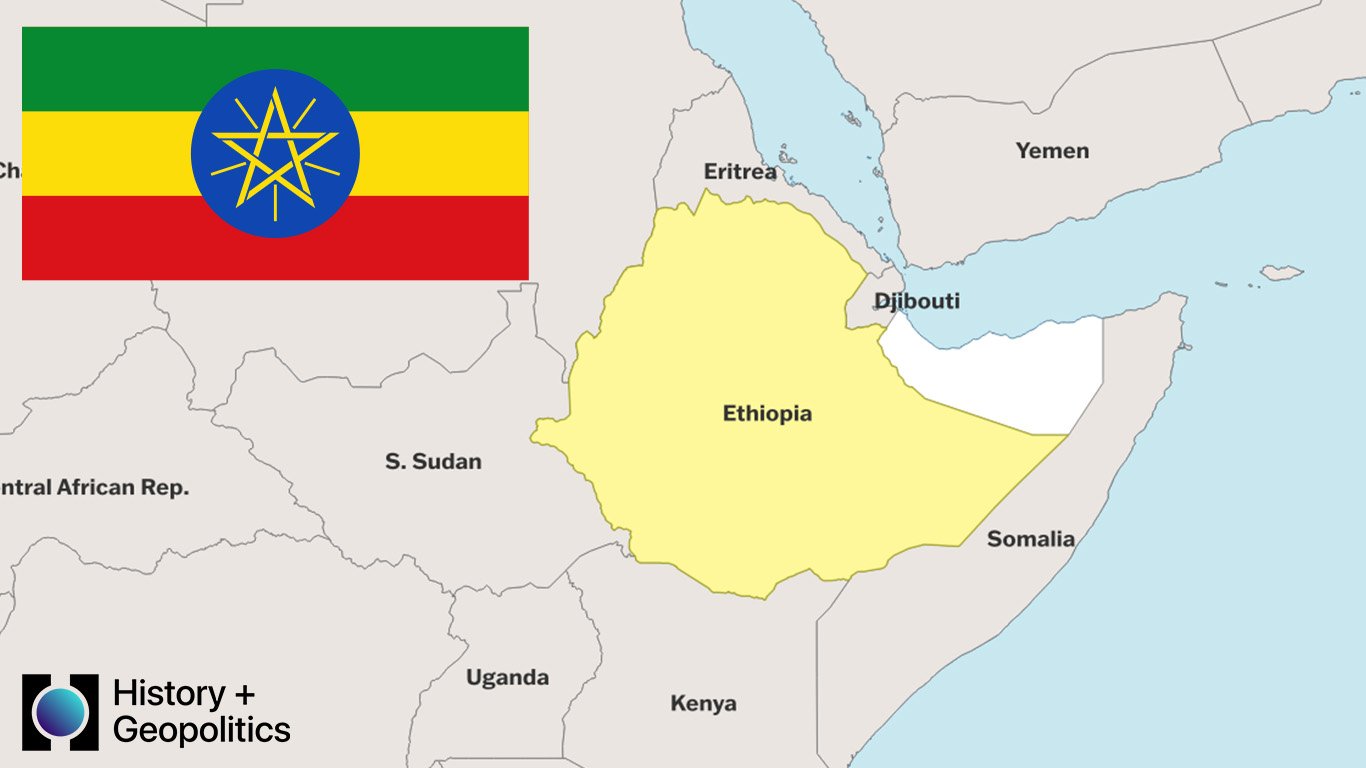
Ethiopia is located in the Horn of Africa, the second most populous country on the African continent. It is bordered by Eritrea to the north, Djibouti and Somalia to the east, Kenya to the south, South Sudan to the west, and Sudan to the northwest. Ethiopia is one of the few African countries with no coastline, though it borders the Red Sea region through Eritrea.
Ethiopia Facts
- OFFICIAL NAME: Federal Democratic Republic of Ethiopia
- CAPITAL: Addis Ababa
- POPULATION: 138,902,185 (2026)
- AREA: 1,104,300 square kilometers
- OFFICIAL LANGUAGE: Amharic
- CURRENCY: Ethiopian Birr (ETB)
Ethiopia Flag
The flag of Ethiopia has three equal horizontal stripes — green on top, yellow in the middle, and red on the bottom — with a blue circle in the center containing a yellow star with rays radiating outward. The green represents the fertile land and hope, the yellow represents justice and harmony, and the red represents the sacrifice and heroism of those who defended the country. The blue circle represents peace, and the gold star with its rays represents the diversity and unity of the Ethiopian people coming together for a common purpose. Ethiopia’s flag colors — green, yellow, and red — inspired the Pan-African color scheme adopted by many African nations upon their independence.
Ethiopia Geography
- Located in the Horn of Africa, one of the largest countries on the continent.
- Borders: Eritrea to the north, Djibouti and Somalia to the east, Kenya to the south, South Sudan to the west, Sudan to the northwest.
- Ethiopia is completely landlocked, having lost its coastline when Eritrea gained independence in 1993.
- The Ethiopian Highlands, one of the most extensive mountain systems in Africa, dominate the central and northern regions.
- Ras Dashen, the highest peak in Ethiopia and the fourth highest in Africa, rises to 4,550 meters in the Simien Mountains.
- The Great Rift Valley cuts through the country from northeast to southwest, creating a dramatic landscape of lakes, volcanoes, and escarpments.
- The Danakil Depression in the northeast is one of the hottest, driest, and lowest places on Earth.
- The Blue Nile originates from Lake Tana in the Ethiopian Highlands and is the primary source of the Nile’s annual flood waters.
- The western lowlands and southern regions contain tropical forests and savanna.
- Ethiopia has a varied climate, from hot and arid in the lowlands to temperate and cool in the highlands.
Ethiopia Government
- Ethiopia is a federal democratic republic divided into regional states largely organized along ethnic and linguistic lines.
- The President serves as a largely ceremonial head of state.
- The Prime Minister holds executive authority and serves as head of government.
- Abiy Ahmed has served as Prime Minister since 2018 and was awarded the Nobel Peace Prize in 2019 for his efforts to resolve the long-standing conflict with Eritrea.
- Ethiopia has a bicameral parliament consisting of the House of People’s Representatives and the House of the Federation.
- The country experienced a devastating civil war in the Tigray region from 2020 to 2022, which caused significant humanitarian suffering.
History of Ethiopia
- Ethiopia has one of the oldest histories of any country in the world, with evidence of early hominid ancestors, including Lucy, discovered in the Afar region dating back over 3 million years.
- The ancient Kingdom of Aksum, centered in northern Ethiopia, was one of the most powerful empires of the ancient world and among the first nations to adopt Christianity in the 4th century A.D.
- The Aksumite Empire controlled important Red Sea trade routes and maintained contact with the Roman Empire, Persia, and India.
- Ethiopia maintained its independence through much of the medieval period under successive dynasties tracing their lineage to King Solomon and the Queen of Sheba.
- Emperor Tewodros II began the modernization of Ethiopia in the 19th century, unifying the country after a period of fragmentation.
- Emperor Menelik II decisively defeated the Italian army at the Battle of Adwa in 1896, making Ethiopia one of the only African countries to successfully repel European colonial conquest.
- Italy invaded and occupied Ethiopia from 1936 to 1941 under Mussolini before being expelled with British assistance.
- Emperor Haile Selassie ruled Ethiopia from 1930 until he was overthrown by a military coup in 1974.
- The Derg, a communist military junta, ruled Ethiopia from 1974 to 1991, overseeing a period of famine, civil war, and political repression.
- The Ethiopian People’s Revolutionary Democratic Front overthrew the Derg in 1991 and established the current federal system.
- Ethiopia and Eritrea fought a devastating border war from 1998 to 2000, with a peace agreement finally signed in 2018 under Prime Minister Abiy Ahmed.
People and Culture of Ethiopia
- Ethiopia is one of the most ethnically diverse countries in the world, with over 80 recognized ethnic groups.
- The Oromo are the largest ethnic group, making up approximately 35% of the population, followed by the Amhara at around 24%.
- The Tigray, Somali, Sidama, and Gurage are among the other significant ethnic communities.
- Amharic is the official language, while Oromo, Tigrinya, Somali, and dozens of other languages are widely spoken.
- Ethiopian Orthodox Christianity, one of the world’s oldest Christian denominations, is practiced by approximately 44% of the population, while Islam is practiced by about 34%.
- Injera, a sourdough flatbread made from teff, is the cornerstone of Ethiopian cuisine, served with various stews of lentils, vegetables, and meat known as wot.
- Ethiopian coffee, widely considered the birthplace of coffee as a beverage, is central to daily social life and the country’s most famous export.
- The Ethiopian calendar, which has 13 months and runs approximately seven to eight years behind the Gregorian calendar, is still widely used in the country.
Economy of Ethiopia
- Ethiopia has one of the fastest-growing economies in Africa, driven by agriculture, manufacturing, and infrastructure investment.
- Agriculture is the backbone of the economy, employing the majority of the workforce and contributing significantly to GDP.
- Coffee is the most important export crop, with Ethiopia being one of the world’s leading coffee producers and the largest in Africa.
- The manufacturing sector has grown rapidly, with industrial parks attracting garment and textile investment from Asia and elsewhere.
- The Grand Ethiopian Renaissance Dam on the Blue Nile, the largest hydroelectric dam in Africa, represents a major infrastructure investment aimed at transforming the country’s energy capacity.
- Ethiopia faces significant challenges including poverty, food insecurity, ethnic tensions, and the economic impact of recent civil conflict.
Ethiopia Resources
- Ethiopia has significant hydropower potential, with the Blue Nile and other rivers providing enormous capacity for electricity generation.
- The country has deposits of gold, tantalum, potash, and natural gas, though many remain underdeveloped.
- Fertile highland soils support large-scale production of coffee, teff, barley, and various vegetables.
- The Great Rift Valley lakes provide freshwater fishery resources and geothermal energy potential.
- Ethiopia’s diverse landscapes and ancient cultural heritage represent significant potential resources for tourism.
Ethiopia Wildlife
- Ethiopia’s diverse ecosystems, from the Simien Mountains to the Rift Valley and tropical lowlands, support extraordinary biodiversity.
- The Ethiopian wolf, the most endangered canid in the world and Africa’s most threatened carnivore, is found only in the Ethiopian Highlands.
- The gelada baboon, a unique grass-eating primate, inhabits the dramatic cliffs of the Simien Mountains and is found nowhere else on Earth.
- The mountain nyala, a large antelope endemic to Ethiopia, roams the forests of the Bale Mountains.
- The Bale Mountains and Simien Mountains national parks are the most important protected areas, sheltering numerous endemic species.
- The Great Rift Valley lakes support vast flocks of flamingos and pelicans, making them some of the most spectacular bird habitats in Africa.
- Ethiopia is considered a biodiversity hotspot, with numerous endemic plant and animal species found nowhere else in the world.