Jamaica Country Profile
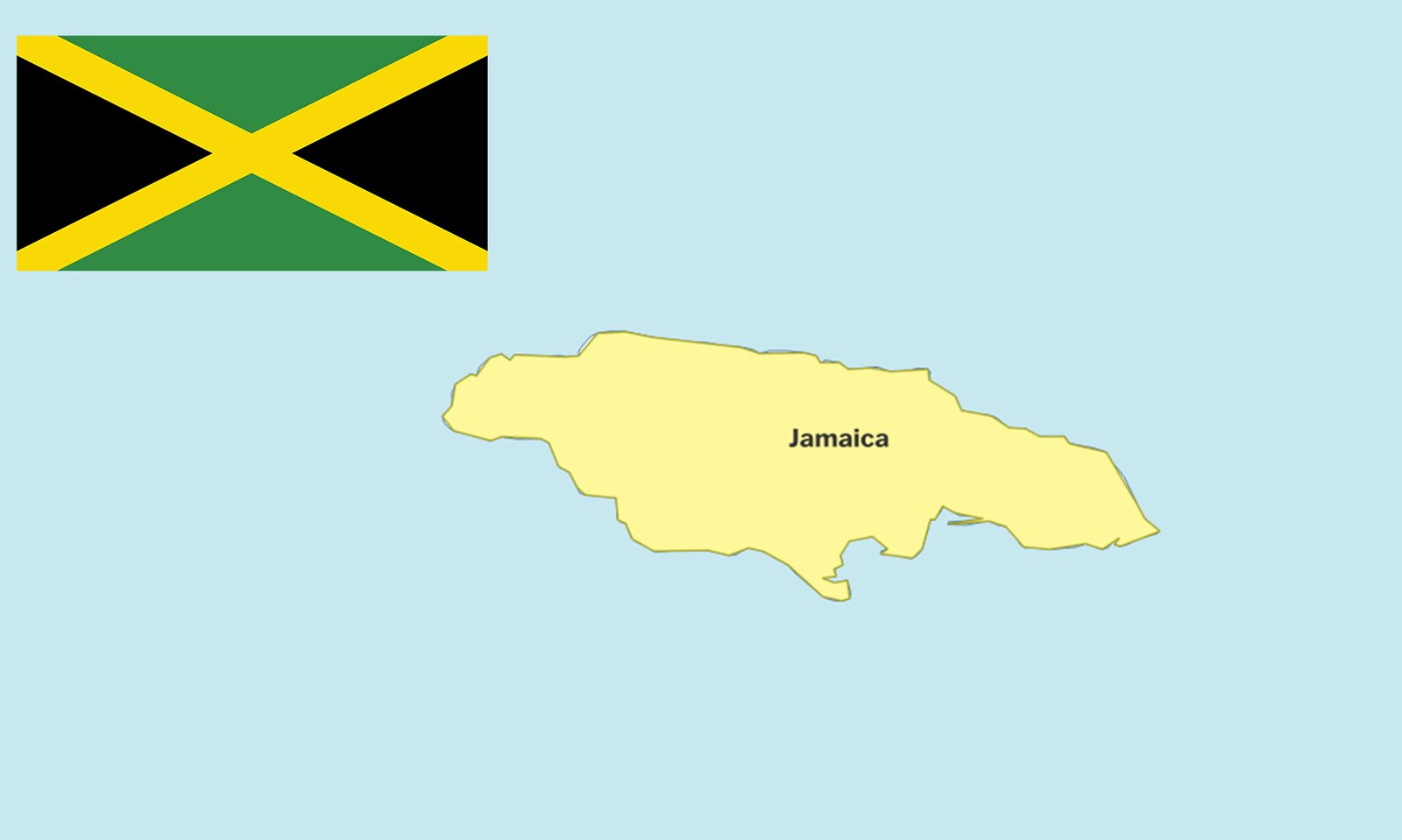
Jamaica is located in the Caribbean Sea, the third largest island in the Greater Antilles. It lies south of Cuba, west of Haiti, and north of Colombia, surrounded entirely by the Caribbean Sea.
Jamaica Facts
- OFFICIAL NAME: Jamaica
- CAPITAL: Kingston
- POPULATION: 2,833,403 (2026)
- AREA: 10,990 square kilometers
- OFFICIAL LANGUAGE: English
- CURRENCY: Jamaican Dollar (JMD)
Jamaica Flag
The flag of Jamaica has a diagonal gold cross dividing it into four triangles — black on the left and right, and green on the top and bottom. The black represents the strength and creativity of the Jamaican people and the hardships they have overcome. The gold represents the natural wealth and beauty of the sunlight. The green represents the lush vegetation and hope for the future. The flag was adopted upon Jamaica’s independence from Britain in 1962 and is the only national flag in the world that contains neither red, white, nor blue.
Jamaica Geography
- Located in the Caribbean Sea, the third largest island in the Greater Antilles.
- Lies south of Cuba, west of Haiti, and north of Colombia.
- Surrounded entirely by the Caribbean Sea with no land borders.
- The terrain is mostly mountainous in the interior, with narrow coastal plains and river valleys.
- The Blue Mountains in the eastern part of the island contain the highest peak, Blue Mountain Peak, rising to 2,256 meters.
- The Blue Mountains are one of the most prominent mountain ranges in the Caribbean.
- Jamaica has a tropical climate, warm and humid throughout the year, with a wet season and a drier winter period.
- The island lies within the Atlantic hurricane belt and is periodically affected by tropical storms.
- Numerous rivers flow from the central mountains to the coast, the most important being the Black River in the south.
- Jamaica’s coastline features white sand beaches, coral reefs, and dramatic limestone cliffs.
Jamaica Government
- Jamaica is a parliamentary democracy and a Commonwealth realm.
- The British monarch serves as head of state, represented locally by a Governor-General.
- The Prime Minister serves as head of government.
- Jamaica has a bicameral parliament consisting of the Senate and the House of Representatives.
- Andrew Holness has served as Prime Minister since 2016.
- Jamaica gained independence from the United Kingdom on August 6, 1962.
- There is growing public debate about Jamaica becoming a republic and removing the British monarch as head of state.
History of Jamaica
- The island was originally inhabited by the Taíno people, who called it Xaymaca, meaning “Land of Wood and Water.”
- Christopher Columbus arrived in Jamaica in 1494 during his second voyage to the Americas.
- Spain colonized the island in 1509, and the Taíno population was virtually eliminated within decades through disease, forced labor, and violence.
- The Spanish introduced African enslaved people to work on sugar plantations.
- Britain captured Jamaica from Spain in 1655 and developed it into one of the most profitable sugar colonies in the Caribbean.
- Jamaica became a major center of the transatlantic slave trade and sugar production, generating enormous wealth for Britain.
- Slave rebellions were frequent, with figures such as Nanny of the Maroons becoming iconic symbols of resistance.
- Britain abolished slavery in 1834, and indentured laborers from India and China were subsequently brought to work on the plantations.
- Jamaica gained independence from the United Kingdom on August 6, 1962, becoming the first Caribbean country in the British West Indies to do so.
- Since independence, Jamaica has faced economic challenges and high crime rates while developing a globally influential cultural identity.
People and Culture of Jamaica
- The majority of Jamaica’s population is of African descent, reflecting the legacy of the plantation era and the transatlantic slave trade.
- English is the official language, while Jamaican Patois, a creole language blending English with African linguistic influences, is widely spoken in everyday life.
- Protestant Christianity, particularly Baptist, Pentecostal, and Seventh-day Adventist denominations, is the dominant religion.
- Ackee and saltfish, made from the ackee fruit cooked with salted codfish, onions, and spices, is the national dish of Jamaica and a beloved breakfast staple.
- Jerk chicken, marinated in a blend of hot scotch bonnet peppers and spices before being grilled over pimento wood, is Jamaica’s most internationally recognized food.
- Reggae music, developed in Jamaica in the late 1960s, and its most famous ambassador Bob Marley, have had a profound and lasting influence on global music culture.
- Jamaica holds the world record for producing the most Olympic sprint champions per capita, with athletes like Usain Bolt cementing the island’s reputation as the fastest nation on Earth.
Economy of Jamaica
- Jamaica has a developing economy with tourism, remittances, and bauxite mining as the main pillars.
- Tourism is the largest formal sector, with millions of visitors annually attracted to the island’s beaches, resorts, and cultural experiences.
- Remittances from the large Jamaican diaspora, particularly in the United States, United Kingdom, and Canada, are a critical source of national income.
- Bauxite and alumina production has historically been an important export sector, though production has declined in recent decades.
- Jamaica faces persistent economic challenges including high public debt, crime, and significant emigration of skilled workers.
- The government has been working to improve the business environment and attract foreign investment in manufacturing and services.
Jamaica Resources
- Jamaica has significant bauxite deposits, from which alumina is processed and exported, making the country one of the world’s notable bauxite producers.
- Fertile agricultural land supports production of sugar cane, coffee, bananas, and citrus fruits.
- The Blue Mountains produce one of the world’s most prized and expensive coffees, Blue Mountain Coffee, exported primarily to Japan.
- The surrounding Caribbean waters provide fishing resources, including lobster and various reef fish.
- Jamaica’s beaches, coral reefs, mountains, and cultural heritage are among its most economically valuable resources for tourism.
Jamaica Wildlife
- Jamaica’s diverse ecosystems, from the Blue Mountains to coastal mangroves and coral reefs, support a range of endemic and native wildlife.
- The doctor bird, also known as the red-billed streamertail hummingbird, is the national bird and is found only in Jamaica, known for its distinctive long tail feathers.
- The Jamaican iguana, one of the rarest lizards in the world, was once thought extinct before being rediscovered in the Hellshire Hills in 1990.
- The American crocodile inhabits the southern coastal wetlands, particularly around the Black River Great Morass.
- Jamaica’s coral reefs support diverse marine life, including sea turtles, reef fish, and various shark species.
- Deforestation, invasive species, and coastal development pose the most significant threats to Jamaica’s native wildlife.
- Conservation efforts focus on protecting the Jamaican iguana, the doctor bird, and the island’s remaining forest habitats in the Blue and John Crow Mountains National Park, a UNESCO World Heritage Site.