Kiribati Country Profile
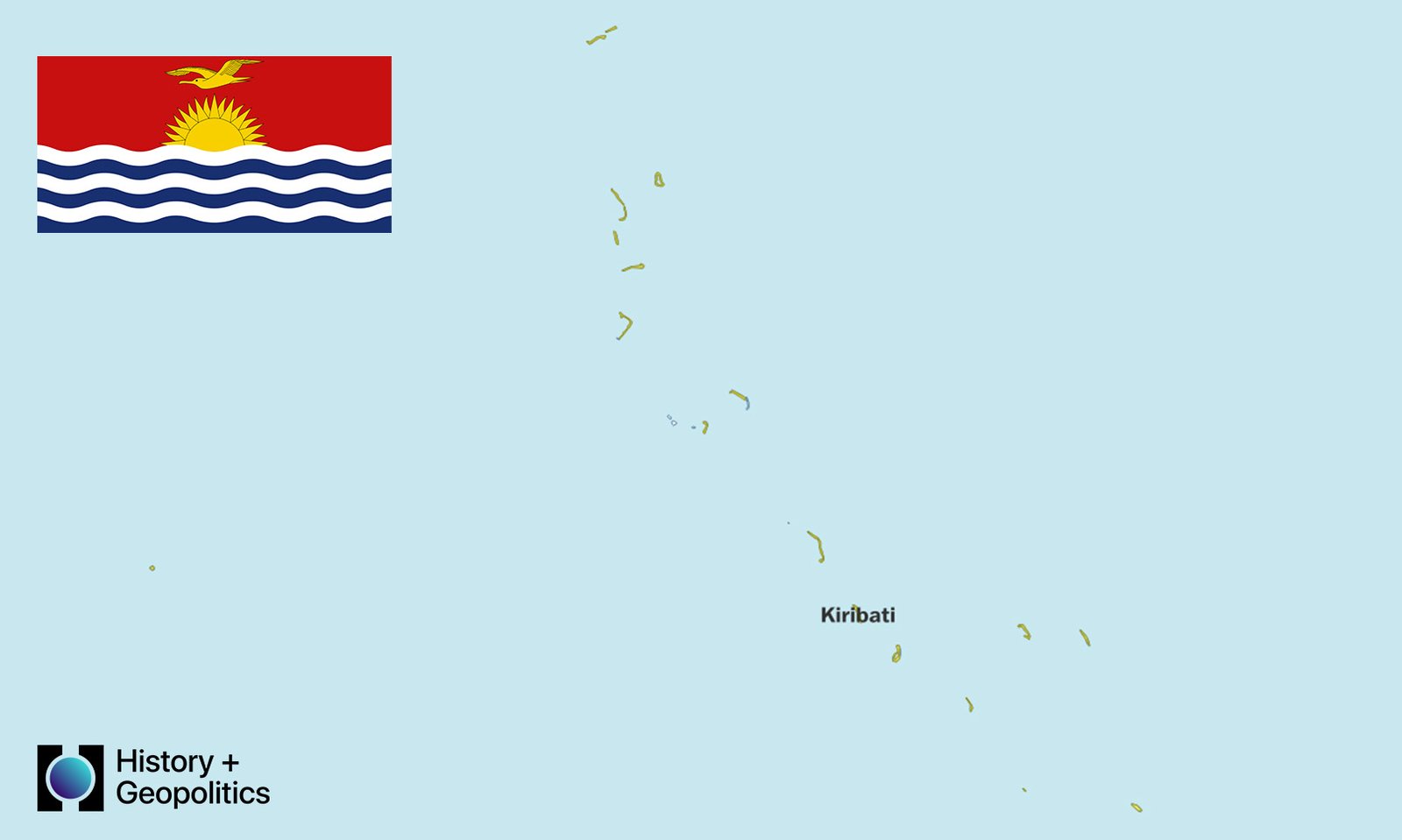
Kiribati is located in the central Pacific Ocean, one of the most remote and geographically dispersed nations on Earth. It consists of 33 atolls and reef islands scattered across an enormous expanse of ocean, straddling both the equator and the International Date Line. It has no land borders, surrounded entirely by the Pacific Ocean.
Kiribati Facts
- OFFICIAL NAME: Republic of Kiribati
- CAPITAL: South Tarawa
- POPULATION: 138,445 (2026)
- AREA: 811 square kilometers
- OFFICIAL LANGUAGES: English, Gilbertese (I-Kiribati)
- CURRENCY: Australian Dollar (AUD)
Kiribati Flag
The flag of Kiribati has a red upper half and a blue lower half with three horizontal white wavy stripes representing the Pacific Ocean, and a golden rising sun with 17 rays in the upper section above a golden frigate bird in flight. The red represents the land and the warmth of the sun, the blue and white wavy stripes represent the Pacific Ocean surrounding the islands. The rising sun symbolizes Kiribati’s position straddling the equator and the International Date Line. The frigate bird, a powerful seabird that soars over the Pacific, represents command of the sea and freedom. The 17 rays of the sun represent the 16 Gilbert Islands and Banaba Island.
Kiribati Geography
- Located in the central Pacific Ocean, one of the world’s most geographically dispersed countries.
- Consists of 33 atolls and reef islands spread across approximately 3.5 million square kilometers of ocean.
- Straddles both the equator and the International Date Line, meaning Kiribati spans all four hemispheres.
- The islands are divided into three main groups — the Gilbert Islands in the west, the Phoenix Islands in the center, and the Line Islands in the east.
- The country has no land borders, surrounded entirely by the Pacific Ocean.
- The terrain is entirely low-lying, with most land rising only 1 to 2 meters above sea level.
- Christmas Island, also known as Kiritimati, in the Line Islands group, is the world’s largest atoll by land area.
- The climate is tropical, hot and humid throughout the year, with limited rainfall on many of the islands.
- Kiribati is one of the countries most severely threatened by rising sea levels due to climate change, with the risk of entire islands becoming uninhabitable or submerged within decades.
Kiribati Government
- Kiribati is a presidential republic.
- The President, known as the Beretitenti, serves as both head of state and head of government.
- Taneti Maamau has served as President since 2016 and was re-elected in 2020.
- Kiribati has a unicameral legislature called the Maneaba ni Maungatabu, or House of Assembly.
- Kiribati gained independence from the United Kingdom on July 12, 1979.
- Kiribati made international headlines in 2022 when it severed diplomatic ties with Taiwan and established relations with China.
History of Kiribati
- The Gilbert Islands have been inhabited by Micronesian peoples for over 3,000 years.
- Polynesian and Fijian influences arrived in later centuries, creating the distinct I-Kiribati culture.
- European explorers began encountering the islands in the late 16th century, with British explorer Thomas Gilbert giving his name to the Gilbert Islands in 1788.
- Britain established the Gilbert and Ellice Islands Colony in 1916.
- Japan occupied the Gilbert Islands during World War II, and the Battle of Tarawa in November 1943 was one of the bloodiest battles in the Pacific campaign, with US forces suffering heavy casualties to retake the atoll.
- The Ellice Islands separated from the colony and became the independent nation of Tuvalu in 1978.
- The Gilbert Islands gained independence as the Republic of Kiribati on July 12, 1979.
- Kiribati purchased land on Fiji in 2014 as a potential relocation site for its population in the event that rising seas make the islands uninhabitable.
People and Culture of Kiribati
- The I-Kiribati people are of Micronesian descent with some Polynesian and Fijian influences.
- Gilbertese, also known as I-Kiribati, is the native language and is spoken by the entire population, with English serving as the second official language.
- Roman Catholicism and the Kiribati Protestant Church are the two main religious denominations, both introduced by missionaries in the 19th century.
- Te bua and babai, a giant taro root crop, are traditional staple foods, alongside fish which forms the cornerstone of the I-Kiribati diet.
- Traditional I-Kiribati culture places great importance on the maneaba, a community meeting house where social, political, and ceremonial life takes place.
- Traditional dance, particularly the graceful te kaimatoa and the more energetic te bino, are central to cultural celebrations and ceremonies.
- The frigate bird holds deep cultural significance as a symbol of the sea and freedom, reflected in the national flag.
Economy of Kiribati
- Kiribati has one of the smallest and most underdeveloped economies in the world, constrained by its remote location, lack of resources, and vulnerability to climate change.
- Fishing license revenues, earned by granting foreign fishing fleets access to Kiribati’s vast exclusive economic zone in the Pacific, are the most important source of government revenue.
- The Revenue Equalization Reserve Fund, established from phosphate revenues before Banaba’s deposits were exhausted, provides a sovereign wealth fund that supports government finances.
- Remittances from I-Kiribati working abroad, particularly as seafarers, are a critical source of household income.
- Copra, dried coconut meat, is the most important agricultural product and a traditional export.
- Foreign aid from Australia, New Zealand, and other development partners is essential for funding public services and infrastructure.
Kiribati Resources
- Kiribati’s most significant resource is its vast exclusive economic zone in the Pacific, rich in tuna and other marine species that generate fishing license revenues.
- The Phoenix Islands Protected Area, one of the world’s largest marine protected areas, represents an important conservation resource.
- Copra from coconut palms is the primary agricultural resource on most islands.
- The phosphate deposits of Banaba Island were extensively mined by Britain and exhausted by the 1970s, leaving significant environmental damage.
- Seabed mineral resources, including potential manganese nodule deposits, may represent a future resource in Kiribati’s vast ocean territory.
Kiribati Wildlife
- Kiribati’s remote atolls and surrounding ocean support distinctive wildlife shaped by island isolation in the vast Pacific.
- The Phoenix Islands Protected Area is one of the most pristine coral reef ecosystems remaining on Earth, supporting extraordinary marine biodiversity including sharks, manta rays, and hundreds of fish species.
- The Christmas Island frigatebird and other seabirds nest in enormous colonies on the uninhabited islands and atolls.
- Green sea turtles and hawksbill turtles nest on the beaches of several of Kiribati’s islands.
- The Bokikokiko, a reed warbler found only on Christmas Island, is one of Kiribati’s notable endemic bird species.
- Rising sea levels and ocean warming pose the most critical threats to Kiribati’s coral reef ecosystems and the wildlife that depends on them.
- Climate change represents an existential threat not just to Kiribati’s wildlife but to the islands themselves, making Kiribati one of the most vulnerable nations on Earth to the impacts of global warming.