Kuwait Country Profile
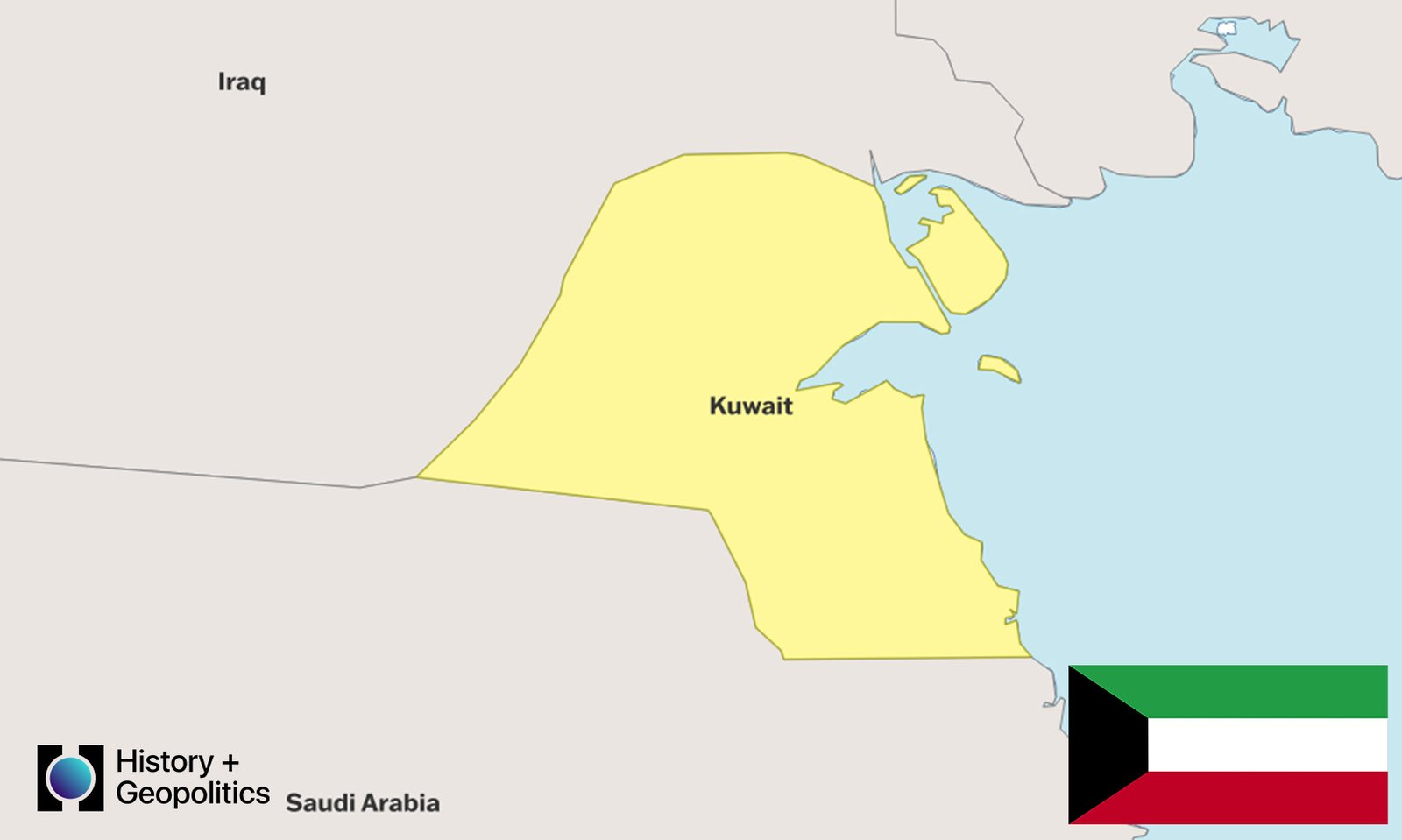
Kuwait is located in the Middle East, a small country in the northwestern corner of the Persian Gulf. It is bordered by Iraq to the north and northwest and Saudi Arabia to the south and southwest, with the Persian Gulf forming its entire eastern coastline.
Kuwait Facts
- OFFICIAL NAME: State of Kuwait
- CAPITAL: Kuwait City
- POPULATION: 5,102,773 (2026)
- AREA: 17,818 square kilometers
- OFFICIAL LANGUAGE: Arabic
- CURRENCY: Kuwaiti Dinar (KWD)
Kuwait Flag
The flag of Kuwait has three equal horizontal stripes — green on top, white in the middle, and red on the bottom — with a black trapezoid on the hoist side. The green represents the fertile land and the prosperity of Kuwait, the white symbolizes peace and purity, the red represents the blood on Kuwaiti swords, and the black represents the defeat of enemies in battle. The trapezoid design on the hoist side is unique among national flags and gives Kuwait’s flag a distinctive appearance. The flag was adopted in 1961 upon Kuwait’s independence from Britain and incorporates the Pan-Arab colors of green, white, red, and black.
Kuwait Geography
- Located in the Middle East, in the northwestern corner of the Persian Gulf.
- Borders: Iraq to the north and northwest, Saudi Arabia to the south and southwest.
- The Persian Gulf forms the entire eastern coastline.
- Kuwait is one of the smallest countries in the world by land area.
- The terrain is almost entirely flat desert, with low-lying sandy plains covering most of the country.
- The highest point in Kuwait rises to only about 306 meters above sea level.
- Kuwait has an extremely arid desert climate, with summers among the hottest on Earth, regularly exceeding 45 degrees Celsius.
- Winters are mild and occasionally wet, providing most of the country’s limited annual rainfall.
- Kuwait Bay, a large natural bay, indents the northeastern coastline and is the site of Kuwait City and the country’s main port facilities.
- Kuwait has no permanent rivers or lakes and relies entirely on desalination for its fresh water supply.
Kuwait Government
- Kuwait is a constitutional monarchy.
- The Emir serves as the head of state and holds significant executive authority.
- Sheikh Mishal Al-Ahmad Al-Sabah has served as Emir since December 2023.
- The Prime Minister heads the government and is appointed by the Emir.
- Kuwait has a unicameral National Assembly, the oldest elected parliament in the Gulf region.
- Kuwait dissolved its parliament in 2024 and the Emir suspended certain constitutional provisions, creating significant political uncertainty.
- Kuwait gained independence from Britain on June 19, 1961.
History of Kuwait
- The region has been inhabited since ancient times, with evidence of settlement dating back to the Ubaid period around 4000 B.C.
- The modern city of Kuwait was founded around 1613 as a fishing and trading port.
- The Al-Sabah family established control over the settlement in the mid-18th century and has ruled Kuwait ever since.
- Kuwait became a British protectorate in 1899, with Britain managing its foreign affairs and defense.
- Oil was discovered in Kuwait in 1938, transforming the country from a modest pearling and trading economy into one of the wealthiest nations in the world.
- Kuwait gained full independence from Britain on June 19, 1961.
- Iraq invaded and occupied Kuwait on August 2, 1990, leading to the Gulf War of 1991 in which a US-led international coalition liberated the country.
- Iraqi forces set fire to over 700 Kuwaiti oil wells as they retreated, causing one of the worst environmental disasters in history.
- Kuwait recovered rapidly after the war and resumed its position as a major oil exporter.
People and Culture of Kuwait
- Kuwaiti nationals make up approximately 30% of the total population, with expatriates from South Asia, other Arab countries, and various other nationalities forming the majority.
- Arabic is the official language, widely spoken by Kuwaitis, while English is extensively used in business and government.
- Islam is the state religion, practiced by approximately 75% of the population, with both Sunni and Shia communities represented.
- Machboos, a spiced rice dish cooked with meat or fish, is the national dish of Kuwait and a centerpiece of Kuwaiti hospitality.
- Murabyan, a prawn and rice dish, is another beloved Kuwaiti specialty reflecting the country’s historic connection to the sea.
- Diwaniya, a gathering of men in a dedicated reception room for socializing and discussion, is a distinctive and important Kuwaiti social tradition.
- Kuwait has a rich heritage as a pearling and maritime trading center that predates its oil wealth by centuries.
Economy of Kuwait
- Kuwait has one of the wealthiest economies in the world per capita, driven almost entirely by oil production.
- The country holds approximately 6% of the world’s proven oil reserves, among the largest in the world.
- Oil revenues fund extensive government subsidies for citizens, including free healthcare, education, and heavily subsidized utilities and fuel.
- Kuwait does not impose income tax on individuals, making it one of the most tax-free economies in the world.
- The Kuwait Investment Authority, one of the world’s oldest and largest sovereign wealth funds, manages the country’s substantial oil revenues for future generations.
- Kuwait has been working to diversify its economy through the Kuwait Vision 2035 plan, developing sectors including finance, tourism, and logistics.
Kuwait Resources
- Kuwait’s most significant resource is its vast oil reserves, concentrated primarily in the Burgan oil field, one of the largest oil fields in the world.
- Natural gas reserves exist alongside oil, though they are less extensive than those of some neighboring Gulf states.
- The Persian Gulf coastline provides marine resources, though fishing and pearl diving industries have declined since the oil era.
- Kuwait has no agricultural land or fresh water resources, relying entirely on desalination plants for drinking water and food imports for nutrition.
- The sovereign wealth fund represents an important financial resource built from decades of oil revenue investment.
Kuwait Wildlife
- Kuwait’s desert environment supports a limited range of wildlife adapted to extreme heat and aridity.
- The Arabian oryx, once extinct in the wild across the region, has been reintroduced into protected areas in Kuwait.
- Desert foxes, sand cats, and various reptile species including desert monitors inhabit Kuwait’s arid terrain.
- The Persian Gulf coastline and Kuwait Bay support migratory and resident waterbirds, including flamingos and various wading birds.
- The Jahra Nature Reserve and other protected areas provide habitat for migratory birds passing through the region.
- Marine life in the Persian Gulf includes dugongs, dolphins, sea turtles, and diverse fish species, though the Gulf’s ecosystems face pressure from pollution and coastal development.
- Kuwait’s extreme heat and desert conditions, combined with rapid urbanization, have significantly limited the diversity of wildlife that can survive in the country.