Japan Country Profile
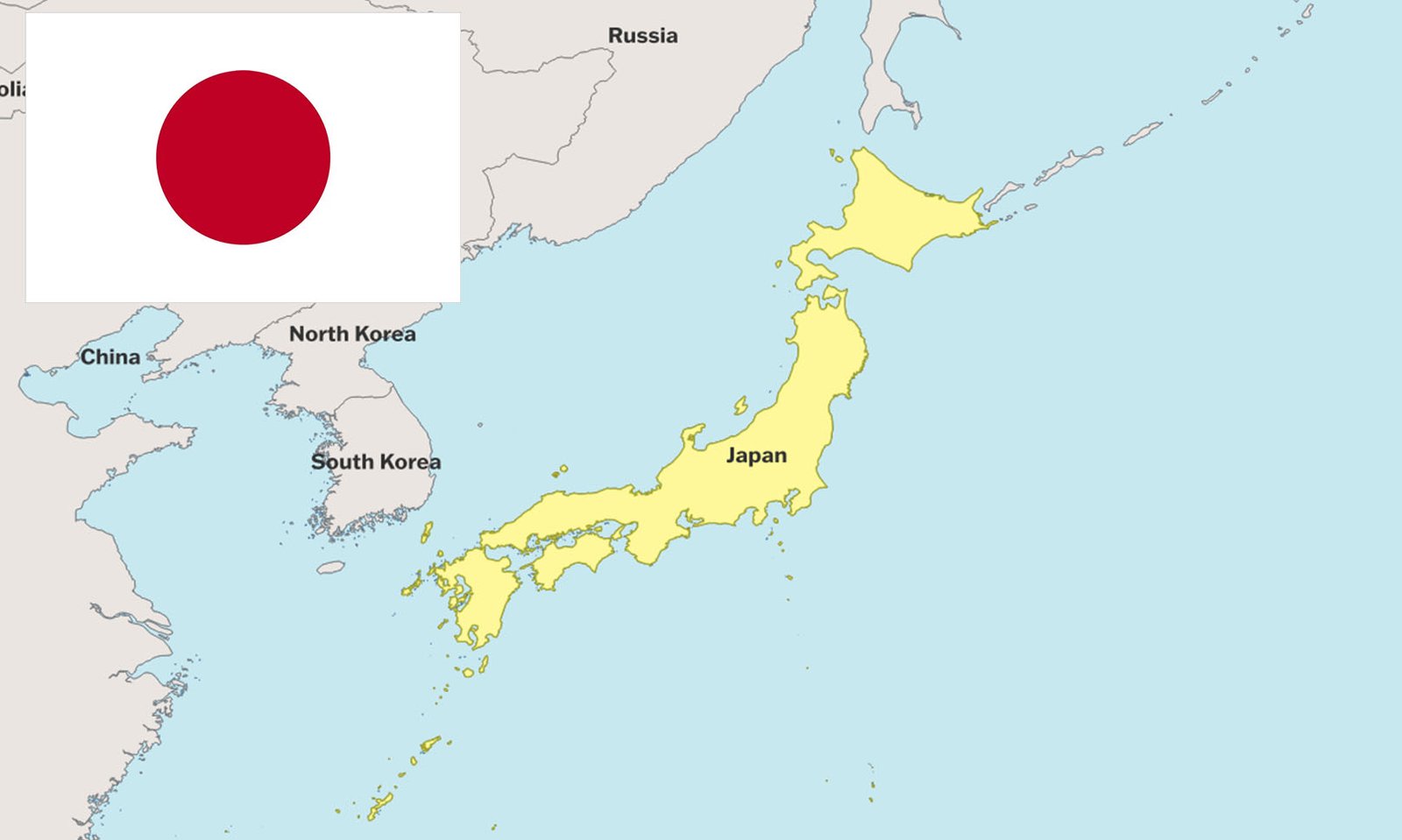
Japan is located in East Asia, an island nation in the Pacific Ocean. It consists of four main islands — Honshu, Hokkaido, Kyushu, and Shikoku — along with nearly 7,000 smaller islands. Japan faces China, Korea, and Russia across the Sea of Japan to the west, and the Pacific Ocean to the east.
Japan Facts
- OFFICIAL NAME: Japan
- CAPITAL: Tokyo
- POPULATION: 122,427,731 (2026)
- AREA: 377,975 square kilometers
- OFFICIAL LANGUAGE: Japanese
- CURRENCY: Japanese Yen (JPY)
Japan Flag
The flag of Japan, known as the Nisshōki or more commonly the Hinomaru, meaning “circle of the sun,” has a white background with a single red circle centered slightly toward the hoist side. The white represents honesty, purity, and integrity. The red circle represents the sun, reflecting Japan’s identity as the “Land of the Rising Sun.” The sun has been a powerful symbol in Japanese culture and mythology for thousands of years, associated with the sun goddess Amaterasu, from whom the imperial family is said to descend. The flag’s simple and striking design has been used in various forms for centuries and was officially adopted as the national flag in 1999.
Japan Geography
- Located in East Asia, an archipelago in the Pacific Ocean consisting of four main islands and nearly 7,000 smaller islands.
- Faces China, Korea, and Russia across the Sea of Japan to the west, and the vast Pacific Ocean to the east.
- Japan has no land borders, surrounded entirely by water.
- The four main islands from north to south are Hokkaido, Honshu, Shikoku, and Kyushu.
- The terrain is predominantly mountainous, with approximately 73% of the land covered by mountains and hills.
- Mount Fuji, an iconic stratovolcano on Honshu, is the highest peak in Japan, rising to 3,776 meters and is recognized as a UNESCO World Heritage Site.
- Japan sits on the Pacific Ring of Fire, making it one of the most seismically and volcanically active countries in the world.
- The country experiences thousands of earthquakes annually, including some of the most devastating in modern history such as the 2011 Tōhoku earthquake and tsunami.
- Japan has a varied climate, from subarctic in Hokkaido to subtropical in the Ryukyu Islands in the far south.
- Fertile plains are concentrated along the coasts and river valleys, with the Kanto Plain around Tokyo being the largest.
Japan Government
- Japan is a constitutional monarchy with a parliamentary system of government.
- The Emperor serves as the ceremonial head of state and symbol of the nation and its people.
- The Prime Minister serves as head of government, holding executive authority.
- Japan has a bicameral National Diet consisting of the House of Representatives and the House of Councillors.
- Sanae Takaichi has served as Prime Minister since November 2024, becoming Japan’s first female Prime Minister.
- Japan is a member of the G7 and has one of the most influential economies in the world.
History of Japan
- Japan has been inhabited since the Paleolithic period, with the Jōmon culture representing one of the world’s oldest known pottery-making traditions.
- The Yayoi people arrived from the Korean Peninsula around 300 B.C., bringing rice cultivation and metalworking.
- The first unified Japanese state emerged under the Yamato clan in the 4th and 5th centuries A.D.
- Buddhism arrived from China via Korea in the 6th century A.D. and profoundly influenced Japanese culture, art, and architecture alongside the indigenous Shinto religion.
- The Heian period from 794 to 1185 is considered a golden age of Japanese culture and aristocratic refinement.
- The rise of the samurai class led to the establishment of feudal military governments called shogunates, beginning with the Kamakura Shogunate in 1185.
- Japan successfully repelled Mongol invasion attempts in 1274 and 1281, aided by powerful storms that became known as kamikaze or divine winds.
- Japan was largely closed to the outside world during the Edo period from 1603 to 1868 under the Tokugawa Shogunate.
- The arrival of US Commodore Matthew Perry with his Black Ships in 1853 forced Japan to open its ports and ended its isolation.
- The Meiji Restoration of 1868 overthrew the shogunate, restored imperial rule, and launched rapid modernization and industrialization.
- Japan became an imperial power, defeating China in 1895 and Russia in 1905, and annexing Korea in 1910.
- Japan expanded militarily across Asia and the Pacific in the 1930s and allied with Nazi Germany and Fascist Italy in World War II.
- The United States dropped atomic bombs on Hiroshima on August 6, 1945, and Nagasaki on August 9, 1945, killing hundreds of thousands of people.
- Japan surrendered on August 15, 1945, and was occupied by Allied forces led by the United States until 1952.
- Japan adopted a pacifist constitution in 1947, renouncing war and the maintenance of war potential.
- The postwar economic miracle transformed Japan from a devastated nation into the world’s second largest economy by the 1960s.
People and Culture of Japan
- Japanese people make up approximately 97.5% of the population, making Japan one of the most ethnically homogeneous developed nations in the world.
- The indigenous Ainu people of Hokkaido and the Ryukyuan people of Okinawa are recognized as distinct indigenous communities.
- Japanese is the official language, a language isolate unrelated to any other major language family, with a complex writing system using three scripts — hiragana, katakana, and kanji.
- Shinto and Buddhism are the two main religious traditions, both practiced by the majority of Japanese people in complementary ways for different life occasions.
- Sushi, vinegared rice with various toppings including raw fish, is Japan’s most internationally recognized food and has become a global culinary staple.
- Ramen, wheat noodles in various broths with toppings, is one of Japan’s most beloved everyday foods with distinct regional styles.
- Japan has one of the world’s oldest populations, with a median age of approximately 51 years, the highest of any major country, and faces a severe demographic crisis of declining birth rates and aging population.
Economy of Japan
- Japan has the fourth largest economy in the world and is a global leader in technology, automotive manufacturing, and electronics.
- Major Japanese companies including Toyota, Honda, Sony, Panasonic, and Nintendo are among the most recognized brands globally.
- The automotive industry is the most important manufacturing sector, with Japan being one of the world’s largest producers and exporters of vehicles.
- Japan is at the frontier of robotics, artificial intelligence, and advanced manufacturing technology.
- Japan’s aging population and low birth rate pose significant long-term economic challenges, with the working-age population declining rapidly.
- The country has the world’s highest public debt as a percentage of GDP, though it is largely held domestically.
Japan Resources
- Japan has very limited natural resources and imports the vast majority of its energy, raw materials, and food needs.
- The country has some deposits of coal, copper, and zinc, but these are insufficient for its industrial needs.
- Japan is a world leader in recycling and resource efficiency, driven by necessity given its resource scarcity.
- Fishery resources from the surrounding Pacific and Sea of Japan are significant, with Japan one of the world’s largest fishing nations.
- Japan’s mountainous terrain provides hydroelectric power generation potential, and the country has significant geothermal energy resources from its volcanic geology.
Japan Wildlife
- Japan’s varied geography, from subarctic Hokkaido to subtropical Okinawa, supports a rich and diverse range of wildlife.
- The Japanese macaque, also known as the snow monkey, is the world’s most northerly living non-human primate and is famous for its habit of bathing in hot springs in winter.
- The Amur leopard cat, Tsushima leopard cat, and Iriomote cat are rare wild cats found only on specific Japanese islands.
- The Okinawa rail, a flightless bird found only on Okinawa, is one of Japan’s most endangered endemic species.
- The Japanese crane, known in Japan as the tancho, is a symbol of longevity and good fortune and is found mainly in Hokkaido.
- The seas around Japan support diverse marine life, including the Japanese giant spider crab, the world’s largest arthropod.
- Japan has established national parks covering approximately 14% of its land area, though rapid urbanization and agricultural development have significantly reduced natural habitats for many native species.