Kazakhstan Country Profile
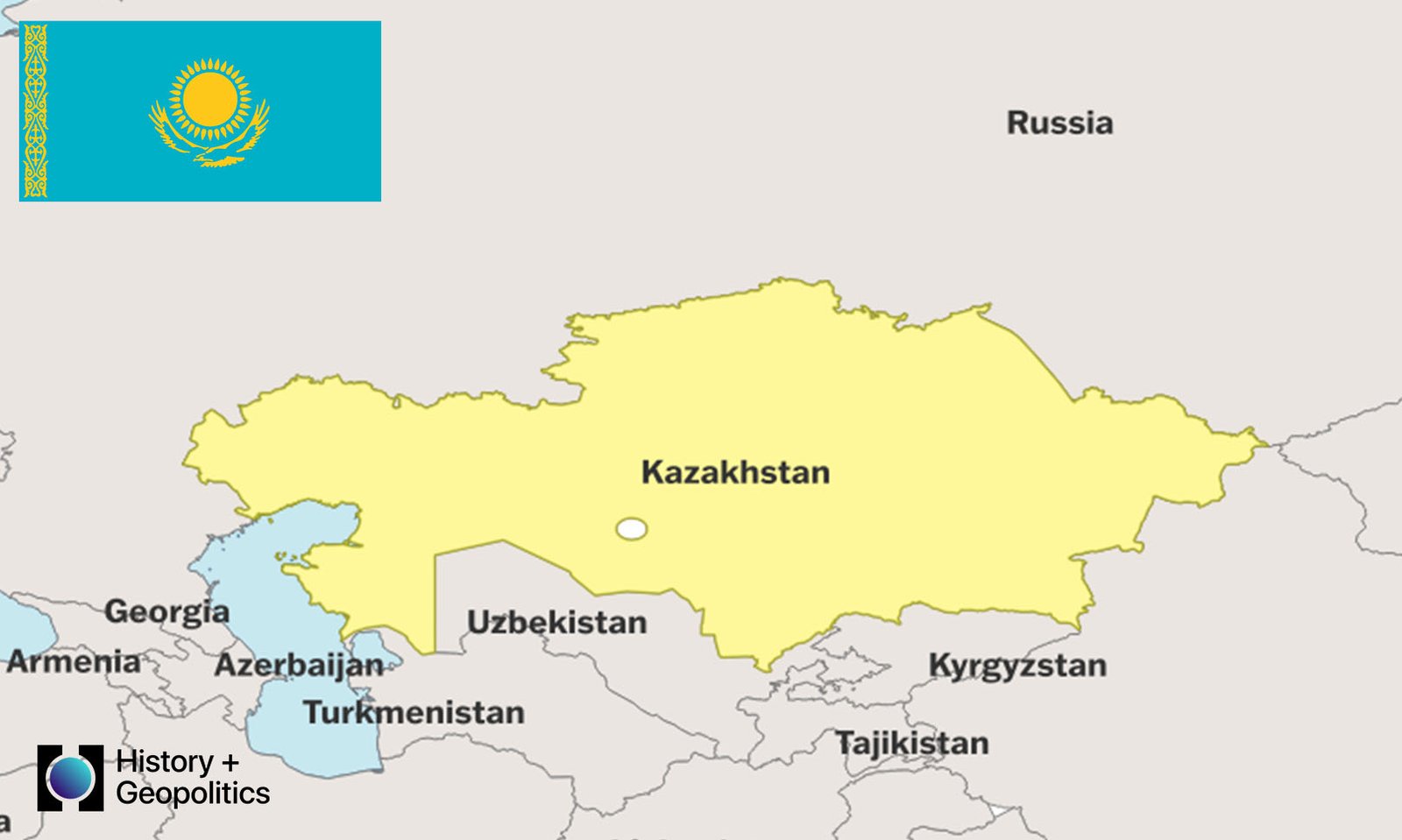
Kazakhstan is located in Central Asia, the world’s largest landlocked country. It is bordered by Russia to the north and northwest, China to the east, Kyrgyzstan and Uzbekistan to the south, Turkmenistan to the southwest, and the Caspian Sea to the west.
Kazakhstan Facts
- OFFICIAL NAME: Republic of Kazakhstan
- CAPITAL: Astana
- POPULATION: 21,083,626 (2026)
- AREA: 2,724,900 square kilometers
- OFFICIAL LANGUAGES: Kazakh, Russian
- CURRENCY: Kazakhstani Tenge (KZT)
Kazakhstan Flag
The flag of Kazakhstan has a light blue background with a yellow sun in the upper left and a yellow soaring eagle beneath it, and a vertical decorative pattern along the hoist side in yellow. The light blue represents the sky and water, and reflects the Turkic peoples’ traditional reverence for the sky. The golden sun with 32 rays represents abundance and prosperity. The steppe eagle, a symbol of freedom, independence, and the foresight of the Kazakh people, soars beneath the sun. The ornamental pattern along the left edge is a traditional Kazakh decorative motif called koshkar-muiz, meaning “ram’s horns,” representing the cultural heritage of the Kazakh people.
Kazakhstan Geography
- Located in Central Asia, the world’s largest landlocked country and the ninth largest country in the world by total area.
- Borders: Russia to the north and northwest, China to the east, Kyrgyzstan and Uzbekistan to the south, Turkmenistan to the southwest.
- The Caspian Sea, the world’s largest enclosed body of water, lies along the western border.
- The terrain is extraordinarily diverse, ranging from vast flat steppes in the north and center to deserts in the south and mountains in the east and southeast.
- The Tian Shan and Altai mountain ranges rise along the eastern and southeastern borders with China and Kyrgyzstan.
- Khan Tengri, on the border with Kyrgyzstan, is the highest peak at 6,995 meters.
- The Aral Sea, once one of the world’s largest lakes, has shrunk dramatically due to Soviet-era irrigation projects, representing one of the worst environmental disasters in history.
- Major rivers include the Irtysh, Ural, and Syr Darya.
- Kazakhstan has an extreme continental climate, with very cold winters and very hot summers across most of the country.
Kazakhstan Government
- Kazakhstan is a presidential republic.
- The President holds significant executive authority and is the dominant political figure.
- Kassym-Jomart Tokayev has served as President since 2019, succeeding Nursultan Nazarbayev who had ruled since independence.
- Kazakhstan has a bicameral Parliament consisting of the Senate and the Mazhilis.
- Kazakhstan experienced significant protests in January 2022, known as Bloody January, which were suppressed with assistance from Russian-led CSTO forces.
- Following the protests, Tokayev implemented political and economic reforms and moved to consolidate his own power independent of his predecessor.
History of Kazakhstan
- The steppes of Kazakhstan have been inhabited since the Stone Age, with the region a birthplace of horse domestication approximately 5,500 years ago.
- The Scythians and later the Huns and Turks were among the powerful nomadic peoples who dominated the Central Asian steppes.
- The Mongol Empire under Genghis Khan swept through the region in the 13th century, and the Kazakh Khanate emerged as a distinct political entity in the 15th century.
- The Kazakh people developed a rich nomadic culture on the vast steppes, organized into three great tribal confederations known as zhuz.
- Russia gradually extended its control over the Kazakh steppe throughout the 18th and 19th centuries.
- Kazakhstan became part of the Soviet Union in 1936 as the Kazakh Soviet Socialist Republic.
- The Soviet period brought rapid industrialization, forced collectivization, and a devastating famine in the early 1930s that killed an estimated 1.5 million Kazakhs.
- Soviet nuclear tests at the Semipalatinsk Polygon from 1949 to 1989 caused widespread environmental and health damage to the population.
- Kazakhstan declared independence from the Soviet Union on December 16, 1991.
- Under Nursultan Nazarbayev, who ruled until 2019, Kazakhstan developed rapidly using oil revenues while maintaining an authoritarian political system.
- The capital was moved from Almaty to Astana in 1997, with the new capital developed as a modern showcase city.
People and Culture of Kazakhstan
- Kazakhs make up approximately 70% of the population, with a significant Russian minority of around 15% concentrated in the north.
- Other communities include Uzbeks, Ukrainians, Uyghurs, and over 130 ethnic groups reflecting Kazakhstan’s position as a crossroads of civilizations.
- Kazakh is the official state language, while Russian retains official status and is widely used in business, government, and daily life.
- Islam is practiced by approximately 70% of the population, mainly among Kazakhs and other Turkic groups, while Russian Orthodox Christianity is practiced by much of the Russian minority.
- Beshbarmak, a dish of boiled meat served over flat noodles and topped with onion broth, is the national dish of Kazakhstan and is central to celebrations and hospitality.
- Traditional Kazakh culture is deeply rooted in nomadic heritage, with the yurt, eagle hunting, and horse riding central to cultural identity.
- Eagle hunting, the ancient practice of hunting with trained golden eagles, is a UNESCO-recognized intangible cultural heritage of Kazakhstan.
Economy of Kazakhstan
- Kazakhstan has the largest economy in Central Asia, driven primarily by oil and gas production.
- The country holds significant oil reserves, with major fields including Tengiz, Kashagan, and Karachaganak among the largest in the world.
- Kazakhstan is a major producer and exporter of oil, uranium, and various metals including copper, zinc, and chromite.
- The country is the world’s largest uranium producer, supplying a significant share of global nuclear fuel needs.
- Agriculture, particularly wheat production on the vast steppe lands, is an important sector.
- Kazakhstan has been working to diversify its economy beyond hydrocarbons through investment in manufacturing, technology, and financial services.
Kazakhstan Resources
- Kazakhstan has extraordinary mineral wealth, including some of the world’s largest reserves of oil, natural gas, uranium, chromite, copper, zinc, and lead.
- The country is the world’s largest producer of uranium, contributing approximately 40% of global supply.
- Vast agricultural land on the northern steppe supports grain production, particularly wheat.
- The Caspian Sea provides fishery resources, including the internationally prized Beluga sturgeon and caviar, though stocks have declined dramatically.
- Kazakhstan’s rivers and mountains offer hydropower potential, particularly in the southeast near the Tian Shan range.
Kazakhstan Wildlife
- Kazakhstan’s vast and varied landscapes, from steppes to mountains and deserts, support a remarkable range of wildlife.
- The Saiga antelope, one of the world’s most ancient and distinctive mammals, inhabits the steppes of Kazakhstan in one of its last remaining strongholds, though the population has suffered catastrophic declines.
- The snow leopard inhabits the Tian Shan and Altai mountain ranges in the east, with Kazakhstan holding an important population of this endangered big cat.
- The Caspian seal, found only in the Caspian Sea, is one of the world’s smallest and most threatened seal species.
- The steppe eagle and saker falcon, both threatened species, are found across Kazakhstan’s open landscapes.
- The shrinking Aral Sea has been a conservation disaster, with endemic fish species extinct and the surrounding ecosystem severely degraded.
- Kazakhstan has established several national parks and nature reserves to protect its unique steppe and mountain ecosystems, including the Altyn-Emel and Ile-Alatau national parks.