Laos Country Profile
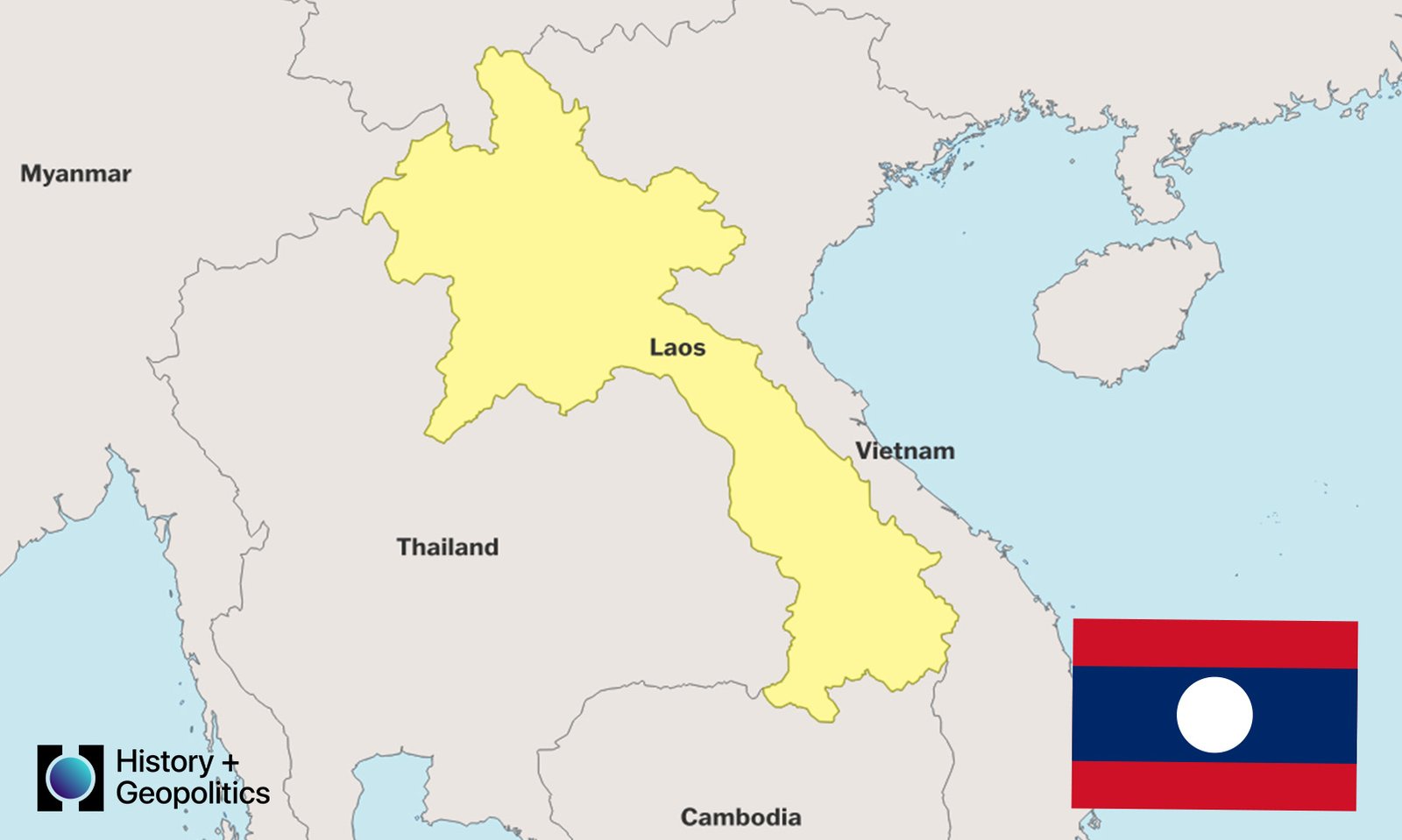
Laos is located in Southeast Asia, a landlocked country bordered by China to the north, Vietnam to the east, Cambodia to the south, Thailand to the west, and Myanmar to the northwest.
Laos Facts
- OFFICIAL NAME: Lao People’s Democratic Republic
- CAPITAL: Vientiane
- POPULATION: 7,974,017 (2026)
- AREA: 236,800 square kilometers
- OFFICIAL LANGUAGE: Lao
- CURRENCY: Lao Kip (LAK)
Laos Flag
The flag of Laos has three horizontal stripes — red on top, a wider blue in the middle, and red on the bottom — with a white circle centered on the blue stripe. The red stripes represent the blood shed by the Lao people in their struggle for independence and freedom. The blue represents the wealth of the country and the Mekong River that flows through it. The white circle represents the full moon reflected over the Mekong River and also symbolizes the unity of the Lao people under the Lao People’s Revolutionary Party. The flag is one of the few communist national flags that does not feature a star.
Laos Geography
- Located in Southeast Asia, the only landlocked country in the region.
- Borders: China to the north, Vietnam to the east, Cambodia to the south, Thailand to the west, Myanmar to the northwest.
- The Mekong River forms much of the western border with Thailand and is the country’s most important waterway.
- The terrain is mostly mountainous and forested, particularly in the north and east.
- The Annamite Mountains run along the eastern border with Vietnam, forming a natural divide between the two countries.
- Phou Bia is the highest peak, rising to 2,817 meters in the central highlands.
- The Vientiane Plain and the Mekong River valley in the west are the most fertile and densely populated regions.
- Laos has a tropical monsoon climate with a distinct wet season from May to October and a dry season from November to April.
- The country has extensive river systems and numerous waterfalls, including the famous Khone Phapheng, the widest waterfall in Southeast Asia.
Laos Government
- Laos is a single-party socialist republic governed by the Lao People’s Revolutionary Party.
- The President serves as head of state.
- The Prime Minister serves as head of government.
- Laos has a unicameral National Assembly.
- Sonexay Siphandon has served as Prime Minister since 2022.
- Laos is one of the few remaining communist states in the world alongside China, Vietnam, Cuba, and North Korea.
History of Laos
- The region has been inhabited since prehistoric times, with evidence of human settlement dating back tens of thousands of years.
- The Plain of Jars, a mysterious landscape of thousands of stone jars scattered across the highlands, dates back to the Iron Age and remains one of Southeast Asia’s most remarkable archaeological sites.
- The Lane Xang Kingdom, meaning “Land of a Million Elephants,” was established in 1353 and became one of the most powerful kingdoms in Southeast Asia.
- Lane Xang fragmented into three smaller kingdoms in the early 18th century, weakening the region.
- Laos came under Siamese, or Thai, control in the late 18th and early 19th centuries.
- France established control over Laos in 1893 as part of French Indochina.
- Japan occupied Laos during World War II before French control was briefly restored.
- Laos gained independence from France on October 22, 1953.
- The country became deeply embroiled in the Vietnam War, with the United States conducting a massive secret bombing campaign between 1964 and 1973 that made Laos the most heavily bombed country per capita in history.
- Unexploded ordnance from the bombing campaign continues to kill and injure Lao people today.
- The Lao People’s Revolutionary Party took power in 1975, establishing the current communist state.
People and Culture of Laos
- The Lao Loum, or lowland Lao, make up the majority of the population and live primarily in the Mekong River valley.
- The Lao Theung and Lao Soung, including the Hmong and Akha peoples, inhabit the upland and highland regions.
- Lao is the official language, a Tai-Kadai language closely related to Thai, with numerous ethnic minority languages also spoken.
- Theravada Buddhism is the dominant religion, practiced by approximately 65% of the population and deeply embedded in daily life, culture, and governance.
- Khao niaw, sticky rice, is the staple food and cultural cornerstone of Lao cuisine, eaten at virtually every meal.
- Laap, a minced meat salad seasoned with fish sauce, lime, herbs, and toasted rice powder, is considered the national dish of Laos.
- Boun Bang Fai, the rocket festival, and That Luang, the national festival centered around the golden stupa in Vientiane, are among the most important cultural celebrations.
Economy of Laos
- Laos has one of the fastest growing economies in Southeast Asia, driven by hydropower, mining, and agriculture.
- Hydropower is the most important export sector, with Laos aiming to become the “Battery of Southeast Asia” by exporting electricity generated from the Mekong River and its tributaries to neighboring countries.
- Mining of copper, gold, and potash contributes significantly to export revenues.
- Agriculture employs the majority of the population, with rice, coffee, and rubber among the most important crops.
- Tourism has grown significantly, with visitors attracted to the ancient city of Luang Prabang, the Mekong River, and the country’s natural landscapes.
- Laos faces challenges including high public debt, much of it owed to China, limited infrastructure, and dependence on natural resource extraction.
Laos Resources
- Laos has significant hydropower potential from the Mekong River and its many tributaries, with dozens of dams built or under construction.
- Mineral resources include copper, gold, tin, gypsum, and potash, with mining an increasingly important export sector.
- Fertile river valley land supports rice, coffee, and sugarcane cultivation.
- Extensive tropical forests, though significantly reduced by logging, support timber resources and biodiversity.
- The country’s natural landscapes, rivers, and cultural heritage represent growing resources for ecotourism.
Laos Wildlife
- Laos retains some of the most intact and least disturbed forest ecosystems in Southeast Asia, supporting remarkable biodiversity.
- The saola, one of the rarest and most recently discovered large mammals in the world, was first identified in the Annamite Mountains of Laos and Vietnam in 1992 and remains critically endangered.
- Asian elephants inhabit the forests of Laos, with the elephant holding deep cultural significance historically reflected in the country’s name, Land of a Million Elephants.
- Tigers, clouded leopards, and Asiatic black bears inhabit the remaining forest areas, though populations are severely threatened.
- The Mekong River supports the Irrawaddy dolphin in small numbers in the southern stretches near Cambodia.
- Nam Et-Phou Louey National Protected Area in the north is one of the most important wildlife areas in Laos, protecting tigers, dholes, and numerous other species.
- Deforestation, illegal wildlife trade, and hydropower development pose the most significant threats to Laos’s extraordinary but vulnerable biodiversity.