Latvia Country Profile
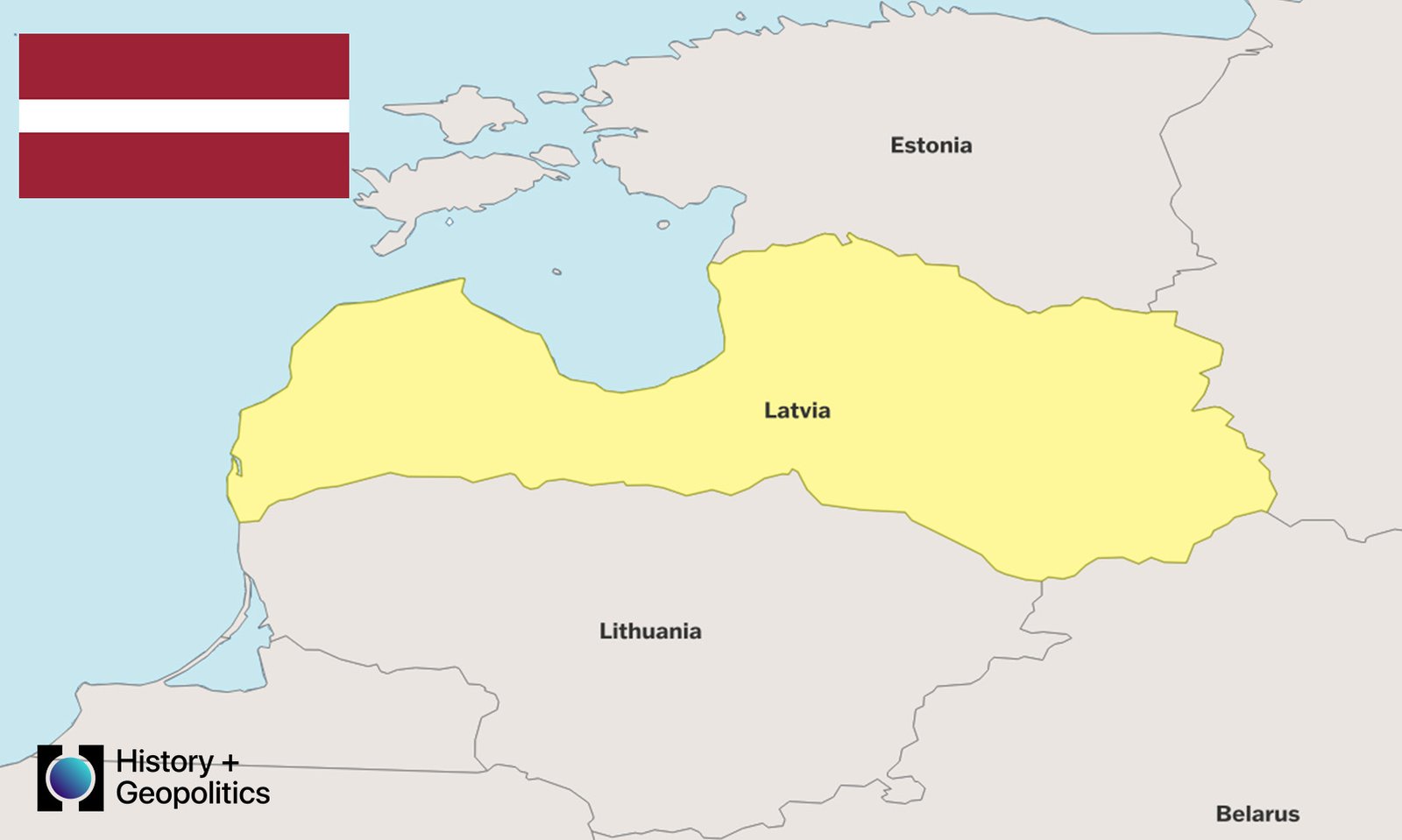
Latvia is located in Northern Europe, a Baltic state bordered by Estonia to the north, Lithuania to the south, Russia to the east, and Belarus to the southeast. To the west lies the Baltic Sea, giving Latvia its western coastline.
Latvia Facts
- OFFICIAL NAME: Republic of Latvia
- CAPITAL: Riga
- POPULATION: 1,845,000 (2026, Central Statistical Bureau of Latvia)
- AREA: 64,589 square kilometers
- OFFICIAL LANGUAGE: Latvian
- CURRENCY: Euro (EUR)
Latvia Flag
The flag of Latvia has three horizontal stripes — dark red on top, white in the middle, and dark red on the bottom — with the white stripe being half the width of each red stripe. The distinctive dark red color, sometimes called carmine or Latvian red, is one of the most unique flag colors in the world and has been associated with Latvia since the 13th century. According to a medieval legend, a Latvian tribal leader was wounded in battle and wrapped in a white sheet, with the blood soaking through except for a white stripe in the middle, creating the red-white-red pattern. The flag was officially adopted in 1922 and restored upon Latvia’s independence in 1991.
Latvia Geography
- Located in Northern Europe, one of the three Baltic states.
- Borders: Estonia to the north, Lithuania to the south, Russia to the east, Belarus to the southeast.
- The Baltic Sea lies to the west, with the Gulf of Riga forming a significant inlet along the northwestern coastline.
- The terrain is mostly flat, low-lying, and heavily forested, with gently rolling hills in the east.
- Latvia has extensive wetlands, rivers, and over 3,000 lakes.
- The highest point, Gaiziņkalns, rises to only 312 meters above sea level.
- The Daugava River is the most important waterway, flowing from Belarus through Latvia to the Gulf of Riga.
- Latvia has a temperate climate influenced by the Baltic Sea, with cold winters and mild summers.
- Forests cover approximately 54% of the country, one of the highest proportions in the European Union.
Latvia Government
- Latvia is a parliamentary republic.
- The President serves as head of state with largely ceremonial duties.
- The Prime Minister serves as head of government, holding executive authority.
- Latvia has a unicameral parliament called the Saeima, consisting of 100 members.
- Latvia joined both NATO and the European Union in 2004 and adopted the Euro in 2014.
- Edvards Smiltēns serves as Speaker of the Saeima and Evika Siliņa has served as Prime Minister since 2023.
- Latvia faces one of the fastest population decline rates in the world, driven by low birth rates, emigration, and an aging population.
History of Latvia
- The region has been inhabited since approximately 9000 B.C., with Baltic tribes settling the area over many centuries.
- German crusaders and merchants arrived in the early 13th century, establishing Riga in 1201 and gradually subjugating the local peoples.
- Latvia came under Polish-Lithuanian, Swedish, and eventually Russian rule over the following centuries.
- The 19th century saw a strong Latvian national awakening, with the development of a distinct cultural and linguistic identity.
- Latvia declared independence on November 18, 1918, following the collapse of the Russian Empire.
- The country maintained independence throughout the interwar period, developing a prosperous democratic society.
- Latvia was forcibly annexed by the Soviet Union in 1940 under the Molotov-Ribbentrop Pact between Nazi Germany and the USSR.
- Germany occupied Latvia from 1941 to 1944, during which most of Latvia’s Jewish population was murdered in the Holocaust.
- Soviet forces reoccupied Latvia in 1944 and it remained part of the Soviet Union for nearly five decades.
- The Singing Revolution, a peaceful independence movement characterized by mass song festivals and human chains, helped restore independence on August 21, 1991.
- Latvia joined NATO and the European Union in 2004 and has since integrated deeply into European institutions.
People and Culture of Latvia
- Latvians make up approximately 63.8% of the population, with a significant Russian minority of around 22% concentrated mainly in Riga and the eastern Latgale region.
- Latvian is the official language, a Baltic language and one of the oldest living Indo-European languages, closely related only to Lithuanian.
- Lutheranism is the largest religion, practiced by approximately 36% of the population, with Roman Catholicism and Russian Orthodox Christianity also present.
- Rupjmaize, a dense dark rye bread, is Latvia’s most iconic food and a staple of the national diet eaten daily across the country.
- Grey peas with bacon, known as pelēkie zirņi ar speķi, is considered a national dish and a centerpiece of Latvian celebrations.
- The Song and Dance Festival, held every five years, is one of the largest choral events in the world and is recognized by UNESCO as intangible cultural heritage, shared with Estonia and Lithuania.
- Riga’s Old Town, featuring remarkable Art Nouveau architecture, is a UNESCO World Heritage Site and one of the best-preserved medieval city centers in Northern Europe.
Economy of Latvia
- Latvia has a small open market economy with services, manufacturing, and trade as the main sectors.
- Riga serves as an important financial, logistics, and services hub for the Baltic region.
- Timber and wood processing are significant industries given Latvia’s extensive forest cover.
- Food processing, pharmaceuticals, and information technology are important and growing sectors.
- Latvia adopted the Euro in 2014 and is deeply integrated into the European Union’s single market.
- The country faces significant demographic challenges, with a declining and aging population reducing the size of the workforce.
Latvia Resources
- Latvia has extensive forest resources, with timber and wood products among the most important exports.
- The country has deposits of peat, limestone, dolomite, and amber, with Latvia being one of the world’s most important sources of Baltic amber.
- Agricultural land supports dairy farming, grain, and sugar beet production.
- Latvia’s rivers, particularly the Daugava, provide hydroelectric power generation through several large dams.
- The Baltic Sea coastline provides fishing resources and supports a growing maritime tourism industry.
Latvia Wildlife
- Latvia’s extensive forests, wetlands, and coastal areas support a rich diversity of northern European wildlife.
- Brown bears, wolves, lynx, and wild boar inhabit the country’s forests, with Latvia having some of the healthiest large carnivore populations in the European Union.
- The white stork is a beloved symbol of Latvian rural life, nesting widely across the countryside each summer.
- The Baltic Sea and Gulf of Riga support harbor seals, grey seals, and numerous fish species including cod, herring, and sprat.
- Latvia’s wetlands and coastal areas are important stopover points for migratory birds, including cranes and various waterfowl traveling along the East Atlantic Flyway.
- Latvia has established several national parks and nature reserves, including Gauja National Park and Kemeri National Park, to protect its forest and wetland ecosystems.