Lesotho Country Profile
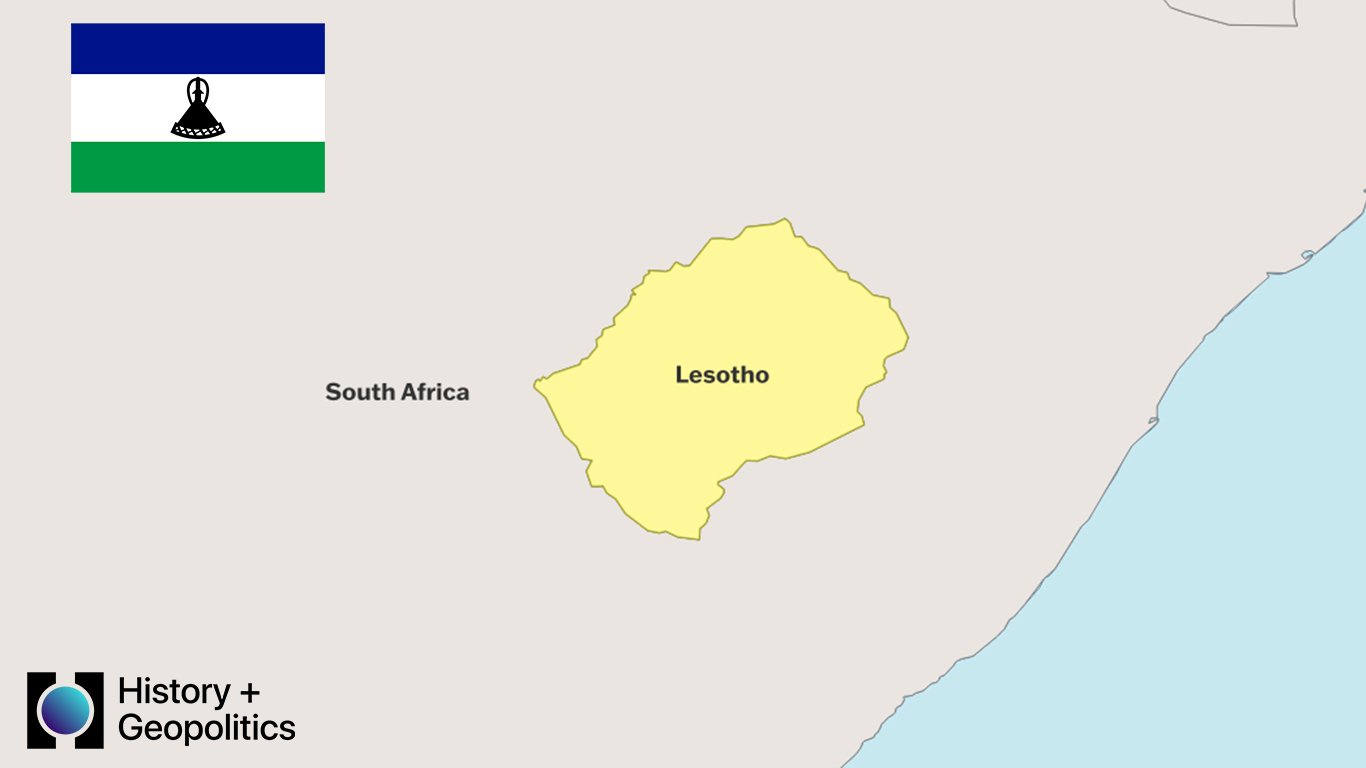
Lesotho is located in Southern Africa, a small landlocked kingdom entirely surrounded by South Africa, making it one of only three countries in the world to be completely encircled by another single country.
Lesotho Facts
- OFFICIAL NAME: Kingdom of Lesotho
- CAPITAL: Maseru
- POPULATION: 2,389,336 (2026)
- AREA: 30,355 square kilometers
- OFFICIAL LANGUAGES: Sesotho, English
- CURRENCY: Lesotho Loti (LSL)
Lesotho Flag
The flag of Lesotho has three equal horizontal stripes — blue on top, white in the middle, and green on the bottom — with a black Basotho hat, known as a mokorotlo, centered on the white stripe. The blue represents rain and the sky, the white represents peace, and the green represents prosperity and the land. The black mokorotlo is a traditional conical woven hat that is one of the most distinctive cultural symbols of the Basotho people. The flag was redesigned and adopted in 2006 to mark the 40th anniversary of Lesotho’s independence, replacing an earlier version that featured a Basotho shield and weapons.
Lesotho Geography
- Located in Southern Africa, completely surrounded by South Africa on all sides.
- Lesotho is one of only three countries in the world entirely enclosed within another country, alongside Vatican City and San Marino.
- The country is sometimes called the “Kingdom in the Sky” due to its extraordinarily high elevation.
- Lesotho is the only country in the world where the entire territory lies above 1,000 meters above sea level.
- The terrain is predominantly mountainous, with the Maluti and Drakensberg ranges dominating the landscape.
- Thabana Ntlenyana, the highest peak, rises to 3,482 meters and is the highest point in Southern Africa outside of mountain ranges on the continent’s edge.
- The Orange River, one of the most important rivers in Southern Africa, originates in the highlands of Lesotho.
- The western lowlands are the most fertile and most densely populated part of the country.
- Lesotho has a highland climate, with cold winters that bring significant snowfall and warm summers.
Watch Lesotho Geography on YouTube
Lesotho Government
- Lesotho is a constitutional monarchy.
- King Letsie III serves as the ceremonial head of state.
- The Prime Minister holds executive power and serves as head of government.
- Lesotho has a bicameral parliament consisting of the National Assembly and the Senate.
- Samuel Matekane has served as Prime Minister since 2022, leading a coalition government.
- Lesotho gained independence from Britain on October 4, 1966.
- The country has experienced recurring political instability, including several attempted coups and military interventions in its post-independence history.
History of Lesotho
- The region has been inhabited by San hunter-gatherers for thousands of years, with their rock art found throughout the highlands.
- Bantu-speaking Sotho peoples migrated into the region from the north several centuries ago.
- King Moshoeshoe I unified the Basotho people in the early 19th century, skillfully navigating the threats posed by Zulu expansion and Boer settlers.
- Moshoeshoe I sought British protection, and Basutoland became a British protectorate in 1868.
- Unlike neighboring territories, Basutoland was never incorporated into South Africa, preserving it as a distinct entity.
- Lesotho gained independence from Britain on October 4, 1966, under King Moshoeshoe II.
- The country experienced periods of authoritarian rule and political instability throughout the 1970s and 1980s.
- Democratic governance was established in the 1990s though political tensions have continued.
- Lesotho’s economy and society are deeply intertwined with neighboring South Africa, with many Basotho working in South African mines and industries.
People and Culture of Lesotho
- The Basotho people make up approximately 99.7% of the population, making Lesotho one of the most ethnically homogeneous countries in Africa.
- Sesotho and English are both official languages, with Sesotho spoken by the entire population in daily life.
- Christianity is the predominant religion, practiced by approximately 90% of the population, with both Protestant and Roman Catholic denominations strongly represented.
- Papa, a thick porridge made from maize or sorghum, is the staple food of Lesotho, typically served with vegetables or meat stew.
- The mokorotlo, the distinctive conical woven hat, and the Basotho blanket, a thick decorated blanket worn as a traditional garment, are the most iconic symbols of Basotho cultural identity.
- Lesotho has one of the highest literacy rates in Africa, at approximately 85%, reflecting a long tradition of mission education.
- Horse riding is central to Basotho culture, with the Basotho pony, a hardy mountain breed, essential for transport across the rugged highland terrain.
read more about Chile country profile
Economy of Lesotho
- Lesotho has a lower-middle-income economy heavily influenced by its geographic and economic relationship with South Africa.
- The textile and garment manufacturing sector is the largest formal employer, with factories producing clothing for export primarily to the United States under preferential trade agreements.
- Remittances from Basotho working in South Africa, particularly in the mining industry, are a critical source of household income.
- The Lesotho Highlands Water Project is one of the largest water infrastructure projects in the world, transferring water from Lesotho’s highland rivers to water-scarce areas of South Africa in exchange for royalty payments.
- Diamond mining has become an increasingly important sector, with Lesotho producing high-quality gem diamonds from the Letseng and Letšeng mines.
- The country faces significant challenges including high unemployment, poverty, and one of the highest HIV/AIDS prevalence rates in the world.
Lesotho Resources
- Lesotho’s most significant resource is its water, generated by highland rainfall and rivers, which is exported to South Africa through the Lesotho Highlands Water Project.
- The country has notable diamond deposits, including the Letseng mine which is known for producing exceptionally large and high-quality diamonds.
- Fertile lowland agricultural land supports subsistence farming of maize, sorghum, and wheat.
- The Maluti Mountains provide significant potential for hydroelectric power generation.
- Lesotho’s dramatic highland landscapes and unique cultural heritage represent growing resources for tourism.
Lesotho Wildlife
- Lesotho’s highland grasslands and river valleys support a range of wildlife adapted to the cool mountain environment.
- The bearded vulture, also known as the lammergeier, inhabits the rocky cliffs and highlands and is one of the most spectacular raptors in Africa.
- The Cape vulture also nests in colonies on the rocky cliffs of the Maluti Mountains.
- The Maluti minnow, a small fish found only in the highland rivers of Lesotho, is a critically endangered endemic species.
- The highlands support populations of eland, oribi, and grey rhebok antelope in more remote areas.
- Lesotho’s rivers and streams, fed by highland rainfall, support important freshwater ecosystems including trout fishing introduced during the colonial period.
- Conservation efforts focus on protecting the highland grassland ecosystems and endemic species from overgrazing and agricultural expansion.