Brunei Country Profile
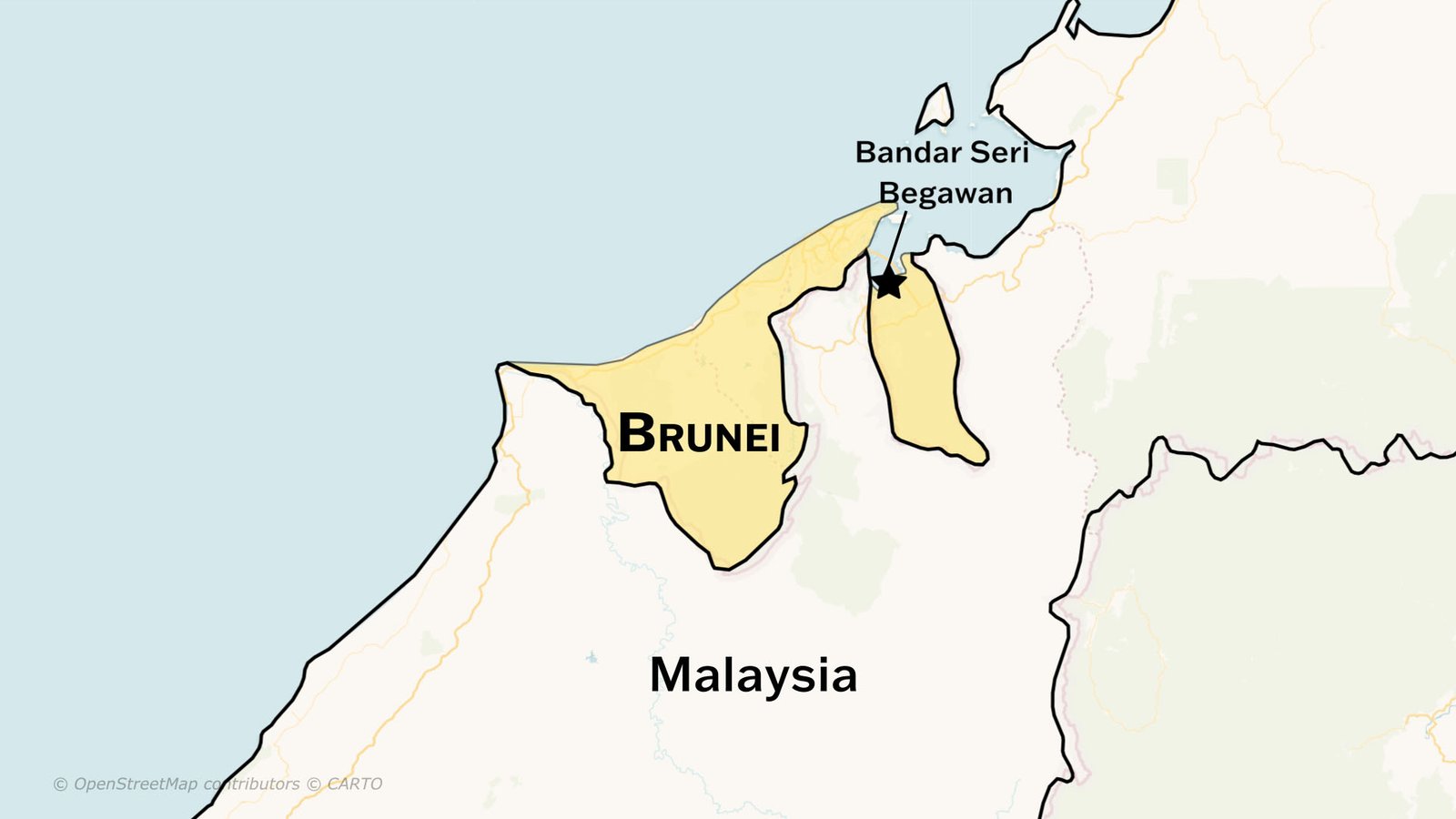
Brunei is located in Southeast Asia, on the northern coast of the island of Borneo. It is surrounded on three sides by the Malaysian state of Sarawak, which divides Brunei into two separate parts, and faces the South China Sea to the north.
Brunei Facts
- OFFICIAL NAME: Nation of Brunei, the Abode of Peace (Negara Brunei Darussalam)
- CAPITAL: Bandar Seri Begawan
- POPULATION: 469,775 (2026)
- AREA: 5,765 square kilometers
- OFFICIAL LANGUAGE: Malay
- CURRENCY: Brunei Dollar (BND)
Brunei Flag
The flag of Brunei has a yellow background with two diagonal stripes — white and black — running from the upper left to the lower right. In the center sits the national emblem in red, featuring a crescent moon, a parasol representing the monarchy, two hands symbolizing the government’s duty to promote welfare, and a pair of wings. A ribbon below the crescent bears the country’s motto in Arabic. The yellow represents the Sultan, the white and black stripes represent the two chief ministers who historically advised the Sultan, and the red emblem reflects the country’s Islamic identity. The flag has been used in its current form since Brunei’s independence in 1984.
Brunei Geography
- Located in Southeast Asia, on the northwestern coast of the island of Borneo.
- Surrounded on three sides by Malaysia’s Sarawak state, which divides Brunei into two non-contiguous parts.
- The South China Sea borders Brunei to the north.
- Brunei is one of the smallest countries in Asia by land area.
- The terrain consists of flat coastal plains in the west, with hilly and forested interior regions.
- Tropical rainforest covers approximately 70% of the country, much of it remaining largely undisturbed.
- Brunei has a hot and humid equatorial climate, with heavy rainfall throughout the year.
- The Belait River is the longest river in the country, flowing through the interior rainforest to the coast.
- Brunei Bay is a large natural bay shared with Malaysia that provides important coastal waters.
Brunei Government
- Brunei is an absolute monarchy, ruled by the Sultan who serves as head of state, head of government, and Prime Minister.
- The Sultan of Brunei holds significant and wide-ranging executive authority.
- Brunei operates under a Malay Islamic Monarchy philosophy known as Melayu Islam Beraja (MIB), which forms the foundation of national identity and governance.
- Political parties are largely inactive and elections for the national legislature have not been held since 1962.
- Brunei gained full independence from the United Kingdom on January 1, 1984.
History of Brunei
- The Sultanate of Brunei was established around the 15th century and became a powerful maritime trading empire controlling much of Borneo and the northern Philippines.
- Brunei was a significant center of Islam in the region, with the faith spreading outward from the Sultanate across much of Southeast Asia.
- Portuguese and Spanish explorers encountered Brunei in the 16th century, and the Spanish referred to the entire island of Borneo by a variation of the Sultanate’s name.
- British influence in the region grew in the 19th century, and Brunei gradually ceded territory to the British-backed Rajah of Sarawak.
- Brunei became a British protectorate in 1888, with Britain managing its foreign affairs and defense.
- Japan occupied Brunei during World War II from 1941 to 1945, during which significant oil infrastructure was targeted.
- Brunei chose not to join the Malaysian Federation in 1963, retaining its separate status.
- Brunei gained full independence from the United Kingdom on January 1, 1984, with the Sultan assuming all governmental powers.
People and Culture of Brunei
- The Malay ethnic group, known as Bumiputera, forms the majority of the population, alongside Chinese and various indigenous communities.
- Malay is the official language, though English and Chinese are widely spoken.
- Islam is the official state religion, practiced by the majority of the population, with Buddhism and Christianity also present among minority communities.
- Ambuyat, a starchy dish made from the sago palm served with various side dishes and sauces, is considered a traditional national dish.
- Brunei’s culture is deeply shaped by Islamic values, reflected in dress codes, public conduct, and the national philosophy of Melayu Islam Beraja.
- The Sultan of Brunei is one of the longest-reigning and wealthiest monarchs in the world.
- Traditional crafts including weaving, silverwork, and boat building remain part of the country’s cultural heritage.
Economy of Brunei
- Brunei has one of the highest per capita incomes in Asia, driven almost entirely by oil and natural gas production.
- The country is a significant exporter of liquefied natural gas (LNG) and crude oil, primarily to Asian markets.
- The government provides extensive subsidies to citizens, including free education, healthcare, and heavily subsidized fuel.
- Brunei does not impose personal income tax, making it one of the few countries in the world with no income tax.
- The government has been working to diversify the economy away from oil dependence through investment in finance, tourism, and halal food industries.
- Agriculture and fishing play a small but traditional role in the rural economy.
Brunei Resources
- Brunei’s most significant resources are its oil and natural gas reserves, located both onshore and offshore in the South China Sea.
- The country has been producing oil since the 1920s, with Shell being a long-standing partner in extraction and production.
- Extensive tropical rainforests provide timber resources, though conservation efforts have limited large-scale logging.
- Coastal and offshore waters support a fishing industry serving local consumption.
- The undisturbed rainforest interior represents an important ecotourism and biodiversity resource.
Brunei Wildlife
- Brunei’s largely intact tropical rainforest supports exceptional biodiversity, including many species rare or endangered elsewhere in Borneo.
- The proboscis monkey, a species unique to Borneo with a distinctive large nose, inhabits the mangrove and riverside forests of Brunei.
- Orangutans are found in Brunei’s interior rainforests, though their populations are under pressure from habitat loss across Borneo.
- The clouded leopard, a medium-sized wild cat unique to Southeast Asia, inhabits the dense forests of Brunei.
- Pygmy elephants of Borneo, among the smallest elephants in the world, are found in forested areas.
- Brunei’s coastal waters and mangroves support diverse marine life, including dolphins, sea turtles, and numerous fish species.
- Brunei has committed to maintaining 70% forest cover, helping preserve one of the most biodiverse rainforest environments remaining in Southeast Asia.