Greece Country Profile
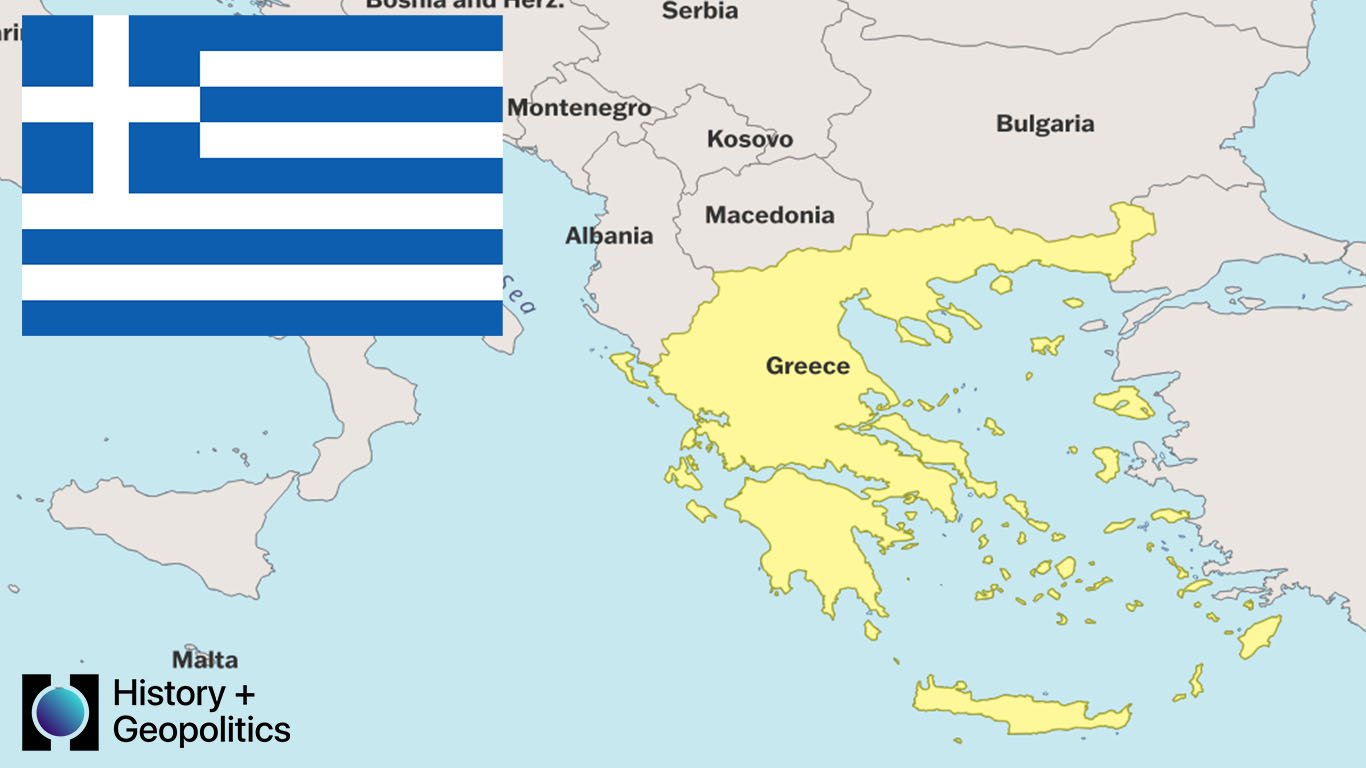
Greece is located in Southeastern Europe, at the southern tip of the Balkan Peninsula. It is bordered by Albania, North Macedonia, and Bulgaria to the north, and Turkey to the northeast. To the west lies the Ionian Sea, to the south the Mediterranean Sea, and to the east the Aegean Sea.
Greece Facts
- OFFICIAL NAME: Hellenic Republic
- CAPITAL: Athens
- POPULATION: 9,897,115 (2026)
- AREA: 131,957 square kilometers
- OFFICIAL LANGUAGE: Greek
- CURRENCY: Euro (EUR)
Greece Flag
The flag of Greece has nine equal horizontal stripes alternating between blue and white, with a blue square canton in the upper left corner containing a white cross. The nine stripes are said to represent the nine syllables of the Greek phrase “Eleftheria i Thanatos,” meaning “Freedom or Death,” the rallying cry of the Greek War of Independence. The white cross represents Greek Orthodox Christianity, which has been central to Greek identity for centuries. The blue and white colors have been associated with Greece since antiquity, representing the sea and sky surrounding the country.
Greece Geography
- Located in Southeastern Europe, at the southern tip of the Balkan Peninsula.
- Borders: Albania, North Macedonia, and Bulgaria to the north, Turkey to the northeast.
- The Ionian Sea lies to the west, the Mediterranean Sea to the south, and the Aegean Sea to the east.
- Greece has one of the longest coastlines in the world, stretching approximately 13,676 kilometers including its many islands.
- The country includes approximately 6,000 islands and islets, of which around 227 are inhabited.
- The largest islands include Crete, Euboea, Lesbos, and Rhodes.
- The terrain is predominantly mountainous, with Mount Olympus, the highest peak, rising to 2,918 meters.
- The Pindus mountain range forms the backbone of mainland Greece, running from north to south.
- Greece has a Mediterranean climate, with hot dry summers and mild wet winters.
- The country is located in a seismically active zone and experiences frequent earthquakes.
Greece Government
- Greece is a parliamentary republic.
- The President serves as a largely ceremonial head of state.
- The Prime Minister serves as head of government, holding executive authority.
- Greece has a unicameral parliament called the Hellenic Parliament.
- Kyriakos Mitsotakis has served as Prime Minister since 2019, re-elected in 2023.
- Greece joined NATO in 1952 and the European Union in 1981.
- Greece adopted the Euro in 2001.
History of Greece
- Greece is widely regarded as the cradle of Western civilization, with a recorded history stretching back over 3,000 years.
- Ancient Greek city-states, particularly Athens and Sparta, developed foundational concepts of democracy, philosophy, science, and the arts between the 8th and 4th centuries B.C.
- The Athenian democracy established in the 5th century B.C. under Cleisthenes is considered the earliest form of democratic governance in recorded history.
- Alexander the Great of Macedon conquered a vast empire from Greece to India in the 4th century B.C., spreading Greek culture across the ancient world in a period known as the Hellenistic Age.
- Greece was incorporated into the Roman Empire in 146 B.C. and later became the eastern heartland of the Byzantine Empire.
- The Ottoman Empire conquered Greece in the 15th century, ruling for nearly 400 years.
- The Greek War of Independence began in 1821, and Greece became an independent kingdom in 1830.
- Greece fought in the Balkan Wars, both World Wars, and a civil war between communist and government forces from 1946 to 1949.
- A military junta governed Greece from 1967 to 1974, known as the Regime of the Colonels.
- Democracy was restored in 1974, and Greece has been a democratic republic since.
- Greece experienced a severe sovereign debt crisis from 2010 to 2018, requiring three international bailout packages and imposing significant austerity measures on its population.
People and Culture of Greece
- Greeks make up approximately 91% of the population, with Albanian and other minority communities also present.
- Greek is the official language, one of the oldest recorded living languages in the world with a continuous written tradition of over 3,000 years.
- Greek Orthodox Christianity is the dominant religion, practiced by approximately 81% of the population and deeply embedded in national culture and identity.
- Moussaka, a layered dish of eggplant, minced meat, and béchamel sauce, is one of Greece’s most internationally recognized traditional dishes.
- Souvlaki, grilled meat skewers served with pita bread and tzatziki, is one of the most popular everyday foods in Greece.
- Greek culture has made foundational contributions to philosophy, mathematics, literature, theatre, and the arts, with figures such as Socrates, Aristotle, Homer, Pythagoras, and Archimedes among history’s most influential thinkers.
- The Olympic Games, the world’s most prestigious international sporting event, originated in ancient Olympia, Greece, and were revived in Athens in 1896.
Economy of Greece
- Greece has a developed economy with services, particularly tourism and shipping, as the dominant sectors.
- Tourism is the most important industry, with Greece attracting tens of millions of visitors annually to its ancient sites, islands, and beaches.
- Greece has one of the largest merchant shipping fleets in the world, and the shipping industry is a major source of national income.
- Agriculture produces olives, olive oil, wine, citrus fruits, and vegetables, with Greek olive oil internationally renowned.
- Greece’s economy suffered severely during the debt crisis of 2010 to 2018, contracting by approximately 25% over that period.
- The economy has recovered significantly since 2018, with tourism and investment driving renewed growth.
Greece Resources
- Greece has deposits of bauxite, lignite, magnesite, and marble, the last of which has been quarried since antiquity.
- Offshore natural gas reserves in the Ionian and Aegean seas are being explored and developed.
- Fertile agricultural land in Thessaly and Macedonia supports grain, cotton, and tobacco production.
- The Greek islands and mainland coastline are among the country’s most economically valuable natural resources through tourism.
- Significant wind and solar energy potential exists due to Greece’s geographic position and climate.
Greece Wildlife
- Greece’s diverse landscapes, from mountain forests to Mediterranean scrubland and island ecosystems, support a rich variety of wildlife.
- The brown bear inhabits the Pindus and Rhodope mountain ranges in northern Greece, with one of the largest populations in the Balkans.
- The grey wolf survives in the mountains of northern Greece, gradually recovering in numbers.
- The Mediterranean monk seal, one of the world’s most endangered marine mammals, is found in the waters around Greek islands, with the National Marine Park of Alonnisos being a key protected habitat.
- The loggerhead sea turtle nests extensively on the beaches of Zakynthos, Kefalonia, and the Peloponnese.
- The Dadia Forest in northeastern Greece is one of the most important raptor habitats in Europe, home to black vultures, griffon vultures, and imperial eagles.
- Greece has established several national parks and marine protected areas to conserve its distinctive Mediterranean ecosystems and endemic species.