Grenada Country Profile
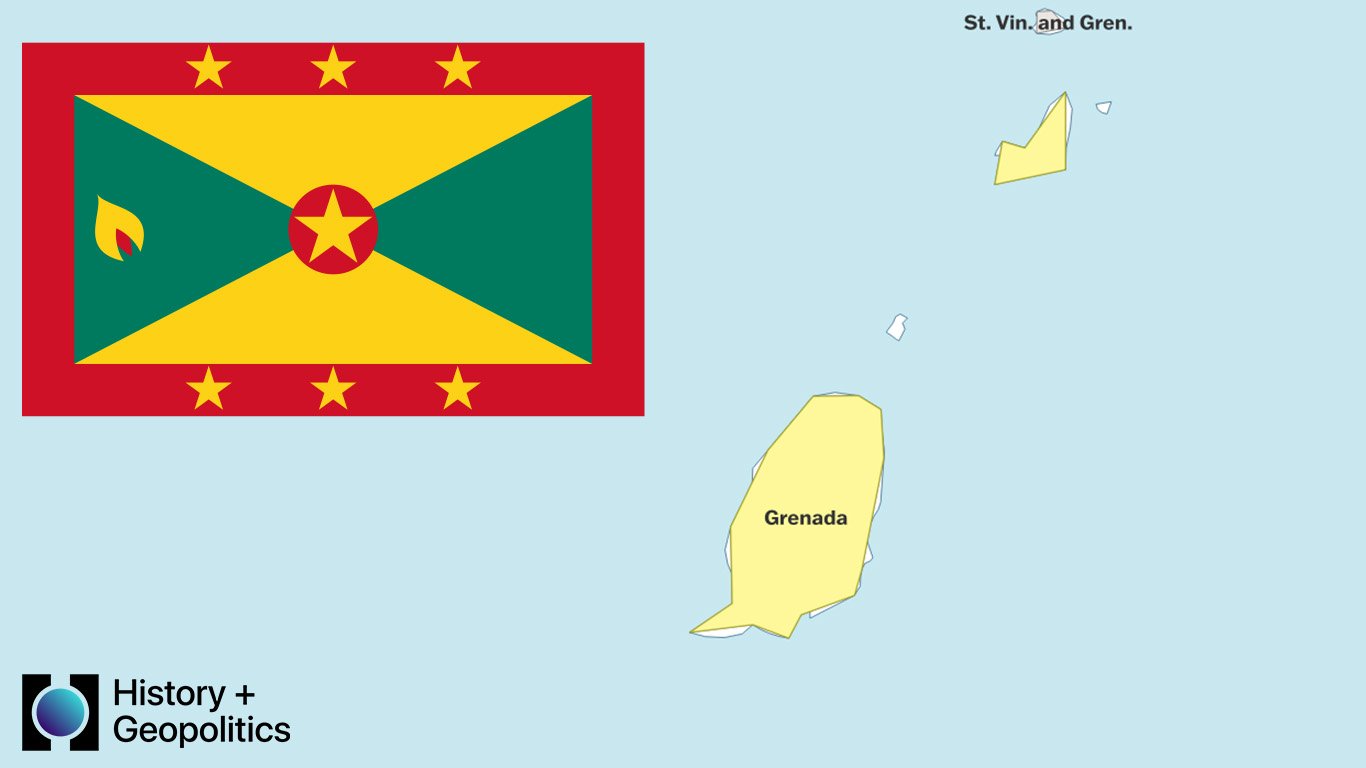
Grenada is located in the southeastern Caribbean Sea, a small island nation in the Lesser Antilles. It lies north of Trinidad and Tobago, southwest of Saint Vincent and the Grenadines, and northwest of Barbados, surrounded entirely by the Caribbean Sea to the west and the Atlantic Ocean to the east.
Grenada Facts
- OFFICIAL NAME: Grenada
- CAPITAL: St. George’s
- POPULATION: 117,362 (2026)
- AREA: 344 square kilometers
- OFFICIAL LANGUAGE: English
- CURRENCY: Eastern Caribbean Dollar (XCD)
Grenada Flag
The flag of Grenada has a red border surrounding a divided background of yellow on the top and bottom triangles and green on the left and right triangles, with three yellow five-pointed stars along the top red border, three along the bottom, and one yellow star in the center of a red circle. On the green triangle to the left sits a nutmeg, representing one of Grenada’s most famous exports and earning it the nickname the “Spice Isle.” The red represents courage and vitality, the yellow represents wisdom and the warmth of the sun, and the green represents the vegetation and agriculture of the island. The seven stars represent the seven parishes of Grenada.
Grenada Geography
- Located in the southeastern Caribbean Sea, part of the Lesser Antilles island chain.
- Surrounded by the Caribbean Sea to the west and the Atlantic Ocean to the east.
- Lies north of Trinidad and Tobago and southwest of Saint Vincent and the Grenadines.
- Grenada is the southernmost of the Windward Islands and consists of the main island of Grenada and several smaller islands including Carriacou and Petite Martinique.
- The terrain is mountainous and volcanic in the interior, with a rugged spine running north to south.
- The highest point, Mount Saint Catherine, rises to 840 meters in the northern part of the main island.
- Grenada has a tropical climate with a dry season from January to May and a rainy season from June to December.
- The island is located at the southern edge of the Atlantic hurricane belt, giving it some protection from the most severe storms.
- Grand Anse Beach on the southwestern coast is one of the most celebrated beaches in the Caribbean.
Grenada Government
- Grenada is a parliamentary democracy and a Commonwealth realm.
- The British monarch serves as head of state, represented locally by a Governor-General.
- The Prime Minister serves as head of government.
- Grenada has a bicameral parliament consisting of the Senate and the House of Representatives.
- Grenada gained independence from the United Kingdom on February 7, 1974.
- Dickon Mitchell has served as Prime Minister since 2022.
History of Grenada
- The island was originally inhabited by the Arawak people and later the Kalinago, who called the island Camerhogne.
- Christopher Columbus sighted the island in 1498 during his third voyage to the Americas but did not land.
- French settlers established the first European colony on the island in 1649, displacing and largely eliminating the indigenous Kalinago population.
- France and Britain competed for control of Grenada throughout the 17th and 18th centuries.
- Britain gained permanent control of Grenada in 1783 following the Treaty of Paris, developing sugar and spice plantations using enslaved African labor.
- Grenada gained independence from the United Kingdom on February 7, 1974.
- A left-wing coup in 1979 brought Maurice Bishop and the New Jewel Movement to power.
- An internal power struggle within the revolutionary government led to Bishop’s execution in 1983.
- The United States invaded Grenada in October 1983, citing the threat to American medical students and concern over growing Cuban and Soviet influence.
- Democratic governance was restored following the US intervention and has been maintained since.
People and Culture of Grenada
- The majority of the population is of African descent, reflecting the legacy of the colonial sugar and spice plantation era.
- English is the official language, though a French-based creole called Grenadian Creole is also spoken.
- Christianity, with a mix of Roman Catholic and Protestant denominations, is the predominant religion.
- Oil down, a one-pot dish of breadfruit, salted meat, callaloo, dumplings, and coconut milk, is the national dish of Grenada.
- Grenada is famous worldwide for producing nutmeg, mace, cinnamon, cloves, and other spices, earning it the title of the “Spice Isle of the Caribbean.”
- Spicemas Carnival, held in August, is the island’s most vibrant cultural festival, featuring music, costumes, and the unique jab jab masquerade tradition.
- Cricket is the most popular sport, and Grenada has produced notable international cricket players.
Economy of Grenada
- Grenada has a small developing economy based primarily on tourism, spice exports, and offshore financial services.
- Tourism is the largest economic sector, driven by visitors attracted to the island’s beaches, diving sites, and natural scenery.
- Nutmeg and mace are historically the most important agricultural exports, with Grenada once producing approximately one third of the world’s nutmeg supply before Hurricane Ivan devastated the crop in 2004.
- The spice industry has gradually recovered and remains culturally and economically significant.
- Grenada operates a citizenship by investment program that has become an important source of government revenue.
- The economy is vulnerable to natural disasters, particularly hurricanes, which can cause devastating damage given the island’s small size.
Grenada Resources
- Grenada’s most significant agricultural resources are its spice crops, particularly nutmeg, mace, cloves, and cinnamon.
- The surrounding Caribbean and Atlantic waters provide fishing resources, including tuna, mahi-mahi, and various reef fish.
- Fertile volcanic soil supports agriculture including cocoa, bananas, and tropical fruits.
- The island’s beaches, coral reefs, and natural scenery are among its most economically valuable resources for tourism.
- Grenada has some potential for geothermal energy development given its volcanic origins.
Grenada Wildlife
- Grenada’s tropical forests and coastal waters support a variety of wildlife despite the island’s small size.
- The Grenada dove, a critically endangered species found only on Grenada, is the national bird and one of the rarest doves in the world.
- Leatherback and hawksbill sea turtles nest on Grenada’s beaches, with Levera Beach on the northeastern coast being one of the most important nesting sites.
- The Mona monkey, introduced centuries ago, is now common in forested areas of the island.
- The surrounding waters support colorful coral reef ecosystems, including the world’s first underwater sculpture park off the coast of St. George’s, which has become an artificial reef.
- Conservation efforts focus on protecting the Grenada dove, sea turtle nesting sites, and the island’s remaining dry forest habitats.