Indonesia Country Profile
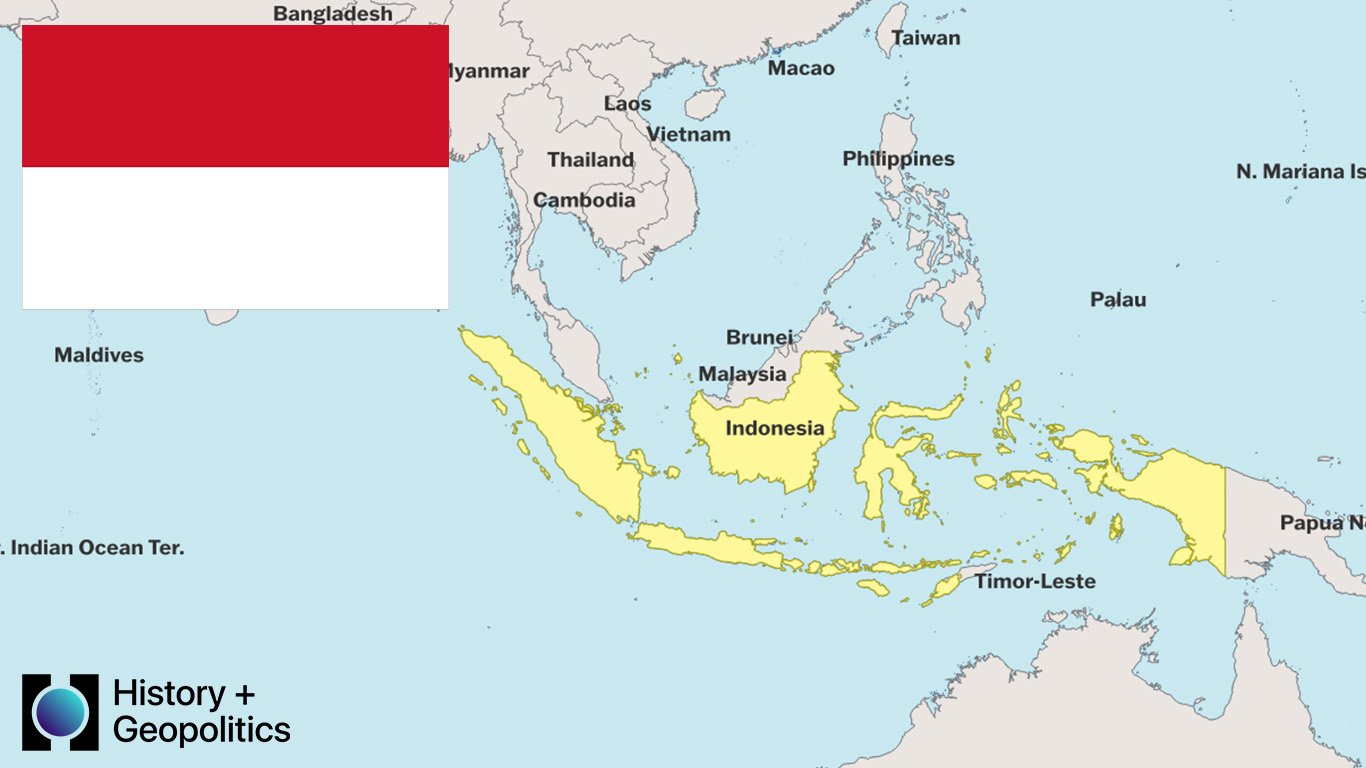
Indonesia is located in Southeast Asia and Oceania, the world’s largest archipelago nation. It shares land borders with Malaysia on the island of Borneo, Papua New Guinea on the island of New Guinea, and East Timor on the island of Timor. The Indian Ocean lies to the south and west, the Pacific Ocean to the north and east, and the South China Sea to the northwest.
Indonesia Facts
- OFFICIAL NAME: Republic of Indonesia
- CAPITAL: Jakarta (note: the new capital Nusantara is under construction in East Kalimantan)
- POPULATION: 287,886,782 (2026)
- AREA: 1,904,569 square kilometers
- OFFICIAL LANGUAGE: Indonesian (Bahasa Indonesia)
- CURRENCY: Indonesian Rupiah (IDR)
Indonesia Flag
The flag of Indonesia, known as the Sang Saka Merah Putih or the Red and White, has two equal horizontal stripes — red on top and white on the bottom. The red represents courage and the physical world, while the white represents purity and the spiritual world. The design is nearly identical to the flag of Monaco, differing only slightly in proportions. The red and white colors have deep historical roots in Indonesian culture, tracing back to the Majapahit Empire of the 13th to 15th centuries. The flag was first raised on August 17, 1945, the day Indonesia proclaimed independence from Dutch colonial rule.
Indonesia Geography
- Located in Southeast Asia and Oceania, straddling the equator between the Indian and Pacific Oceans.
- The world’s largest archipelago, consisting of over 17,000 islands, of which approximately 6,000 are inhabited.
- Shares land borders with Malaysia on Borneo, Papua New Guinea on New Guinea, and East Timor on Timor.
- The five main islands are Sumatra, Java, Kalimantan (the Indonesian portion of Borneo), Sulawesi, and Papua (the western half of New Guinea).
- Java is the most populous island in the world, home to over half of Indonesia’s total population.
- The terrain is largely mountainous and volcanic, with Indonesia having more active volcanoes than any other country in the world.
- Puncak Jaya in Papua is the highest peak, rising to 4,884 meters and is the highest point between the Himalayas and the Andes.
- Indonesia sits on the Pacific Ring of Fire, making it one of the most seismically and volcanically active regions on Earth.
- The 2004 Indian Ocean earthquake and tsunami, one of the deadliest natural disasters in recorded history, originated off the coast of Sumatra.
- Indonesia has a tropical climate throughout, with high humidity and rainfall across most of the archipelago.
Indonesia Government
- Indonesia is a presidential republic and the world’s third largest democracy.
- The President serves as both head of state and head of government.
- Indonesia has a bicameral People’s Consultative Assembly, consisting of the People’s Representative Council and the Regional Representative Council.
- Prabowo Subianto has served as President since October 2024, succeeding Joko Widodo who served two terms.
- Indonesia is the world’s largest Muslim-majority country by population.
- The country is moving its capital from Jakarta to the newly constructed city of Nusantara in East Kalimantan on the island of Borneo.
History of Indonesia
- The Indonesian archipelago has been home to advanced civilizations for thousands of years, with the Srivijaya maritime empire and the Majapahit Empire among the most powerful in Southeast Asian history.
- Indian cultural and religious influences, including Hinduism and Buddhism, shaped much of early Indonesian civilization.
- Islam arrived through Arab and Indian traders from the 13th century onward and gradually became the dominant religion across most of the archipelago.
- Portuguese traders arrived in the early 16th century, followed by the Dutch, who established the Dutch East India Company (VOC) and eventually colonized the archipelago.
- The Netherlands ruled the Dutch East Indies for approximately 350 years, exploiting the islands’ spices, coffee, and other resources.
- Japan occupied Indonesia during World War II from 1942 to 1945, ending Dutch colonial control.
- Sukarno and Mohammad Hatta proclaimed Indonesian independence on August 17, 1945, two days after Japan’s surrender.
- The Dutch attempted to reassert colonial control, leading to the Indonesian National Revolution until the Netherlands recognized Indonesian sovereignty in 1949.
- Sukarno led the country through its early independent decades before being replaced by General Suharto in 1966 following a period of political turmoil.
- Suharto’s New Order government ruled Indonesia for 32 years, overseeing rapid economic development alongside authoritarian control.
- The Asian Financial Crisis of 1997 triggered mass protests and Suharto’s resignation in 1998, opening Indonesia’s democratic reform era known as Reformasi.
- East Timor gained independence from Indonesia in 2002 following a UN-supervised referendum.
- Indonesia has since developed into a stable democracy and one of the largest economies in Southeast Asia.
People and Culture of Indonesia
- Indonesia is one of the most ethnically diverse countries in the world, with over 300 distinct ethnic groups.
- The Javanese are the largest ethnic group, making up approximately 40% of the population, followed by the Sundanese at around 15%.
- Bahasa Indonesia, a standardized form of Malay, is the official and unifying national language, with over 700 regional languages also spoken.
- Islam is practiced by approximately 87% of the population, making Indonesia the world’s largest Muslim-majority nation by population.
- Nasi goreng, fried rice seasoned with sweet soy sauce, shrimp paste, and various toppings, is one of Indonesia’s most beloved national dishes.
- Rendang, a slow-cooked dry beef curry originating from West Sumatra, has been internationally recognized as one of the most delicious foods in the world.
- Batik, a traditional Indonesian fabric-dyeing technique, is recognized by UNESCO as intangible cultural heritage and is widely worn in daily life and ceremonies.
Economy of Indonesia
- Indonesia has the largest economy in Southeast Asia and one of the largest in the world, ranking among the G20 nations.
- Natural resources, including coal, palm oil, rubber, and minerals, are major contributors to export revenue.
- Indonesia is the world’s largest producer of palm oil and one of the largest producers of coal and nickel.
- The manufacturing sector, particularly textiles, footwear, and electronics, is an important employer and export sector.
- The services sector, including finance, trade, and tourism, is the largest contributor to GDP.
- Indonesia has significant nickel reserves, positioning it as a key player in the global electric vehicle battery supply chain.
Indonesia Resources
- Indonesia has extraordinary natural resource wealth, including vast reserves of coal, natural gas, and oil.
- The country is the world’s largest producer and exporter of palm oil, grown primarily in Sumatra and Kalimantan.
- Indonesia has some of the world’s largest nickel reserves, making it a critical supplier for the global battery and stainless steel industries.
- Gold, copper, and bauxite deposits are found across several islands, with the Grasberg mine in Papua being one of the world’s largest gold and copper mines.
- Indonesia’s tropical forests, though significantly depleted, contain some of the most biodiverse ecosystems on Earth.
Indonesia Wildlife
- Indonesia is one of the most biodiverse countries in the world, home to an extraordinary concentration of endemic species found nowhere else on Earth.
- The orangutan, one of humanity’s closest relatives, is native to Sumatra and Borneo and is critically endangered due to deforestation and habitat loss.
- The Sumatran tiger, Sumatran rhinoceros, and Sumatran elephant are all critically endangered species found only on the island of Sumatra.
- The Komodo dragon, the world’s largest living lizard, is found only on a few Indonesian islands including Komodo and Flores.
- The bird of paradise, found in Papua, is one of the most spectacular and colorful birds in the world.
- Indonesia’s coral reefs, particularly in the Coral Triangle region of eastern Indonesia, are the most biodiverse marine ecosystems on Earth.
- Deforestation, driven by palm oil expansion and illegal logging, is the most significant threat to Indonesia’s extraordinary biodiversity and has contributed to Indonesia being one of the world’s largest greenhouse gas emitters.