Marshall Islands Country Profile
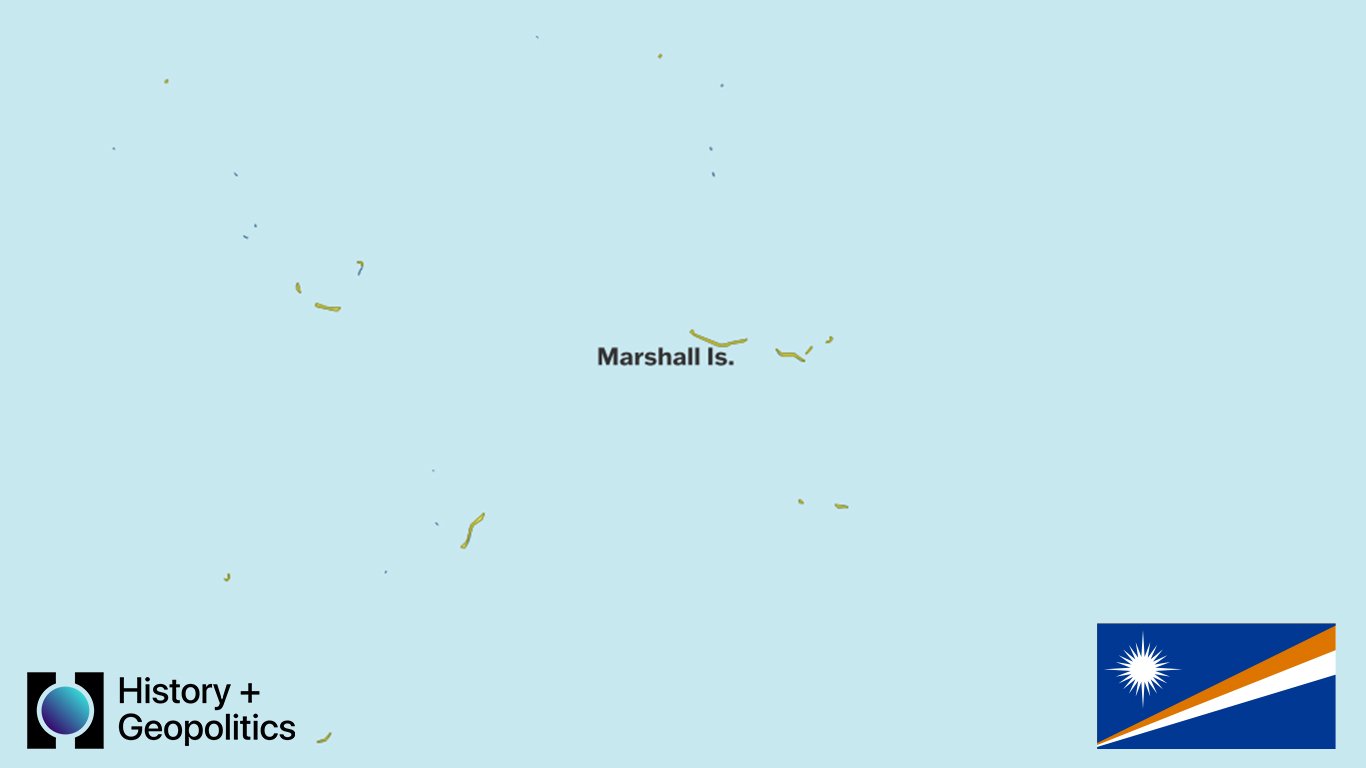
The Marshall Islands is located in the central Pacific Ocean, a remote island nation in Micronesia. It has no land borders, surrounded entirely by the Pacific Ocean, lying roughly halfway between Hawaii and Australia.
Marshall Islands Facts
- OFFICIAL NAME: Republic of the Marshall Islands
- CAPITAL: Majuro
- POPULATION: 35,075 (2026)
- AREA: 181 square kilometers
- OFFICIAL LANGUAGES: Marshallese, English
- CURRENCY: United States Dollar (USD)
Marshall Islands Flag
The flag of the Marshall Islands has a dark blue background with two diagonal stripes — orange on top and white below — running from the lower left to the upper right, and a large white sun with 24 rays in the upper left corner. The blue represents the Pacific Ocean. The orange stripe represents bravery and the Ralik chain of islands, while the white stripe represents peace and the Ratak chain of islands. The sun with 24 rays represents the 24 electoral districts of the country, with four longer rays pointing in the cardinal directions representing the main cultural centers of the islands. The flag’s diagonal stripes rising from left to right symbolize the geographic location of the islands north of the equator.
Marshall Islands Geography
- Located in the central Pacific Ocean, part of the Micronesia region.
- No land borders, surrounded entirely by the Pacific Ocean.
- An archipelago of 29 coral atolls and 5 single islands, comprising over 1,200 individual islands and islets.
- The islands are divided into two parallel chains — the Ratak chain to the east and the Ralik chain to the west.
- The total land area is extremely small despite the islands being spread across approximately 1.9 million square kilometers of ocean.
- The terrain is entirely low-lying, with most land rising only 2 meters above sea level.
- Majuro Atoll, the capital, is one of the most densely populated atolls in the Pacific.
- The Marshall Islands has a tropical climate, warm and humid throughout the year with a wet season and a drier season.
- The country is severely threatened by rising sea levels due to climate change, with entire islands at risk of submersion.
- Kwajalein Atoll contains one of the largest lagoons in the world and is home to a major US military installation.
Watch video on YouTube: Geography of Marshall Island
Marshall Islands Government
- The Marshall Islands is a presidential republic in free association with the United States.
- The President serves as both head of state and head of government, elected by the parliament.
- Hilda Heine has served as President since January 2024, returning to the role she previously held from 2016 to 2020.
- The Marshall Islands has a unicameral parliament called the Nitijela.
- The Compact of Free Association with the United States provides significant financial assistance and allows Marshallese citizens to live and work freely in the United States.
- The Marshall Islands gained independence from US administration on October 21, 1986.
History of the Marshall Islands
- The Marshall Islands has been inhabited by Micronesian peoples for approximately 2,000 years.
- Spanish explorers were among the first Europeans to encounter the islands in the 16th century.
- British captain John Marshall gave his name to the archipelago after sailing through in 1788.
- Germany declared the islands a protectorate in 1885 and administered them until World War I.
- Japan occupied the Marshall Islands from World War I until its defeat in World War II.
- The islands were the site of significant battles during World War II, including the Battle of Kwajalein in 1944.
- The United States administered the Marshall Islands as part of the Trust Territory of the Pacific Islands after World War II.
- Between 1946 and 1958, the United States conducted 67 nuclear weapons tests on Bikini and Enewetak Atolls, causing devastating and long-lasting environmental and health consequences for the Marshallese people.
- The residents of Bikini Atoll were displaced for the nuclear tests and have never been able to permanently return due to lingering contamination.
- The Marshall Islands became self-governing in 1979 and entered into free association with the United States in 1986.
- The country became a member of the United Nations in 1991.
People and Culture of the Marshall Islands
- The Marshallese people are of Micronesian descent and form the vast majority of the population.
- Marshallese and English are both official languages, with Marshallese spoken by virtually the entire population in daily life.
- Christianity, predominantly Protestant denominations including the United Church of Christ, is practiced by the overwhelming majority of the population.
- Rice and fish form the foundation of the Marshallese diet, with tuna and other reef fish central to both daily meals and cultural gatherings.
- Traditional navigation using stick charts, intricate maps made from palm sticks and shells that represent ocean swells and island positions, is one of the most remarkable cultural achievements of the Marshallese people.
- Weaving, particularly the creation of baskets and mats from pandanus leaves, is an important traditional craft practiced by Marshallese women.
- The Marshall Islands is one of the countries most vocal in international forums about the existential threat of climate change and rising sea levels.
Economy of the Marshall Islands
- The Marshall Islands has a very small developing economy heavily dependent on US financial assistance provided under the Compact of Free Association.
- Fishing license revenues, earned from foreign fishing fleets operating in the country’s vast exclusive economic zone, are an important source of government income.
- Copra, dried coconut meat, is the most important agricultural product and a traditional export.
- A growing ship registry business, one of the largest in the world by registered tonnage, provides significant government revenue.
- Tourism remains underdeveloped due to the country’s remote location and limited infrastructure.
- Many Marshallese have emigrated to the United States, particularly to Hawaii and Arkansas, with remittances playing an important role in the domestic economy.
Marshall Islands Resources
- The surrounding Pacific Ocean and the country’s vast exclusive economic zone are its most significant natural resources, rich in tuna and other marine species.
- Coconut palms provide copra and other products across the inhabited atolls.
- The deep seabed within the country’s exclusive economic zone may contain significant mineral resources including manganese nodules and cobalt-rich crusts.
- The Marshall Islands’ ship registry represents a significant economic resource, generating substantial revenue from international shipping companies.
- The country’s clear lagoons and coral reefs represent a potential ecotourism resource that remains largely undeveloped.
Marshall Islands Wildlife
- The Marshall Islands’ remote coral atolls and surrounding ocean support distinctive Pacific wildlife.
- The green sea turtle and hawksbill turtle nest on the beaches of several Marshall Islands atolls.
- Seabirds including frigatebirds, boobies, and terns nest in large colonies on uninhabited islets and atolls.
- The coral reefs surrounding the atolls support extraordinary marine biodiversity including sharks, rays, and hundreds of fish species.
- Bikini Atoll, despite its nuclear testing history, has developed into a remarkable marine environment where the sunken warships from the nuclear tests have become artificial reefs supporting diverse marine life, and it is now a UNESCO World Heritage Site.
- Rising sea temperatures causing coral bleaching and rising sea levels threatening atoll habitats are the most critical threats to the Marshall Islands’ ecosystems and wildlife.