France Country Profile
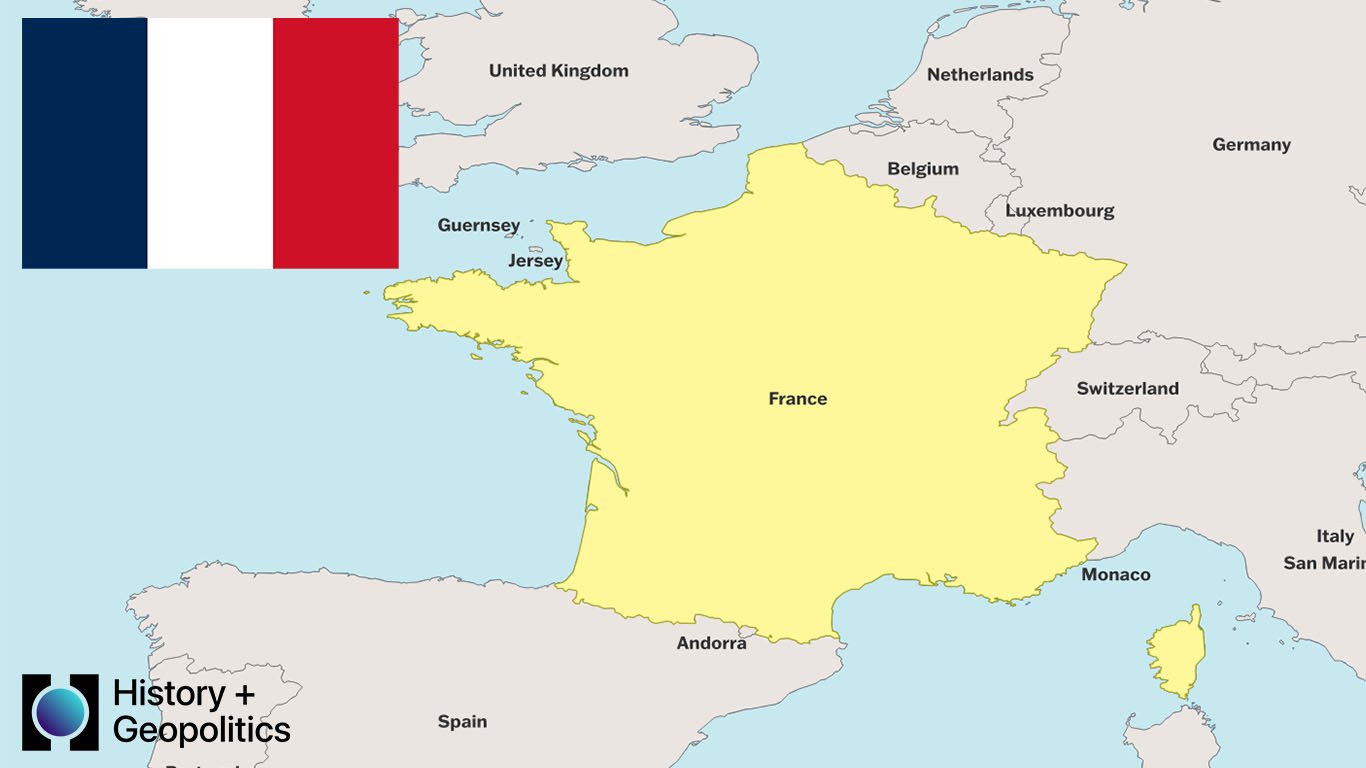
France is located in Western Europe, bordered by Belgium and Luxembourg to the north, Germany, Switzerland, and Italy to the east, Monaco to the southeast, Spain and Andorra to the south, and the Atlantic Ocean and the English Channel to the west and northwest.
France Facts
- OFFICIAL NAME: French Republic
- CAPITAL: Paris
- POPULATION: 66,746,401 (2026)
- AREA: 551,695 square kilometers
- OFFICIAL LANGUAGE: French
- CURRENCY: Euro (EUR)
France Flag
The flag of France, known as the Tricolore, has three equal vertical stripes — blue on the left, white in the middle, and red on the right. The three colors became associated with France during the French Revolution of 1789, when revolutionaries combined the red and blue colors of Paris with the white of the royal Bourbon dynasty. The blue represents liberty, the white represents equality, and the red represents fraternity — the three ideals of the French Republic summarized in the national motto “Liberté, Égalité, Fraternité.” The Tricolore went on to inspire the design of numerous national flags around the world, becoming one of the most influential flag designs in history.
France Geography
- Located in Western Europe, one of the largest countries in Europe by land area.
- Borders: Belgium and Luxembourg to the north, Germany, Switzerland, and Italy to the east, Monaco to the southeast, Spain and Andorra to the south.
- The Atlantic Ocean lies to the west, the English Channel to the northwest, and the Mediterranean Sea to the southeast.
- France also administers overseas territories across the world, including French Guiana in South America, Martinique and Guadeloupe in the Caribbean, and Réunion in the Indian Ocean.
- The terrain is highly varied, featuring the flat plains of the north, the Massif Central plateau in the center, the Alps and Pyrenees mountain ranges in the east and south, and the Mediterranean coast in the southeast.
- Mont Blanc, on the border with Italy, is the highest peak in France and in the entire Alps, rising to 4,808 meters.
- The Loire, Seine, Rhône, and Garonne are the country’s most important rivers.
- France has a diverse climate, ranging from oceanic in the northwest, continental in the east, and Mediterranean in the south.
- The island of Corsica in the Mediterranean Sea is also part of France.
France Government
- France is a semi-presidential republic, combining elements of both presidential and parliamentary systems.
- The President serves as head of state and holds significant executive authority, particularly in foreign and defense policy.
- The Prime Minister serves as head of government, overseeing domestic policy and the cabinet.
- France has a bicameral parliament consisting of the National Assembly and the Senate.
- Emmanuel Macron has served as President since 2017 and was re-elected in 2022.
- France is a founding member of the European Union and a permanent member of the United Nations Security Council.
- France is a nuclear power and one of the five permanent members of the UN Security Council with veto authority.
History of France
- France has one of the longest and most influential histories of any nation in the world, with human habitation dating back tens of thousands of years.
- The region was inhabited by Celtic Gauls before the Roman conquest led by Julius Caesar between 58 and 50 B.C.
- The Frankish Kingdom emerged after the fall of the Roman Empire, with Charlemagne becoming the most powerful ruler in Western Europe in the 9th century.
- The Capetian dynasty unified France in the medieval period, establishing Paris as a major European capital.
- The Hundred Years War with England from 1337 to 1453, during which Joan of Arc became a national heroine, consolidated French identity and territorial unity.
- The French Revolution of 1789 overthrew the monarchy, executed King Louis XVI, and established radical new principles of liberty, equality, and popular sovereignty that influenced the entire modern world.
- Napoleon Bonaparte rose to power following the revolution, built a vast European empire, and spread French legal and administrative principles across the continent before his final defeat in 1815.
- France built one of the largest colonial empires in history during the 19th and early 20th centuries, spanning Africa, Asia, and the Americas.
- France suffered immense destruction and loss of life in both World War I and World War II, with German forces occupying much of the country from 1940 to 1944.
- France was liberated in 1944 and went on to become a founding member of NATO and a driving force behind European integration.
- France decolonized its empire during the 1950s and 1960s, with the Algerian War of Independence being the most traumatic of these transitions.
People and Culture of France
- France has a diverse population reflecting centuries of immigration from Europe, North Africa, Sub-Saharan Africa, and Asia.
- French is the official language and is spoken by virtually the entire population, with regional languages such as Breton, Alsatian, and Occitan also present.
- France does not officially collect data on ethnicity, reflecting the republican principle that all citizens are equal regardless of origin.
- Christianity, particularly Roman Catholicism, has historically been the dominant religion, though France is one of the most secular countries in the world and Islam is the second largest religion.
- Baguette and croissant are among the most internationally recognized symbols of French cuisine, which is UNESCO-recognized as intangible cultural heritage.
- French cuisine, wine, and gastronomy are central to national identity, with France having more Michelin-starred restaurants than almost any other country.
- France has produced some of the world’s most celebrated philosophers, writers, artists, and scientists, including Descartes, Voltaire, Victor Hugo, Claude Monet, and Marie Curie.
- Fashion, luxury goods, and haute couture are synonymous with France, with Paris remaining the global capital of fashion.
Economy of France
- France has the seventh largest economy in the world and one of the largest in Europe.
- Key industries include aerospace, automotive, luxury goods, pharmaceuticals, agriculture, and tourism.
- France is the world’s most visited country, attracting tens of millions of tourists annually to Paris, the French Riviera, Loire Valley, and other destinations.
- The country is a leading producer of wine and agricultural products, with French wine internationally regarded as among the finest in the world.
- France has a significant nuclear energy sector, with nuclear power providing the majority of the country’s electricity.
- The French economy is characterized by a large public sector, strong welfare state, and significant state involvement in key industries.
France Resources
- France has significant agricultural resources, with fertile plains supporting wheat, wine, dairy, and livestock production.
- The country has substantial nuclear energy capacity, with numerous reactors providing a large share of domestic electricity.
- Hydroelectric power is generated from rivers in the Alps and Pyrenees.
- France has modest deposits of coal, iron ore, and bauxite, though mineral extraction has significantly declined.
- The country’s cultural heritage, landscapes, and cuisine represent some of its most valuable economic resources through tourism.
France Wildlife
- France’s diverse landscapes, from Atlantic coastlines to Alpine peaks and Mediterranean scrubland, support a rich variety of European wildlife.
- Brown bears survive in very small numbers in the Pyrenees, having been supplemented by reintroduced individuals from Slovenia.
- Wolves have naturally recolonized France from Italy since the 1990s and now inhabit several mountain and forest regions.
- The Camargue wetlands in southern France are home to flamingos, white horses, and black bulls in one of Europe’s most distinctive ecosystems.
- The French Alps support ibex, chamois, and golden eagles, while the forests of the Massif Central and Vosges shelter red deer and wild boar.
- France has established an extensive network of national parks, including the Vanoise, Écrins, and Cévennes parks, to protect its natural heritage.
- Marine mammals including dolphins and porpoises inhabit the Atlantic coastline, while the Mediterranean coast supports loggerhead sea turtles and diverse marine ecosystems.