Liechtenstein Country Profile
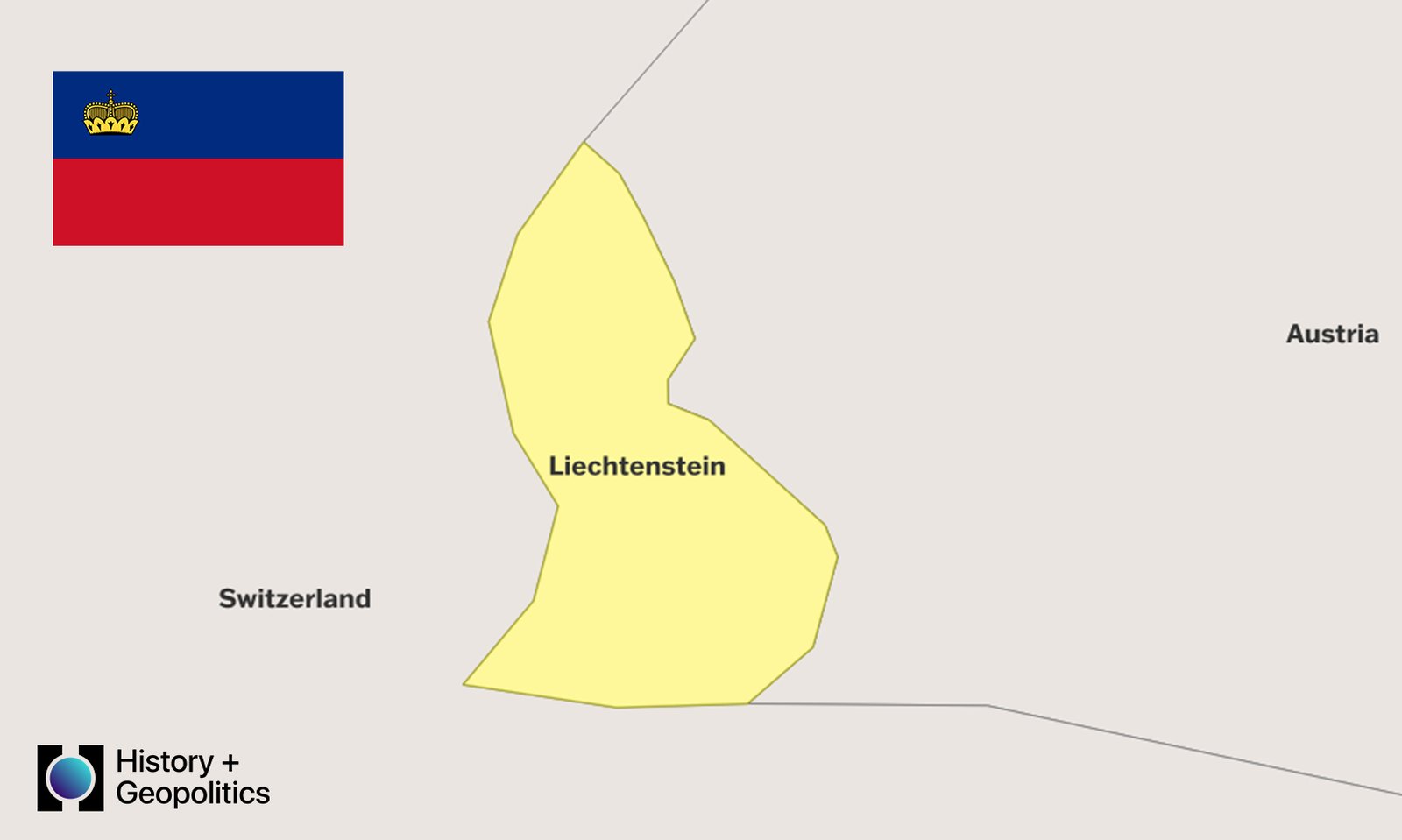
Liechtenstein is located in Central Europe, a tiny doubly landlocked principality nestled between Switzerland to the west and south and Austria to the east. It has no coastline and is one of only two doubly landlocked countries in the world, meaning it is surrounded entirely by landlocked countries.
Liechtenstein Facts
- OFFICIAL NAME: Principality of Liechtenstein
- CAPITAL: Vaduz
- POPULATION: 40,368 (2026)
- AREA: 160 square kilometers
- OFFICIAL LANGUAGE: German
- CURRENCY: Swiss Franc (CHF)
Liechtenstein Flag
The flag of Liechtenstein has two equal horizontal stripes — blue on top and red on the bottom — with a golden crown in the upper left corner of the blue stripe. The blue represents the sky above the country, while the red represents the evening fires traditionally lit inside the homes of the Liechtenstein people. The golden crown was added after the 1936 Berlin Olympics, when Liechtenstein discovered its flag was identical to that of Haiti and needed a way to distinguish itself. The crown represents the unity of the people and their prince, reflecting the country’s status as a constitutional monarchy.
Liechtenstein Geography
- Located in Central Europe, one of the smallest countries in the world.
- Bordered by Switzerland to the west and south and Austria to the east.
- One of only two doubly landlocked countries in the world, along with Uzbekistan.
- Despite its tiny size, Liechtenstein has remarkably varied terrain.
- The Rhine River valley runs along the western border with Switzerland.
- The eastern two-thirds of the country rise into the Alps, with rugged mountain terrain.
- The highest peak, Grauspitz, rises to 2,599 meters on the southern border.
- Liechtenstein has a temperate alpine climate, with cold winters and mild summers.
- The country is one of the most densely populated in the world despite its small size.
- Vaduz, the capital, sits in the Rhine valley and is overlooked by Vaduz Castle, the residence of the reigning prince.
watch Liechtenstein geography on youtube
Liechtenstein Government
- Liechtenstein is a constitutional monarchy and parliamentary democracy.
- The Prince serves as head of state with significant executive powers, more than most European monarchs.
- Prince Hans-Adam II has been the reigning prince since 1989 and transferred most day-to-day duties to his son Hereditary Prince Alois in 2004.
- The Prime Minister serves as head of government.
- Liechtenstein has a unicameral parliament called the Landtag, consisting of 25 members.
- Liechtenstein is not a member of the European Union but is part of the European Economic Area and uses the Swiss Franc.
- Liechtenstein joined the United Nations in 1990.
History of Liechtenstein
- The territory that became Liechtenstein has been inhabited since the Stone Age.
- The region was part of the Roman Empire and later came under the influence of various Germanic peoples and medieval principalities.
- The House of Liechtenstein, an Austrian noble family, purchased the County of Vaduz in 1712 and the Lordship of Schellenberg in 1699, combining them to form the Principality of Liechtenstein in 1719.
- Liechtenstein became a sovereign state within the Holy Roman Empire in 1719.
- Following the dissolution of the Holy Roman Empire in 1806, Liechtenstein briefly came under French influence before joining the German Confederation.
- Liechtenstein dissolved its army in 1868, making it one of the few countries to disband its military permanently.
- A customs and monetary union with Switzerland, established in 1923, has linked the two countries economically ever since.
- Liechtenstein remained neutral during both World War I and World War II.
- Universal male suffrage was introduced in 1984 and women gained the right to vote in 1984 as well, making Liechtenstein one of the last European countries to grant women’s suffrage.
- Since the 1960s, Liechtenstein has transformed from a relatively poor agricultural country into one of the world’s wealthiest nations per capita.
People and Culture of Liechtenstein
- Liechtensteiners make up approximately 65.5% of the population, with significant communities of Swiss, Austrians, Germans, and other nationalities making up the remainder.
- German is the official language, with an Alemannic dialect spoken in everyday life.
- Roman Catholicism is the official state religion, practiced by approximately 73% of the population.
- Käsknöpfle, small pasta dumplings layered with melted cheese and topped with crispy fried onions, is considered Liechtenstein’s national dish.
- Ribel, a traditional cornmeal dish, is another beloved local specialty with roots in the rural Alpine culture of the region.
- Liechtenstein has a strong tradition of postage stamp production, with its stamps being highly sought after by collectors worldwide and a significant source of national revenue.
- The Vaduz Castle, perched on a hillside above the capital, is the residence of the ruling prince and the most iconic symbol of the country.
Economy of Liechtenstein
- Liechtenstein has one of the highest per capita incomes in the world, driven by a combination of manufacturing, financial services, and tourism.
- The manufacturing sector, particularly precision instruments, dental equipment, and industrial machinery, is the most important contributor to GDP and exports.
- Financial services and private banking are significant, with Liechtenstein historically known as a low-tax financial center.
- The country has one of the lowest unemployment rates in the world, consistently below 2%.
- Liechtenstein has no national debt, a remarkable achievement reflecting its fiscal conservatism.
- A large proportion of the workforce commutes daily from neighboring Switzerland and Austria.
Liechtenstein Resources
- Liechtenstein has limited natural resources due to its small size and mountainous terrain.
- The Rhine Valley provides fertile agricultural land supporting viticulture, with Liechtenstein producing its own wines from vineyards along the valley.
- The Alpine terrain offers potential for hydroelectric power generation from mountain streams.
- The country’s natural Alpine landscapes and Vaduz Castle are valuable resources for tourism.
- Liechtenstein’s most significant economic resource is its skilled and highly educated workforce rather than natural assets.
Liechtenstein Wildlife
- Liechtenstein’s Alpine and Rhine Valley environments support a variety of central European wildlife.
- Red deer, roe deer, and chamois inhabit the forested Alpine slopes of the eastern highlands.
- The Rhine Valley wetlands provide habitat for migratory and resident waterbirds.
- The Alpine forests shelter foxes, badgers, and various raptor species including the red kite.
- Liechtenstein participates in regional conservation efforts through coordination with Switzerland and Austria, given that its small size means wildlife populations inevitably overlap across borders.
- The country has established nature reserves to protect its remaining wetlands and Alpine meadow habitats from development pressure.