Malaysia Country Profile
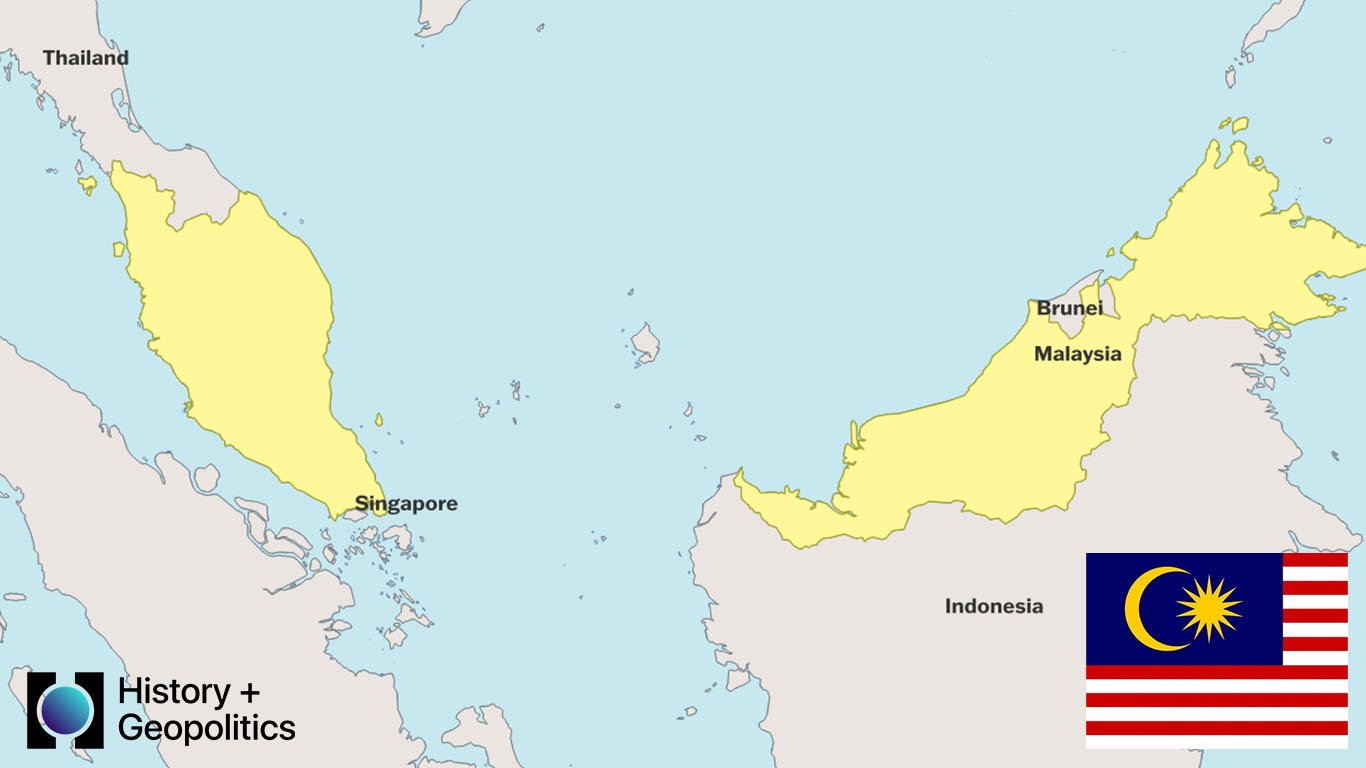
Malaysia is a Southeast Asian nation of remarkable geographic duality — split into two distinct regions separated by roughly 800 kilometres of the South China Sea. Peninsular Malaysia stretches south from Thailand down to Singapore, while East Malaysia occupies the northern third of the island of Borneo, sharing the island with Indonesia and Brunei. This unusual configuration gives Malaysia an extraordinary range of landscapes, cultures, and ecosystems, making it one of the most biodiverse and ethnically diverse countries in Asia.
MalaysiaFacts
- Capital: Kuala Lumpur (administrative capital: Putrajaya)
- Population: ~34.1 million (2025)
- Area: 329,847 km²
- Currency: Malaysian Ringgit (MYR)
- Official Language: Malay (Bahasa Malaysia)
- Time Zone: UTC+8
Flag of Malaysia
The flag of Malaysia, known as the Jalur Gemilang (“Stripes of Glory”), features 14 alternating red and white horizontal stripes representing the 13 states and the federal government. In the upper left canton sits a dark blue rectangle bearing a yellow crescent moon and a 14-pointed star. The crescent symbolises Islam, the state religion, while the 14-pointed star mirrors the unity of the states and federal territories. Yellow is the royal colour of the Malay rulers.
Geography of Malaysia
- Peninsular Malaysia is dominated by a central mountain range running north to south, with coastal plains on either side; East Malaysia (Sabah and Sarawak) is characterised by dense rainforest, river systems, and rugged highlands
- Mount Kinabalu in Sabah rises to 4,095 metres, the highest peak in Southeast Asia and a UNESCO World Heritage Site
- The Strait of Malacca — one of the world’s most strategically important shipping lanes — runs along the western coast of Peninsular Malaysia
- Malaysia has a tropical rainforest climate with high humidity, heavy rainfall year-round, and temperatures averaging 26–28°C
- The country is divided into 13 states and three federal territories; Sabah and Sarawak maintain distinct immigration controls from Peninsular MalaysiaWatch video Malaysia geography on YouTube
Government of Malaysia
- Malaysia is a federal parliamentary constitutional monarchy; the Yang di-Pertuan Agong (King) is elected every five years from among the nine hereditary Malay sultans
- The Prime Minister is the head of government; Anwar Ibrahim has served as Prime Minister since November 2022
- Parliament consists of a bicameral legislature: the Dewan Negara (Senate) and the Dewan Rakyat (House of Representatives)
- The country was governed by the United Malays National Organisation (UMNO)-led coalition for over 60 years until 2018, when it lost power for the first time; subsequent years saw considerable political turnover
- Malaysia is a member of ASEAN, the Commonwealth, and the OIC
History of Malaysia
- The Malay Peninsula has been inhabited for tens of thousands of years; the Sultanate of Malacca, founded around 1400, became one of the greatest trading empires in Southeast Asian history and spread Islam across the region
- Portugal captured Malacca in 1511, followed by the Dutch in 1641 and the British in 1824; British influence gradually extended across the peninsula and into Borneo
- The Federation of Malaya gained independence on 31 August 1957; Malaysia was formally established on 16 September 1963 when Singapore, Sabah, and Sarawak joined the federation
- Singapore was expelled from the federation in 1965, becoming an independent city-state
- Under Prime Minister Mahathir Mohamad (1981–2003), Malaysia transformed from a commodity-dependent economy into an industrialised nation, epitomised by the Petronas Twin Towers and the Vision 2020 development plan
- The 1MDB financial scandal under Prime Minister Najib Razak led to his defeat in 2018 and subsequent conviction for corruption
People and Culture of Malaysia
- Malaysia’s population is multiethnic: Bumiputera (Malays and indigenous groups) make up around 69%, Chinese around 21%, and Indians around 6%
- Islam is the official religion, practised by the Malay majority; Buddhism, Hinduism, Christianity, and Taoism are all practised by other communities
- The diversity of cultures is reflected in Malaysia’s extraordinary food scene — nasi lemak, char kway teow, roti canai, and laksa are beloved national dishes drawing from Malay, Chinese, and Indian traditions
- Bahasa Malaysia is the national language, but English is widely spoken in business and education; Tamil and various Chinese dialects are common in their respective communities
- The concept of “Malaysia Truly Asia” captures the country’s unique multicultural identity and is a core part of its tourism brand
- George Town in Penang is a UNESCO World Heritage Site celebrated for its colonial architecture, street art, and multicultural heritage
Economy of Malaysia
- Malaysia is one of Southeast Asia’s most dynamic economies, ranked 23rd globally for competitiveness in 2025, ahead of countries such as the United Kingdom and South Korea
- GDP reached approximately $410 billion, with the economy projected to grow around 4.5% in 2025, driven by manufacturing, services, and exports
- Electronics and semiconductors account for over 35% of total exports, making Malaysia a critical node in global semiconductor supply chains
- Palm oil is a major agricultural export; Malaysia is one of the world’s two largest producers alongside Indonesia
- Top trading partners include China, Singapore, and the United States
- The government’s New Industrial Master Plan 2030 aims to move Malaysia up the value chain into high-technology manufacturing, the digital economy, and green energy
Resources of Malaysia
- Malaysia holds significant petroleum and natural gas reserves, primarily offshore in Sarawak and Sabah; Petronas, the national oil company, is a Fortune 500 firm
- Timber and tropical hardwood have historically been major exports, though forest conservation has become a growing priority
- Malaysia is a leading producer of solar panels for international markets and has significant potential for large-scale renewable energy development
- Tin, bauxite, and copper are among the country’s mineral resources; Malaysia was once the world’s largest tin producer
Wildlife of Malaysia
- Malaysia is one of the world’s 17 “megadiverse” countries, harbouring an extraordinary concentration of plant and animal species in some of the world’s oldest rainforests, estimated at 130 million years old
- Iconic wildlife includes the Bornean orangutan, Malayan tiger, pygmy elephant, proboscis monkey, and sun bear — many of which are critically endangered
- The Coral Triangle extends into Malaysian Borneo; Sipadan Island off Sabah is considered one of the world’s top scuba diving destinations for its marine biodiversity
- Taman Negara in Peninsular Malaysia is one of the world’s oldest tropical rainforests and a haven for tapirs, leopards, gibbons, and hornbills
- Deforestation and palm oil expansion remain the greatest threats to Malaysia’s extraordinary natural heritage