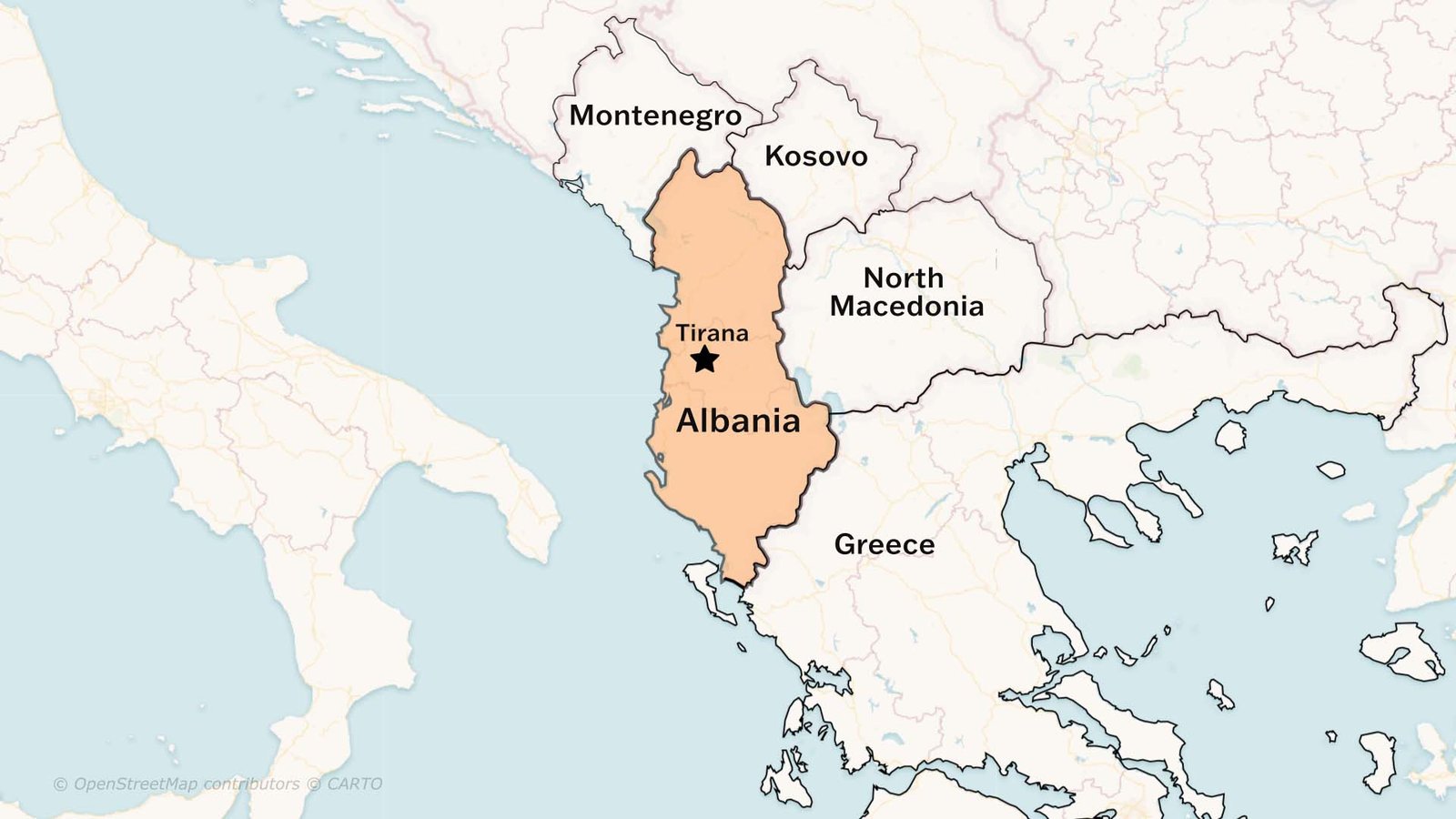
Albania is located in Southeastern Europe, on the western part of the Balkan Peninsula. It shares its borders with Montenegro to the northwest, Kosovo to the northeast, North Macedonia to the east, and Greece to the south. To the west, Albania faces the Adriatic Sea, and to the southwest, the Ionian Sea.
Albania Facts
- OFFICIAL NAME: Republic of Albania
- CAPITAL: Tirana
- POPULATION: 2,751,025 (2026)
- AREA: 28,748 square kilometers
- OFFICIAL LANGUAGE: Albanian
- CURRENCY: Albanian Lek (ALL)
Albania Flag
The flag of Albania has a red background with a black double-headed eagle in the center. The red color represents bravery, strength, and valor. The double-headed eagle is a very old symbol that dates back to the medieval Albanian ruler Gjergj Kastrioti, also known as Skanderbeg, who used it as his personal seal while fighting against the Ottoman Empire in the 15th century. The two heads of the eagle are said to represent the two parts of Albania — the north and the south. The flag is one of the oldest national symbols in Europe and remains a powerful symbol of Albanian identity and independence.
Albania Geography
- Located on the western Balkan Peninsula in Southeastern Europe.
- Borders:
- Montenegro to the northwest
- Kosovo to the northeast
- North Macedonia to the east
- Greece to the south
- The Adriatic Sea lies to the west and the Ionian Sea to the southwest.
- About 70% of the country is covered by mountains and hills.
- The Albanian Alps rise in the north, with rugged peaks and deep valleys.
- The western coastal plain is flat and fertile, where most farming takes place.
- The country has several rivers including the Drin, Shkumbin, and Vjosa.
- Albania has a Mediterranean climate along the coast — hot dry summers and mild wet winters.
- The inland and mountainous areas experience colder winters and heavier snowfall.
- Albania has several lakes including Lake Shkodra, Lake Ohrid, and Lake Prespa, which are shared with neighboring countries.
- Lake Ohrid is one of the oldest and deepest lakes in Europe.
- The coastline stretches for about 476 kilometers along the Adriatic and Ionian Seas.
Albania Government
- Albania is a parliamentary republic.
- The President is the head of state and the Prime Minister is the head of government.
- Albania held its first multiparty elections in 1991 after decades of communist rule.
- Albania became a member of NATO in 2009.
- Albania is currently a candidate country for membership in the European Union.
History of Albania
- Albania has been inhabited since the Paleolithic period, over 100,000 years ago.
- The ancient Illyrians were among the earliest known people to settle the region.
- In 168 B.C., the region came under Roman rule.
- In the 15th century, the Ottoman Empire conquered Albania and ruled it for over 400 years.
- During Ottoman rule, much of the population converted to Islam.
- Gjergj Kastrioti Skanderbeg led a famous resistance against the Ottomans from 1443 to 1468 and is considered Albania’s greatest national hero.
- Albania declared independence on November 28, 1912.
- After World War II, Albania became a communist state under dictator Enver Hoxha.
- For decades, Albania was one of the most isolated and closed countries in the world.
- After the fall of communism in 1991, Albania transitioned to a democratic system.
- Today, Albania is working towards European integration and economic development.
People and Culture of Albania
- Albania is one of the most ethnically homogeneous countries in Europe, with Albanians making up over 95% of the population.
- Small minority groups include Greeks, Macedonians, and Roma.
- The majority of the population is Muslim, with significant Christian minorities including Orthodox Christians and Catholics.
- The Albanian language is unique and does not belong to any other language family — it is its own separate branch of the Indo-European family.
- Albanians are known for their strong tradition of hospitality, guided by an ancient code of conduct called the Kanun.
- The Kanun is a set of traditional laws governing honor, family, and social behavior.
- Folk music, traditional costumes, and dance are an important part of Albanian culture.
- Byrek — a savory pastry filled with cheese or meat — is one of the most popular traditional foods.
- Tavë Kosi, a dish made with lamb and yogurt, is considered the national dish of Albania.
- Coffee culture is very strong, and Albanians enjoy spending time in cafes.
Economy of Albania
- Albania has a developing economy that has grown significantly since the end of communism.
- Agriculture is an important sector, with crops including wheat, corn, vegetables, and fruits.
- Tourism is one of the fastest growing industries, with visitors attracted to Albania’s beaches, mountains, and historical sites.
- The construction, trade, and service sectors also contribute to the economy.
- Many Albanians work abroad and send money home, which plays an important role in supporting the economy.
- Albania has been working to attract foreign investment and improve infrastructure.
- Unemployment and emigration remain ongoing challenges.
Albania Resources
- Albania has significant reserves of chromite — it is one of the largest producers of chromium in Europe.
- Other minerals include copper, iron ore, nickel, and coal.
- Albania also has oil and natural gas reserves, particularly in the western lowlands.
- Hydropower is an important energy resource, with many rivers used to generate electricity.
- Forests cover a large portion of the country and provide timber resources.
- The fertile coastal plains support agricultural production.
- The country’s natural landscapes, coastlines, and mountains are also valuable resources for tourism.
Albania Wildlife
- Albania’s varied landscape supports a rich variety of wildlife.
- The Albanian Alps in the north are home to brown bears, wolves, and lynx.
- The endangered Balkan lynx is one of the rarest cats in the world and lives in the mountainous regions of Albania.
- Golden eagles and various birds of prey are found across the mountains.
- Lake Shkodra and Lake Ohrid are important habitats for fish and waterbirds.
- The Dalmatian pelican, one of the world’s largest flying birds, can be found near Albanian lakes and wetlands.
- Loggerhead sea turtles nest along the Albanian coastline.
- Decades of isolation under communism inadvertently helped preserve some of Albania’s natural environment.
- Increasing tourism and development now pose new challenges to wildlife conservation.
Also read: Afghanistan country profile