Algeria Country Profile
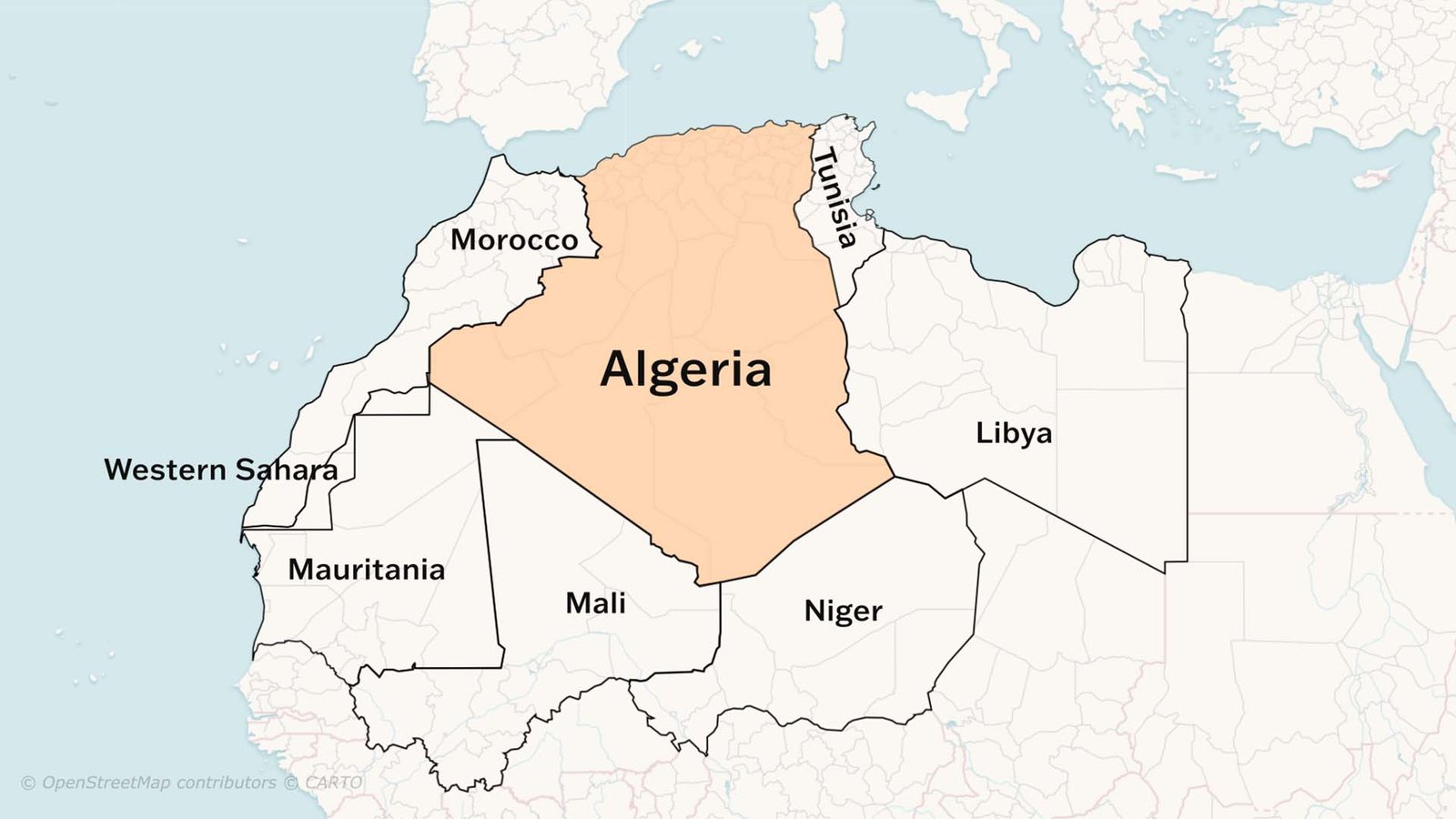
Algeria is located in North Africa, making it the largest country on the African continent and the tenth largest country in the world. It shares its borders with Tunisia and Libya to the northeast, Niger and Mali to the south, Mauritania and Western Sahara to the southwest, and Morocco to the northwest. To the north, Algeria faces the Mediterranean Sea, which forms its entire northern coastline.
Algeria Facts
- OFFICIAL NAME: People’s Democratic Republic of Algeria
- CAPITAL: Algiers
- POPULATION: 48,028,334 (2026)
- AREA: 2,381,741 square kilometers
- OFFICIAL LANGUAGES: Arabic, Amazigh (Tamazight)
- CURRENCY: Algerian Dinar (DZD)
Algeria Flag
The flag of Algeria is divided into two equal vertical halves — green on the left and white on the right. In the center, where the two halves meet, there is a red crescent moon and a red five-pointed star. The green color represents Islam and the natural beauty of the country. The white represents peace and purity. The red crescent and star are traditional symbols of Islam. The crescent is slightly turned, which is a unique feature of the Algerian flag compared to other flags using the same symbol. Algeria officially adopted this flag on July 3, 1962, the day after the country gained independence from France.
Algeria Geography
- Located in North Africa, bordering the Mediterranean Sea to the north.
- Borders: Tunisia and Libya to the northeast, Niger and Mali to the south, Mauritania and Western Sahara to the southwest, Morocco to the northwest.
- Algeria is the largest country in Africa and the tenth largest in the world.
- The northern region, known as the Tell, is fertile and densely populated.
- The Atlas Mountains run through the northern part of the country.
- South of the mountains lies the high plateau region, used mainly for grazing.
- About 90% of Algeria is covered by the Sahara Desert.
- The highest peak, Mount Tahat, rises to 2,908 meters in the Ahaggar range.
- The northern coast has a Mediterranean climate with hot dry summers and mild wet winters.
- The Chelif River is the longest river in Algeria, flowing into the Mediterranean Sea.
- Algeria has a long Mediterranean coastline stretching approximately 1,200 kilometers.
Algeria Government
- Algeria is a presidential republic.
- The President is the head of state and holds significant executive power.
- The Prime Minister serves as the head of government.
- Algeria has a bicameral parliament consisting of the National People’s Assembly and the Council of the Nation.
- Algeria gained independence from France on July 5, 1962.
History of Algeria
- Algeria has been inhabited since prehistoric times, with evidence of human settlement dating back over 200,000 years.
- The Berbers, also known as Amazigh people, are the indigenous inhabitants of the region.
- Arab armies conquered the region in the 7th century A.D., bringing Islam to the Berber population.
- The Ottoman Empire took control of Algeria in the early 16th century.
- France invaded and colonized Algeria in 1830, beginning over 130 years of French rule.
- The Algerian War of Independence began in 1954, led by the National Liberation Front (FLN).
- Algeria gained full independence from France on July 5, 1962.
- During the 1990s, Algeria experienced a civil conflict known as the Black Decade.
- In 2019, mass protests known as the Hirak movement led to the resignation of long-time President Abdelaziz Bouteflika.
People and Culture of Algeria
- Arabs and Berbers (Amazigh) make up the majority of Algeria’s population.
- The Tuareg are a Berber nomadic people who inhabit the Sahara Desert region of Algeria.
- Arabic is the official language, but Tamazight (Berber) was also recognized as an official language in 2016.
- Couscous is the national dish of Algeria, made with steamed semolina and served with meat and vegetables.
- Music is deeply rooted in Algerian culture, with styles including Rai, Chaabi, and Andalusian classical music.
- Hospitality is a deeply valued tradition in Algerian culture.
Economy of Algeria
- Algeria’s economy is heavily dependent on oil and natural gas, which account for the majority of government revenue and export earnings.
- Algeria is one of the largest producers and exporters of natural gas in Africa.
- Agriculture employs a significant portion of the population, with crops including wheat, barley, olives, grapes, and citrus fruits.
- Tourism is a developing sector, with historical sites, Sahara Desert tourism, and Mediterranean coastline attracting visitors.
Algeria Resources
- Algeria has vast reserves of oil and natural gas, making it one of the most energy-rich countries in Africa.
- The country also has significant deposits of iron ore, phosphates, uranium, and lead.
- Algeria is believed to have some of the largest shale gas reserves in the world.
- Renewable energy potential is enormous, particularly solar energy, due to the vast Sahara Desert.
Algeria Wildlife
- The Fennec Fox, the world’s smallest wild dog, is found in the Saharan regions and is the national animal of Algeria.
- The Barbary macaque, one of Africa’s only native primates, lives in the northern Atlas Mountains.
- The Saharan cheetah is one of the rarest animals in the world and can still be found in very small numbers in the Algerian Sahara.
- Addax antelope and Dama gazelle are critically endangered species found in the Saharan regions.
- The Mediterranean monk seal, one of the world’s most endangered marine mammals, has been spotted along Algeria’s coastline.