Angola Country Profile
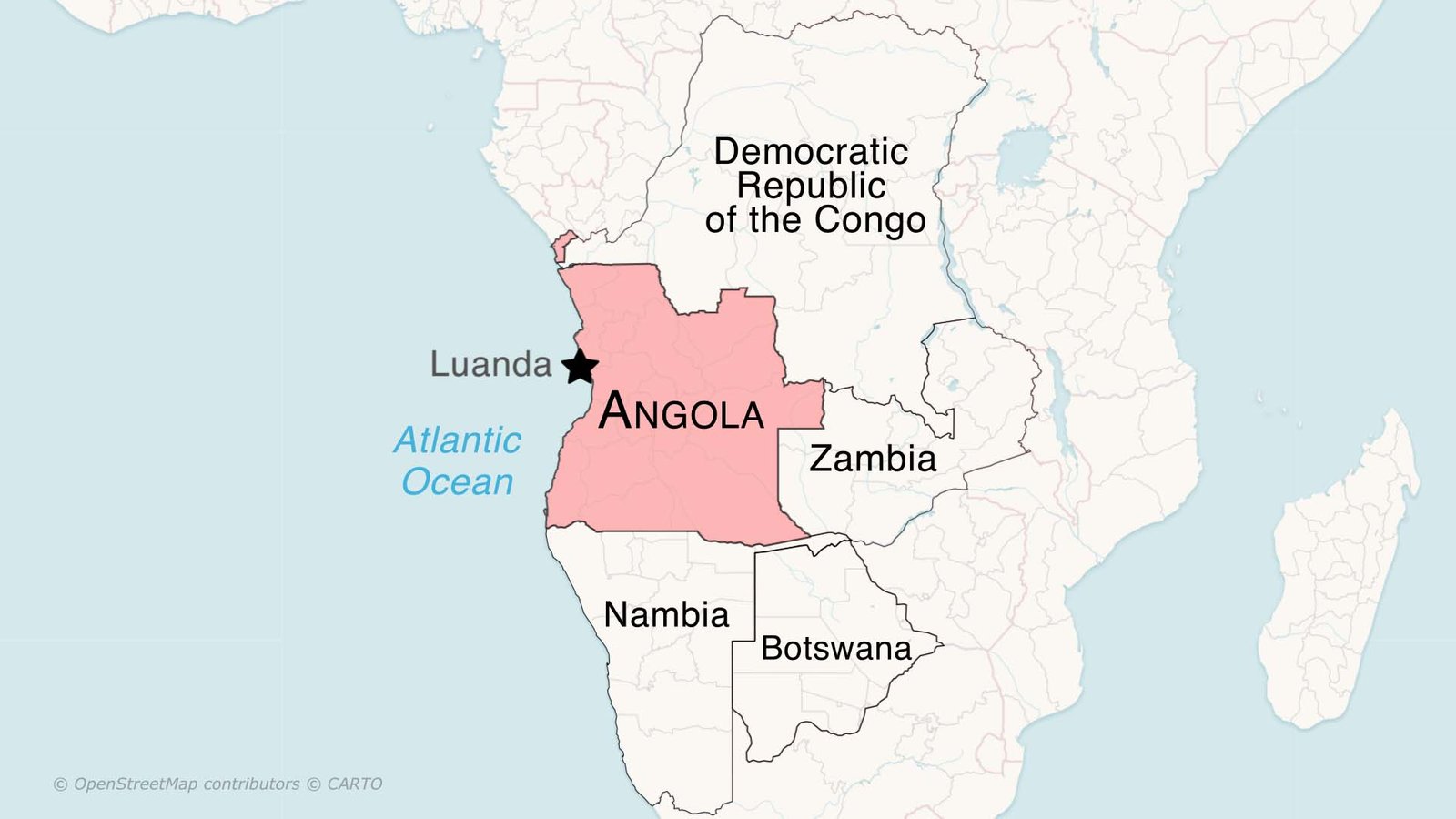
Angola is located in Southern Africa, bordered by the Democratic Republic of the Congo to the north and northeast, Zambia to the east, Namibia to the south, and the Atlantic Ocean to the west.
Angola Facts
- OFFICIAL NAME: Republic of Angola
- CAPITAL: Luanda
- POPULATION: 40,215,179 (2026)
- AREA: 1,246,700 square kilometers
- OFFICIAL LANGUAGE: Portuguese
- CURRENCY: Angolan Kwanza (AOA)
Angola Flag
The flag of Angola has two horizontal bands — red on top and black on the bottom. In the center sits a yellow emblem made up of a machete, a cogwheel segment, and a star. The red represents the bloodshed during the struggle for independence, while the black represents the African continent. The yellow machete symbolizes the peasants and agricultural workers, the cogwheel represents industrial workers, and the star symbolizes progress and international solidarity. The design draws inspiration from the hammer and sickle, reflecting Angola’s Marxist origins as a former liberation movement that became the ruling party after independence.
Angola Geography
- Located in Southern Africa, with a coastline along the Atlantic Ocean to the west.
- Borders: Democratic Republic of the Congo to the north and northeast, Zambia to the east, Namibia to the south.
- Angola also includes the exclave of Cabinda, separated from the rest of the country by a strip of Congolese territory.
- The terrain consists of a narrow coastal plain that rises to vast inland plateaus.
- The interior highlands, known as the Bié Plateau, reach elevations of over 1,500 meters.
- The Namib Desert extends into the southwestern part of the country, creating a dry, arid region.
- Angola has a tropical climate in the north and a more temperate climate in the highlands.
- The country experiences a rainy season and a dry season, with rainfall decreasing from north to south.
- Major rivers include the Cuanza, Cunene, and Zambezi, which originates in Angola’s highlands.
- Angola has a coastline stretching approximately 1,600 kilometers along the Atlantic Ocean.
Angola Government
- Angola is a presidential republic.
- The President serves as both head of state and head of government.
- The People’s Movement for the Liberation of Angola (MPLA) has been the ruling party since independence in 1975.
- Angola has a unicameral parliament called the National Assembly.
- The country transitioned from a one-party Marxist state to a multi-party system in the early 1990s.
History of Angola
- The region has been inhabited for thousands of years by various Bantu-speaking peoples.
- The Kingdom of Ndongo and the Kingdom of Kongo were powerful states in the region before European contact.
- Portuguese explorers arrived in the late 15th century and established trading posts along the coast.
- Angola became a major center of the transatlantic slave trade under Portuguese colonization.
- Portugal formally established Angola as a colony, ruling the territory for nearly 500 years.
- A long war for independence began in 1961 against Portuguese colonial rule.
- Angola gained independence from Portugal on November 11, 1975.
- Independence was immediately followed by a civil war between rival liberation movements, lasting until 2002.
- Since the end of the civil war, Angola has focused on rebuilding infrastructure and growing its oil-based economy.
People and Culture of Angola
- The Ovimbundu are the largest ethnic group in Angola, making up over a third of the population.
- Other major groups include the Kimbundu and the Bakongo.
- Portuguese is the official language, though many Angolans also speak Bantu languages such as Umbundu and Kikongo.
- Roman Catholicism is the largest religion, with other Christian denominations and traditional beliefs also practiced.
- Funge, a starchy dish made from cassava or maize flour, is a staple food often served with fish or meat stew.
- Music and dance play a central role in Angolan culture, with styles such as Kizomba and Semba originating in the country.
- Angolan culture reflects a blend of African traditions and Portuguese colonial influence.
Economy of Angola
- Angola’s economy is heavily dependent on oil production, which accounts for the majority of government revenue and exports.
- Angola is one of the largest oil producers in sub-Saharan Africa.
- Diamond mining is another significant contributor to the economy.
- Agriculture employs a large share of the population, with crops including cassava, maize, and bananas.
- The government has been working to diversify the economy beyond oil and reduce poverty.
- Decades of civil war severely damaged infrastructure, and rebuilding remains an ongoing process.
- Income inequality remains a significant challenge despite the country’s natural wealth.
Angola Resources
- Angola has substantial reserves of oil and natural gas, mainly located offshore and in the Cabinda region.
- The country is one of the world’s leading producers of high-quality diamonds.
- Other mineral resources include iron ore, copper, gold, and phosphates.
- Angola’s fertile highlands support agricultural production, including coffee, which was historically a major export.
- Hydropower potential is significant due to the country’s many rivers, including the Cuanza River.
- Extensive forests in the northern regions provide timber resources.
Angola Wildlife
- Angola’s diverse landscapes, from coastal plains to highlands, support a wide range of wildlife.
- The giant sable antelope, found only in Angola, is the country’s national symbol and one of Africa’s rarest antelope species.
- African elephants, lions, and leopards inhabit Angola’s national parks, including Kissama National Park.
- Black rhinos once roamed Angola but were severely impacted by decades of civil war and poaching.
- The Angolan coastline is home to humpback whales, which migrate through its waters seasonally.
- Years of conflict significantly reduced wildlife populations across the country.
- Conservation efforts in recent years have focused on restoring wildlife populations in protected areas.