Austria Country Profile
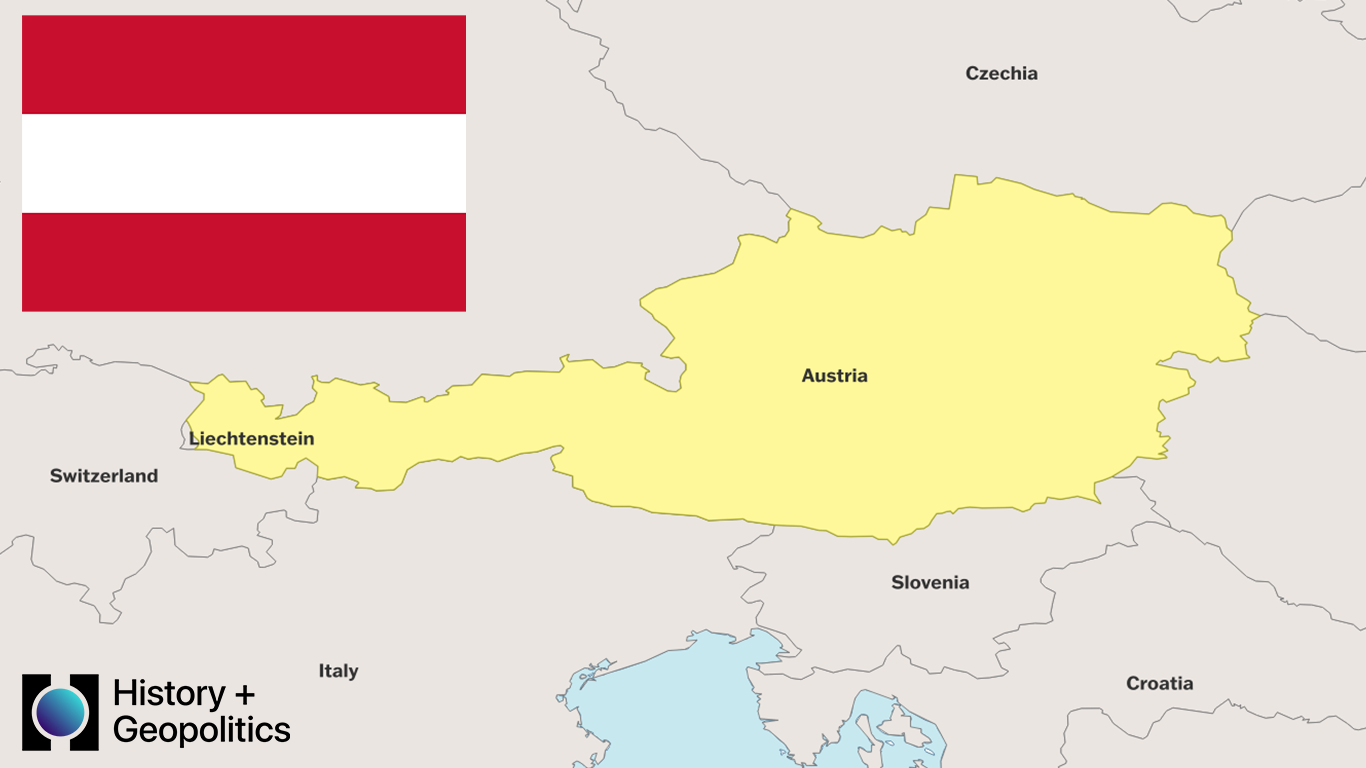
Austria is located in Central Europe, a landlocked country bordered by Germany and the Czech Republic to the north, Slovakia and Hungary to the east, Slovenia and Italy to the south, and Switzerland and Liechtenstein to the west.
Austria Facts
- OFFICIAL NAME: Republic of Austria
- CAPITAL: Vienna
- POPULATION: 9,107,266 (2026)
- AREA: 83,879 square kilometers
- OFFICIAL LANGUAGE: German
- CURRENCY: Euro (EUR)
Austria Flag
The flag of Austria has three horizontal stripes — red on top, white in the middle, and red on the bottom. It is one of the oldest national flags in the world, with origins tracing back to the 13th century. According to legend, the design originated from the blood-stained white tunic of Duke Leopold V after a battle during the Third Crusade, where his white garment remained clean only where his sword belt had been, creating the red-white-red pattern. The flag has remained largely unchanged for centuries and symbolizes Austria’s long-standing national identity.
Austria Geography
- Located in Central Europe, completely landlocked with no access to the sea.
- Borders: Germany and the Czech Republic to the north, Slovakia and Hungary to the east, Slovenia and Italy to the south, Switzerland and Liechtenstein to the west.
- The Alps cover roughly 62% of the country, making Austria one of the most mountainous nations in Europe.
- The highest peak, Grossglockner, rises to 3,798 meters.
- The Danube River flows through northern Austria, including through the capital, Vienna.
- Austria has a temperate climate, with cold winters and mild summers, varying significantly with altitude.
- The eastern regions, including the Vienna Basin, are flatter and used for agriculture.
- Numerous alpine lakes and valleys make Austria a major destination for skiing and mountain tourism.
- Forests cover nearly half of the country’s land area.
Austria Government
- Austria is a federal parliamentary republic.
- The President serves as head of state, with mostly ceremonial duties.
- The Chancellor serves as head of government and holds most executive power.
- Austria is composed of nine federal states, each with its own regional government.
- The national parliament consists of two chambers — the National Council and the Federal Council.
- Austria has been a permanently neutral country since 1955, a status enshrined in its constitution.
History of Austria
- The region has been inhabited since prehistoric times, with Celtic tribes settling the area before Roman conquest.
- The Babenberg dynasty established control over the Austrian territories in the 10th century.
- The Habsburg dynasty took control in 1273, beginning centuries of rule that shaped much of European history.
- Vienna became the capital of the Holy Roman Empire and later the Austro-Hungarian Empire.
- The Austro-Hungarian Empire was one of the great powers of Europe until its collapse following World War I in 1918.
- Austria became a republic in 1918 after the fall of the Habsburg monarchy.
- Austria was annexed by Nazi Germany in 1938 and remained under German control until the end of World War II in 1945.
- Following the war, Austria was occupied by Allied forces until 1955, when it regained full sovereignty and declared permanent neutrality.
- Austria joined the European Union in 1995.
People and Culture of Austria
- The majority of Austria’s population is ethnically Austrian, with growing communities from neighboring and other European countries.
- German is the official language, with regional dialects spoken throughout the country.
- Roman Catholicism is the largest religion, though religious affiliation has been declining in recent decades.
- Austria has a rich tradition in classical music, having been home to composers such as Mozart, Beethoven, and Strauss.
- Wiener Schnitzel, a breaded and fried veal or pork cutlet, is one of Austria’s most famous national dishes.
- Coffee house culture, particularly in Vienna, is an important part of Austrian social life and is recognized by UNESCO as part of the nation’s cultural heritage.
- Skiing and winter sports are deeply embedded in Austrian culture due to the country’s alpine geography.
Economy of Austria
- Austria has a highly developed, export-oriented economy with strong industrial and service sectors.
- Manufacturing, particularly in machinery, automotive parts, and chemicals, plays a significant role in the economy.
- Tourism is a major contributor, with visitors drawn to Austria’s alpine scenery, historic cities, and skiing resorts.
- Austria has close economic ties with Germany and other European Union member states.
- The country has a strong social welfare system and consistently ranks high in quality of life indexes.
- Agriculture, though a smaller part of the economy, includes dairy farming and viticulture.
Austria Resources
- Austria has limited mineral resources but maintains some production of magnesite, iron ore, and salt.
- Forests cover nearly half the country, supporting a significant timber industry.
- Hydropower is a major source of domestic energy, generated extensively from Austria’s rivers and alpine terrain.
- Austria has historically been known for salt mining, particularly in the Salzkammergut region, which gave the city of Salzburg its name.
- The Alps themselves serve as one of Austria’s most valuable economic resources through tourism.
Austria Wildlife
- Austria’s alpine and forested terrain supports a variety of wildlife.
- Alpine ibex and chamois inhabit the high mountain regions of the Alps.
- Red deer and roe deer are common throughout Austria’s forests.
- Golden eagles and bearded vultures can be found in the more remote alpine areas.
- The country has several national parks, including Hohe Tauern National Park, the largest protected area in the Alps.
- Brown bears, once extinct in Austria, have been the subject of reintroduction efforts in select regions.
- Conservation programs continue to focus on preserving alpine biodiversity amid increasing tourism pressure.