Azerbaijan Country Profile
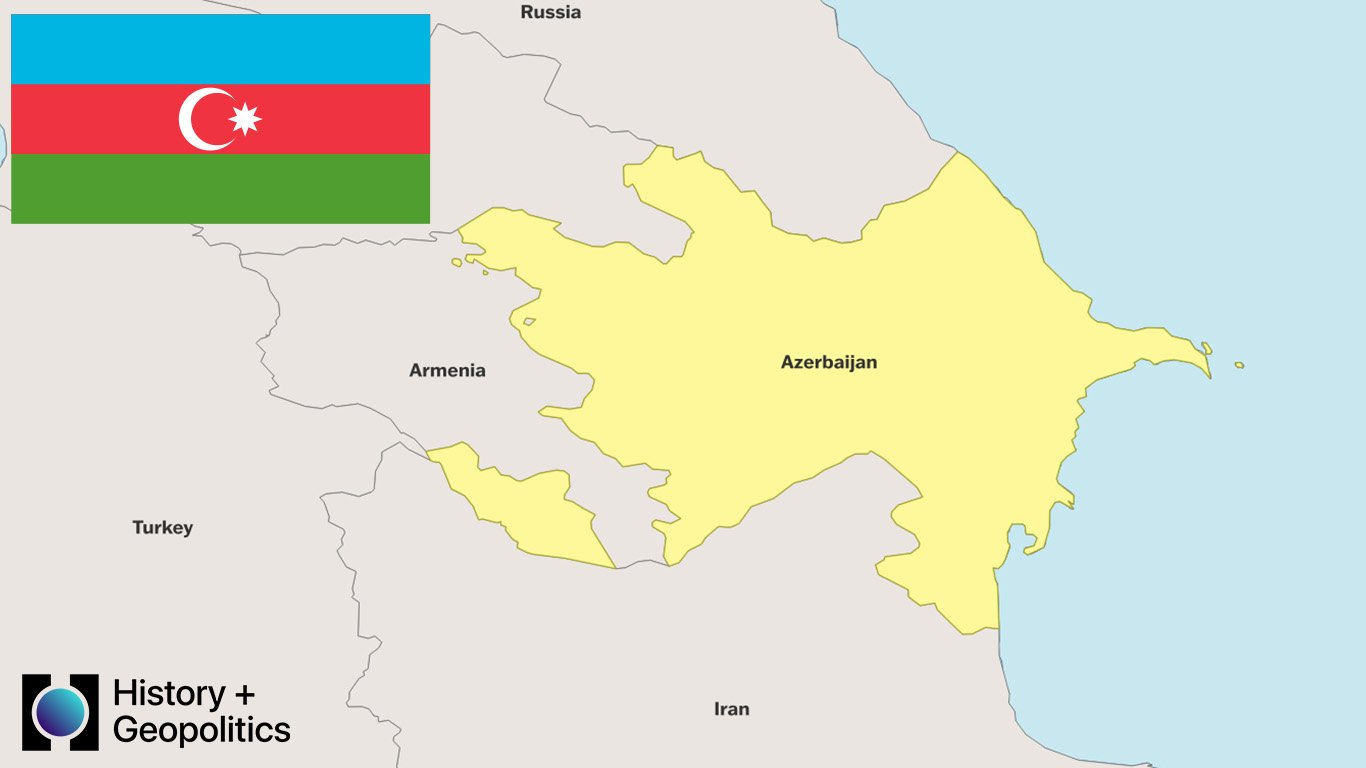
Azerbaijan is located at the crossroads of Eastern Europe and Western Asia, in the South Caucasus region. It is bordered by Russia to the north, Georgia to the northwest, Armenia to the west, Iran to the south, and has a coastline along the Caspian Sea to the east.
Azerbaijan Facts
- OFFICIAL NAME: Republic of Azerbaijan
- CAPITAL: Baku
- POPULATION: 10,454,855 (2026)
- AREA: 86,600 square kilometers
- OFFICIAL LANGUAGE: Azerbaijani
- CURRENCY: Azerbaijani Manat (AZN)
Azerbaijan Flag
The flag of Azerbaijan has three equal horizontal stripes — blue on top, red in the middle, and green on the bottom. In the center of the red stripe is a white crescent moon and an eight-pointed star. The blue represents Azerbaijan’s Turkic heritage, the red symbolizes progress and modernization, and the green represents Islam. The crescent moon and star are traditional symbols of Islamic identity, while the eight points of the star are said to represent the eight branches of the Turkic peoples or the letters of the word “Azerbaijan” in the Arabic script historically used to write the language.
Azerbaijan Geography
- Located in the South Caucasus, at the crossroads of Eastern Europe and Western Asia.
- Borders: Russia to the north, Georgia to the northwest, Armenia to the west, Iran to the south.
- Has a coastline along the Caspian Sea to the east, the largest enclosed inland body of water in the world.
- Azerbaijan also includes the Nakhchivan Autonomous Republic, an exclave separated from the main territory by Armenia.
- The terrain ranges from the Caucasus Mountains in the north to lowland plains near the Caspian coast.
- The Greater Caucasus mountain range runs along the northern border with Russia.
- Azerbaijan is home to a significant number of mud volcanoes, among the highest concentrations in the world.
- The country has a varied climate, including subtropical, semi-arid, and alpine conditions depending on the region.
- The Kura River is the longest river in the country, flowing into the Caspian Sea.
- Azerbaijan is often referred to as the “Land of Fire” due to its natural gas seepages and historic eternal flames.
Azerbaijan Government
- Azerbaijan is a presidential republic.
- The President serves as both head of state and head of government, holding significant executive authority.
- Azerbaijan has a unicameral parliament called the National Assembly, or Milli Majlis.
- The country regained independence from the Soviet Union in 1991.
- Azerbaijan has been involved in a long-standing territorial conflict with Armenia over the Nagorno-Karabakh region.
History of Azerbaijan
- The region has a long history of settlement, with ancient civilizations dating back thousands of years.
- Azerbaijan was an important center along ancient trade routes, including segments of the Silk Road.
- The region came under the influence of various empires, including the Persians, Arabs, and later the Russian Empire in the 19th century.
- Baku became a major center of the global oil industry in the late 19th century, attracting international investment.
- Azerbaijan briefly became an independent republic in 1918 before being incorporated into the Soviet Union in 1920.
- Azerbaijan declared independence from the Soviet Union on October 18, 1991.
- Following independence, Azerbaijan fought a war with Armenia over the Nagorno-Karabakh region in the early 1990s.
- In 2020, renewed conflict over Nagorno-Karabakh resulted in significant territorial changes in Azerbaijan’s favor.
- In 2023, Azerbaijan regained full control over the Nagorno-Karabakh region.
People and Culture of Azerbaijan
- The majority of the population is ethnically Azerbaijani, with smaller communities of Russians, Lezgins, and other groups.
- Azerbaijani, a Turkic language, is the official language of the country.
- Islam is the predominant religion, with the majority of Muslims following the Shia branch.
- Plov, a rice dish often prepared with meat, herbs, and dried fruits, is considered a national dish.
- Azerbaijani culture places strong importance on hospitality, poetry, and traditional music, including the mugham musical tradition.
- Carpet weaving is a centuries-old craft and an important part of Azerbaijani cultural heritage, recognized by UNESCO.
- Tea is widely consumed throughout the country and plays a significant role in social customs.
Economy of Azerbaijan
- Azerbaijan’s economy is heavily dependent on oil and natural gas production, particularly from offshore fields in the Caspian Sea.
- The country is a significant exporter of crude oil and natural gas to international markets, including Europe.
- The government has been working to diversify the economy beyond hydrocarbons, investing in agriculture, tourism, and information technology.
- Agriculture remains important in rural areas, with production of cotton, fruits, and vegetables.
- Baku has developed rapidly as a modern business and tourism hub in recent decades.
- Azerbaijan maintains strong trade relationships with Turkey, Russia, and European nations.
Azerbaijan Resources
- Azerbaijan has substantial reserves of oil and natural gas, primarily located in the Caspian Sea.
- The country has a long history of oil production, dating back over a century.
- Natural gas exports have grown significantly, with pipelines connecting Azerbaijan to European energy markets.
- Mineral resources include iron ore, aluminum, and various non-ferrous metals.
- Fertile lowland regions support agricultural production, including cotton and viticulture.
- The mud volcanoes and natural gas seepages found throughout the country are unique geological resources.
Azerbaijan Wildlife
- Azerbaijan’s diverse landscapes, from mountains to wetlands, support a wide range of wildlife.
- The Caucasian leopard, an endangered subspecies, is found in remote mountainous areas of the country.
- Brown bears, wolves, and lynx inhabit the forested regions of the Greater Caucasus.
- The Caspian seal, found only in the Caspian Sea, is one of the world’s most endangered marine mammals.
- Flamingos and other migratory birds gather in large numbers at wetland areas such as the Kura River Delta.
- Azerbaijan has established several national parks, including Shirvan National Park, to protect its native species.
- Conservation efforts focus on protecting endangered species such as the Caucasian leopard and the Caspian seal.