Bahrain Country Profile
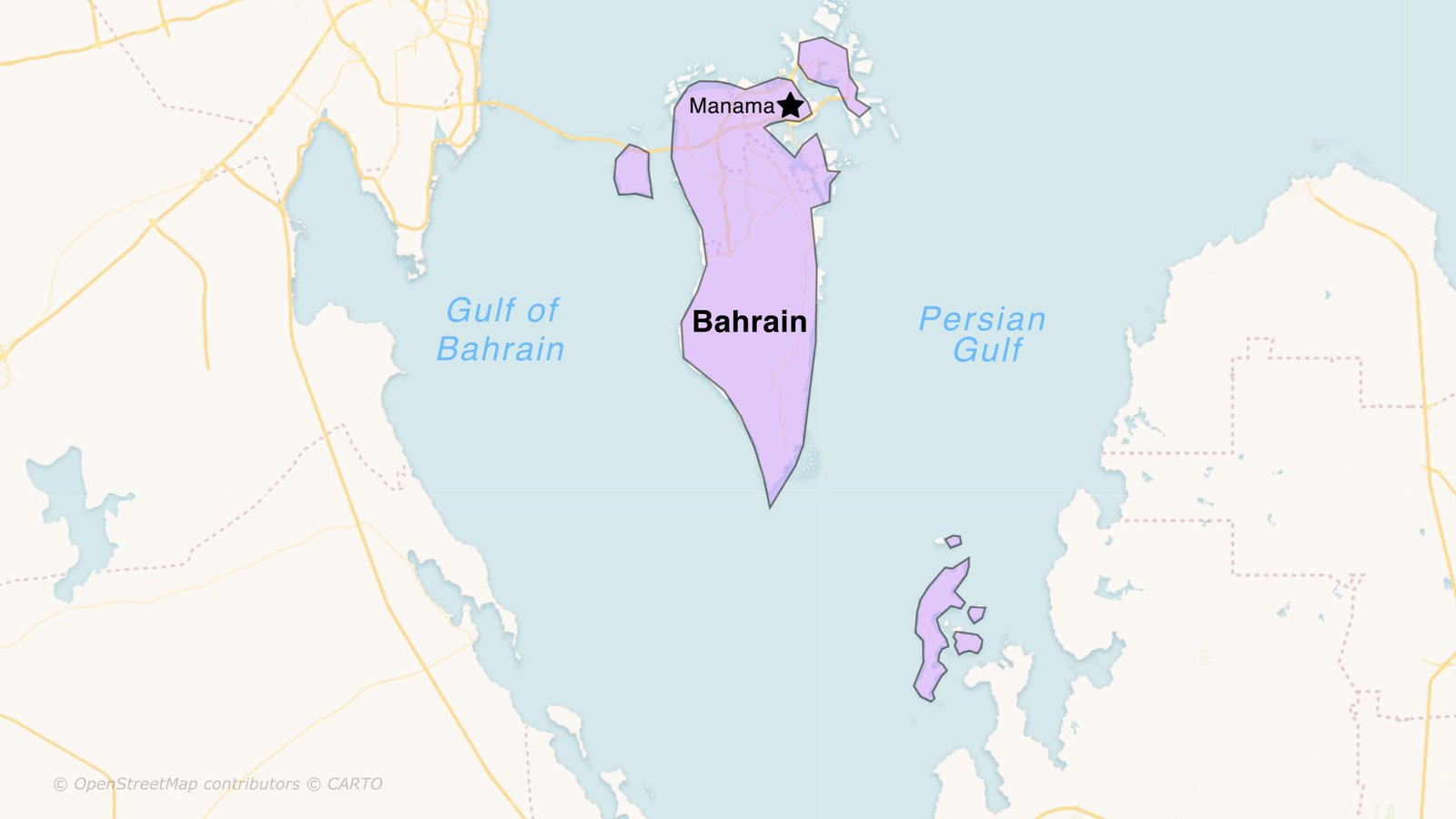
Bahrain is located in the Persian Gulf, an island nation off the eastern coast of Saudi Arabia. It is connected to Saudi Arabia by the King Fahd Causeway and lies near Qatar to the southeast.
Bahrain Facts
- OFFICIAL NAME: Kingdom of Bahrain
- CAPITAL: Manama
- POPULATION: 1,675,572 (2026)
- AREA: 786 square kilometers
- OFFICIAL LANGUAGE: Arabic
- CURRENCY: Bahraini Dinar (BHD)
Bahrain Flag
The flag of Bahrain is divided into two sections — red on the right and white on the left, separated by a serrated line with five points. The red color is traditionally associated with the Khawarij sect and is a common color among Gulf nations. The five white points represent the five pillars of Islam. The serrated edge distinguishes Bahrain’s flag from those of other Gulf countries that also use red and white in their designs.
Bahrain Geography
- Located in the Persian Gulf, off the eastern coast of the Arabian Peninsula.
- An archipelago made up of Bahrain Island and several smaller surrounding islands.
- Connected to Saudi Arabia by the King Fahd Causeway, a 25-kilometer bridge.
- Lies near Qatar, separated by the Gulf of Bahrain.
- Bahrain is one of the smallest countries in the world by land area.
- The terrain is mostly flat desert, with a low-lying central plain and a slightly elevated rocky area in the west.
- The climate is arid, with extremely hot and humid summers and mild winters.
- The country has very limited natural fresh water and relies heavily on desalination.
- Significant land reclamation projects have expanded Bahrain’s total land area in recent decades.
Bahrain Government
- Bahrain is a constitutional monarchy.
- The King serves as the head of state, with significant executive authority.
- The Prime Minister serves as head of government, appointed by the King.
- Bahrain has a bicameral legislature consisting of an elected Chamber of Deputies and an appointed Shura Council.
- Bahrain gained independence from the United Kingdom in 1971.
History of Bahrain
- Bahrain has one of the longest histories of continuous human settlement in the Persian Gulf region, dating back thousands of years.
- The island was an important center of the ancient Dilmun civilization, which thrived through maritime trade.
- Bahrain was historically renowned for its natural pearl beds, making it a major center of the pearling industry for centuries.
- The island came under Portuguese control in the 16th century before being taken by Persian forces.
- The Al Khalifa family established control over Bahrain in 1783 and has ruled the country since.
- Bahrain became a British protectorate in the 19th century, with the UK overseeing its foreign affairs and defense.
- Bahrain gained full independence from the United Kingdom on August 15, 1971.
- Bahrain discovered oil in 1932, becoming the first country in the Gulf region to do so, which transformed its economy.
- In recent decades, Bahrain has developed as a regional center for banking and finance.
People and Culture of Bahrain
- Bahrain has a diverse population, including a significant number of foreign workers from South Asia and other parts of the world.
- Arabic is the official language, though English is widely used in business and government.
- Islam is the state religion, with both Sunni and Shia communities present in the country.
- Machboos, a spiced rice dish typically made with meat or fish, is considered the national dish of Bahrain.
- Pearl diving holds deep cultural and historical significance, reflecting Bahrain’s centuries-old maritime heritage.
- Traditional dhow boatbuilding and sailing remain an important part of Bahraini cultural identity.
- Bahrain hosts a Formula 1 Grand Prix, which has become an important part of its modern cultural and sporting calendar.
Economy of Bahrain
- Bahrain has a diversified economy, having moved away from a primary reliance on oil compared to some of its Gulf neighbors.
- The financial services sector is a major pillar of the economy, with Bahrain serving as a regional banking hub.
- Oil and natural gas still contribute significantly to government revenue, though reserves are smaller than other Gulf states.
- Aluminum production is a significant industrial sector, with Bahrain home to one of the largest aluminum smelters in the world.
- Tourism, particularly from neighboring Gulf countries, contributes to the economy.
- The government has invested in economic diversification initiatives, including fintech and manufacturing.
Bahrain Resources
- Bahrain has modest oil and natural gas reserves compared to other Gulf nations, located both onshore and offshore.
- The country has historically been known for its natural pearl beds, though commercial pearling has significantly declined.
- Bauxite is imported for use in Bahrain’s substantial aluminum smelting industry.
- Limited agricultural resources exist due to the arid climate and scarce fresh water.
- Land reclamation has been used extensively to expand usable land area for development.
Bahrain Wildlife
- Bahrain’s desert and marine environments support a range of wildlife adapted to arid and coastal conditions.
- The Arabian oryx, a desert antelope, has been reintroduced to protected areas such as the Al Areen Wildlife Park.
- The surrounding waters of the Persian Gulf are home to dugongs, with Bahrain hosting one of the largest populations in the region.
- Flamingos and other migratory birds can be found in Bahrain’s coastal wetlands during certain seasons.
- Coral reefs around the islands support a variety of marine fish species.
- Bahrain has established protected reserves to conserve native desert and marine species amid rapid urban development.