Chile Country Profile
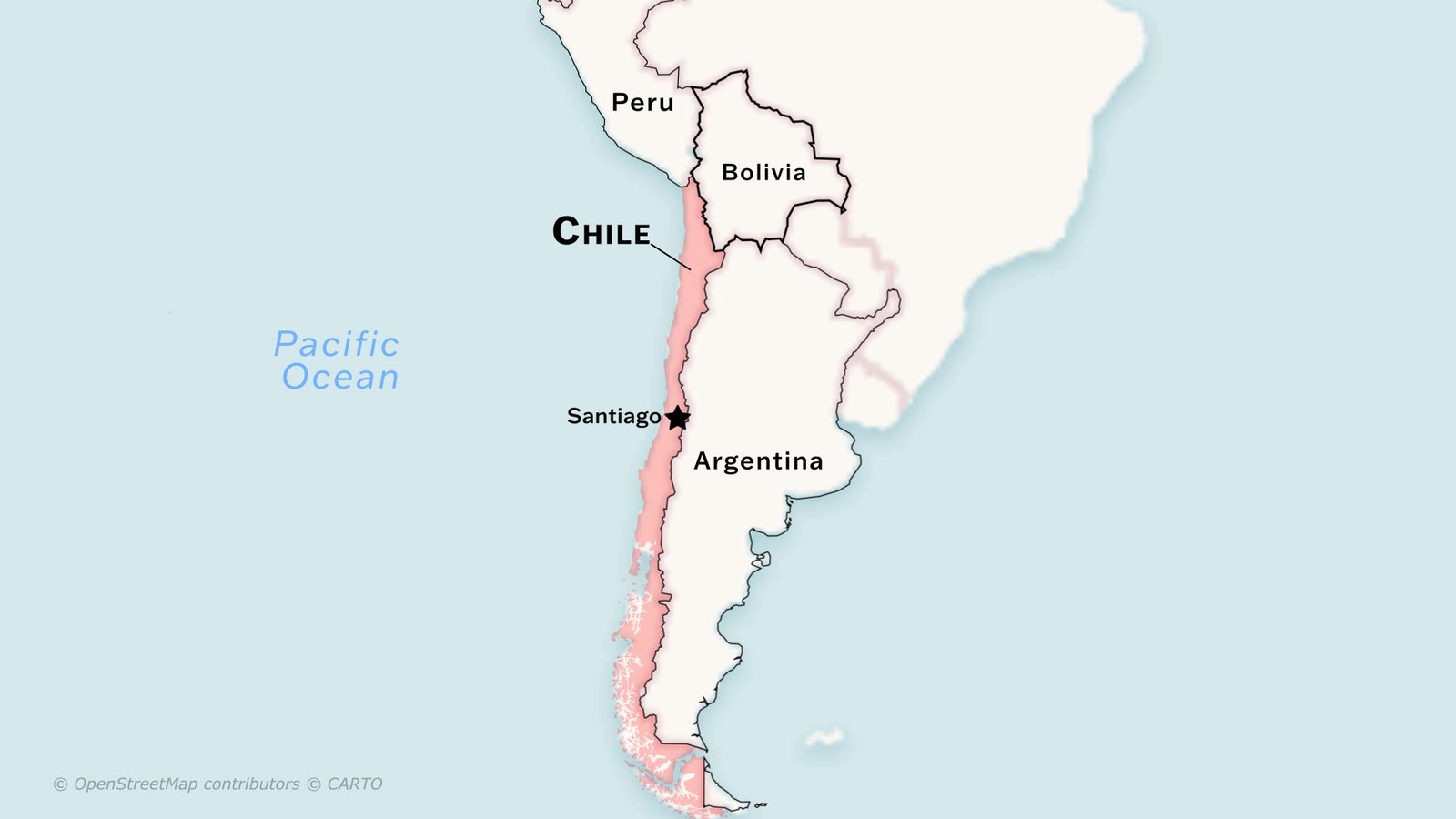
Chile is located in South America, a long and narrow country running along the southwestern coast of the continent. It is bordered by Peru to the north, Bolivia to the northeast, and Argentina to the east. To the west lies the Pacific Ocean, forming the entire length of Chile’s coastline.
Chile Facts
- OFFICIAL NAME: Republic of Chile
- CAPITAL: Santiago
- POPULATION: 19,945,850 (2026)
- AREA: 756,102 square kilometers
- OFFICIAL LANGUAGE: Spanish
- CURRENCY: Chilean Peso (CLP)
Chile Flag
The flag of Chile is divided into two horizontal bands — white on top and red on the bottom — with a blue square in the upper left corner containing a single white five-pointed star. The blue represents the sky and the Pacific Ocean, the white symbolizes the snow-capped peaks of the Andes Mountains, and the red represents the blood shed by those who fought for independence. The white star, known as the Star of Chile or the Lone Star, represents the powers of the state and honors those who gave their lives for the nation. The flag has been in use since Chile’s independence in the early 19th century.
Chile Geography
- Located along the southwestern coast of South America, one of the world’s longest and narrowest countries.
- Borders: Peru to the north, Bolivia to the northeast, Argentina to the east.
- The Pacific Ocean forms the entire western coastline, stretching approximately 6,435 kilometers.
- The Andes Mountains run along the entire eastern border, forming a dramatic natural boundary with Argentina and Bolivia.
- The Atacama Desert in the north is one of the driest places on Earth and one of the world’s most important mining regions.
- The Central Valley is the most populated and agriculturally productive region of the country.
- Patagonia in the south is a region of glaciers, lakes, and dramatic fjords extending toward the tip of the continent.
- Tierra del Fuego, at the southernmost tip, is shared with Argentina.
- Chile also claims sovereignty over Easter Island in the Pacific Ocean and part of Antarctica.
- The country is highly prone to earthquakes and volcanic activity due to its location along the Pacific Ring of Fire.
Chile Government
- Chile is a presidential republic.
- The President serves as both head of state and head of government.
- Chile has a bicameral National Congress consisting of the Senate and the Chamber of Deputies.
- Chile returned to democratic governance in 1990 after nearly two decades of military dictatorship.
- Gabriel Boric has served as President since 2022, making him one of the youngest heads of state in Chilean history.
History of Chile
- The region was originally inhabited by various indigenous peoples, including the Mapuche, who fiercely resisted both Inca and later Spanish conquest.
- Spanish conquistadors arrived in the 16th century, and Chile became part of the Spanish colonial empire.
- Chile declared independence from Spain on September 18, 1810, with full independence achieved by 1818 under General Bernardo O’Higgins.
- In the War of the Pacific from 1879 to 1884, Chile defeated Peru and Bolivia and gained valuable nitrate-rich northern territories, depriving Bolivia of its coastal access.
- Chile experienced significant economic growth in the early 20th century, driven by copper and nitrate exports.
- Salvador Allende became the world’s first democratically elected Marxist president in 1970.
- General Augusto Pinochet led a military coup in 1973, overthrowing Allende and establishing a dictatorship that lasted until 1990.
- Chile has been one of the most economically successful countries in Latin America since returning to democracy.
People and Culture of Chile
- The majority of Chile’s population is of mixed Spanish and indigenous descent, known as mestizo.
- The Mapuche are the largest indigenous group and have maintained a strong cultural and political presence in southern Chile.
- Spanish is the official and almost universally spoken language throughout the country.
- Roman Catholicism has historically been the dominant religion, though its influence has declined significantly in recent decades.
- Empanadas, baked or fried pastries filled with meat, cheese, or seafood, are one of Chile’s most iconic foods.
- Asado, a style of barbecue similar to Argentina, is central to Chilean social gatherings.
- Chilean wine is internationally renowned, with the Central Valley producing some of the most celebrated wines in South America.
Economy of Chile
- Chile has one of the strongest and most stable economies in Latin America.
- The country is the world’s largest producer of copper, which accounts for a significant share of export revenue.
- Chile also holds some of the world’s largest lithium reserves, concentrated in the Atacama Desert’s salt flats.
- Agriculture and wine production are important export sectors, with Chilean fruits and wines exported globally.
- The services sector, including finance and retail, is the largest contributor to GDP.
- Chile has signed extensive free trade agreements and is one of the most open economies in the region.
Chile Resources
- Chile possesses the world’s largest known copper reserves, primarily located in the Atacama Desert and northern mining regions.
- The country holds significant lithium deposits in the Salar de Atacama, one of the world’s most productive lithium brine sources.
- Gold, silver, molybdenum, and iron ore are also mined in significant quantities.
- Chile’s long Pacific coastline supports one of the world’s largest fishing industries, producing fishmeal and salmon for export.
- The Central Valley’s fertile soils and favorable climate support large-scale fruit, vegetable, and wine production.
- Vast hydropower potential exists in the country’s numerous rivers flowing from the Andes.
Chile Wildlife
- Chile’s extraordinary geographic diversity, from the Atacama Desert to Patagonian glaciers, supports a wide range of unique wildlife.
- The Andean condor soars over the length of the Andes and is a national symbol of Chile.
- Pumas inhabit the Andes and Patagonia, while guanacos roam the open grasslands of the south.
- The Pacific coastline supports large colonies of sea lions, penguins, and numerous seabird species.
- The Humboldt penguin nests along the northern and central coast, while Magellanic penguins are found in large colonies in Patagonia.
- Easter Island, a Chilean territory in the Pacific, is home to endemic species including the Easter Island palm and unique seabirds.
- Conservation efforts in Chilean Patagonia have helped protect one of the largest and most pristine wilderness areas in South America.