Egypt Country Profile
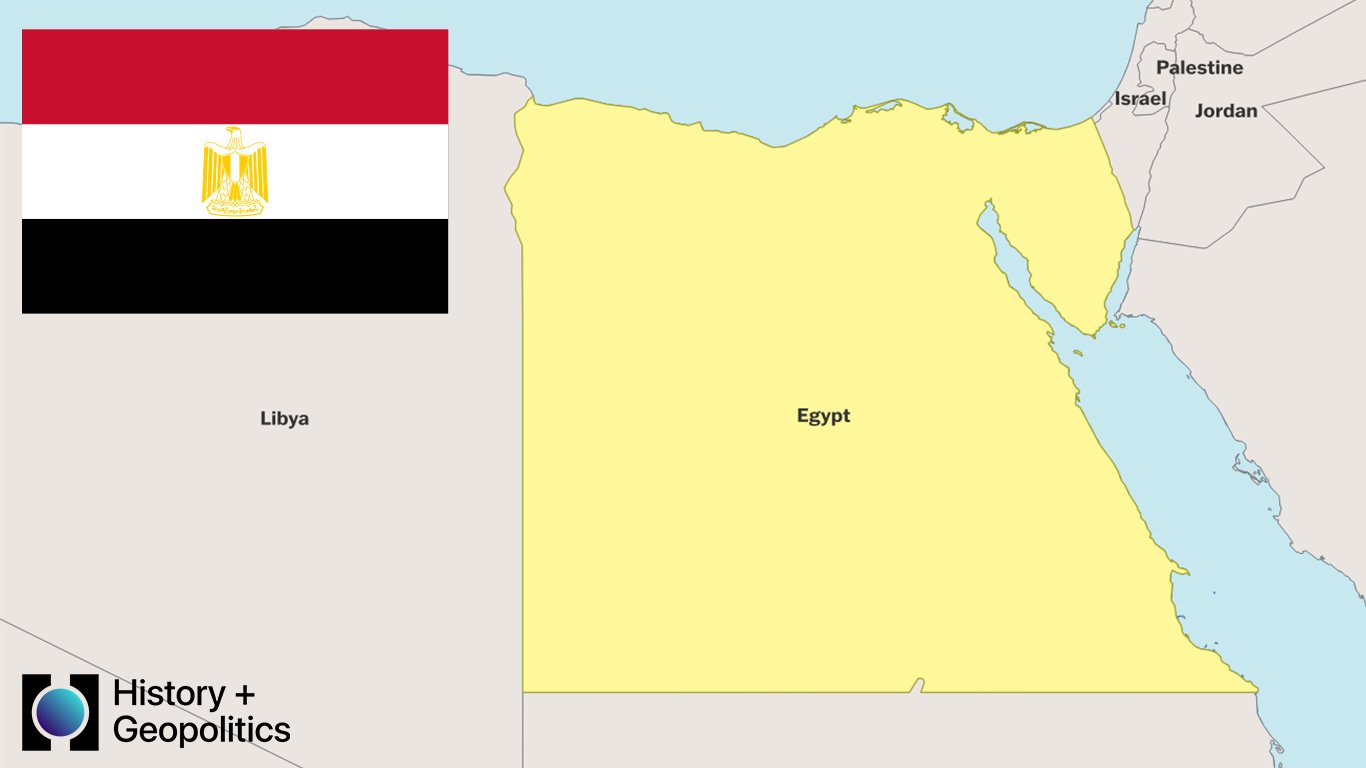
Egypt is located in northeastern Africa, bordered by Libya to the west, Sudan to the south, Israel and the Gaza Strip to the northeast, and the Red Sea to the east. To the north lies the Mediterranean Sea, forming Egypt’s northern coastline.
Egypt Facts
- OFFICIAL NAME: Arab Republic of Egypt
- CAPITAL: Cairo
- POPULATION: 120,101,175 (2026)
- AREA: 1,002,450 square kilometers
- OFFICIAL LANGUAGE: Arabic
- CURRENCY: Egyptian Pound (EGP)
Egypt Flag
The flag of Egypt has three equal horizontal stripes — red on top, white in the middle, and black on the bottom — with the Eagle of Saladin in gold positioned at the center of the white stripe. The red represents the period before the 1952 revolution and the sacrifice of Egyptian martyrs. The white represents the bloodless nature of the 1952 revolution that ended the monarchy. The black represents the end of oppression and the dark period of British occupation. The Eagle of Saladin, named after the famous 12th century Muslim leader, holds a scroll with the words “Arab Republic of Egypt” in Arabic and represents strength and the country’s proud history.
Egypt Geography
- Located in northeastern Africa, forming a land bridge between Africa and Asia through the Sinai Peninsula.
- Borders: Libya to the west, Sudan to the south, Israel and the Gaza Strip to the northeast.
- The Mediterranean Sea lies to the north and the Red Sea to the east.
- Egypt is dominated by desert, with approximately 95% of the country consisting of arid land.
- The Nile River, the longest river in the world, flows northward through the eastern part of the country, creating a narrow fertile valley before fanning out into the Nile Delta.
- The vast majority of Egypt’s population lives along the Nile Valley and Delta, which make up only about 5% of the country’s total land area.
- The Sinai Peninsula in the northeast is a triangular landmass connecting Africa to Asia.
- The Western Desert, part of the Sahara, covers approximately two-thirds of Egypt’s total land area.
- The Eastern Desert lies between the Nile and the Red Sea, featuring rugged hills and plateaus.
- The Suez Canal, an artificial waterway connecting the Mediterranean Sea to the Red Sea, passes through northeastern Egypt and is one of the world’s most important shipping routes.
Egypt Government
- Egypt is a presidential republic.
- The President serves as head of state and supreme commander of the armed forces, with extensive executive authority.
- Abdel Fattah el-Sisi has served as President since 2014 following the removal of President Mohamed Morsi.
- Egypt has a bicameral parliament consisting of the Senate and the House of Representatives.
- The military plays a central role in Egyptian politics and the economy.
History of Egypt
- Egypt is home to one of the world’s oldest civilizations, with a recorded history stretching back over 5,000 years.
- Ancient Egypt developed along the Nile Valley around 3100 B.C., becoming one of the most powerful and culturally rich civilizations of the ancient world.
- The ancient Egyptians built the pyramids of Giza, the Great Sphinx, and numerous temples and monuments that remain among the most iconic structures ever constructed.
- Egypt came under Greek rule following Alexander the Great’s conquest in 332 B.C., with the Ptolemaic dynasty ruling until 30 B.C.
- Rome conquered Egypt in 30 B.C. after the deaths of Cleopatra and Mark Antony.
- Arab Muslim armies conquered Egypt in 641 A.D., bringing Islam and the Arabic language that have defined the country ever since.
- Egypt came under Ottoman rule in 1517 and remained part of the Ottoman Empire for several centuries.
- Napoleon Bonaparte invaded Egypt in 1798, beginning a period of European interest in the country.
- Britain occupied Egypt in 1882 and maintained control until Egyptian independence in 1952.
- The 1952 revolution led by the Free Officers Movement, including Gamal Abdel Nasser, ended the monarchy and established a republic.
- Nasser nationalized the Suez Canal in 1956, triggering the Suez Crisis and establishing Egypt as a leader of Arab nationalism.
- Egypt fought several wars with Israel, including the 1967 Six-Day War and the 1973 October War, and signed a peace treaty with Israel in 1979.
- The Arab Spring uprising of 2011 led to the resignation of President Hosni Mubarak after nearly 30 years in power.
- Following a period of Muslim Brotherhood governance under Mohamed Morsi, the military removed him in 2013, with Abdel Fattah el-Sisi taking power in 2014.
People and Culture of Egypt
- Egyptians form an overwhelmingly homogeneous population, with ethnic Egyptians making up nearly 99% of the country.
- The Coptic Christians are the largest religious minority, representing approximately 10% of the population and one of the oldest Christian communities in the world.
- Arabic is the official language, with Egyptian Arabic being the most widely understood dialect across the Arab world due to Egypt’s cultural influence.
- Sunni Islam is practiced by approximately 90% of the population and is deeply embedded in daily life and culture.
- Koshari, a hearty dish of rice, lentils, pasta, and tomato sauce topped with fried onions, is considered Egypt’s national dish and a staple street food.
- Egypt has been a global center of Arabic literature, cinema, and music, with Cairo historically serving as the cultural capital of the Arab world.
- The pharaonic heritage of ancient Egypt, including the pyramids, sphinx, and temples, remains central to Egyptian national identity and pride.
Economy of Egypt
- Egypt has one of the largest economies in Africa and the Middle East, with diverse sectors including tourism, remittances, the Suez Canal, oil, and manufacturing.
- The Suez Canal is one of Egypt’s most important sources of foreign revenue, with thousands of ships passing through annually.
- Tourism is a major sector, driven by Egypt’s ancient monuments, Red Sea resorts, and Mediterranean coast.
- Remittances from millions of Egyptians working abroad, particularly in Gulf countries, are a significant source of income.
- Egypt has significant natural gas reserves, with offshore discoveries in the Mediterranean making the country an emerging energy exporter.
- Agriculture along the Nile Valley produces cotton, rice, wheat, and fruits, though Egypt relies on food imports to meet the needs of its large and growing population.
Egypt Resources
- Egypt has significant natural gas reserves, particularly the Zohr offshore gas field in the Mediterranean, one of the largest in the region.
- Oil reserves are present in the Western Desert, Gulf of Suez, and Sinai regions.
- Phosphate, iron ore, and gold deposits are mined in various parts of the country.
- The Nile River provides essential fresh water for agriculture and human consumption across the country.
- The Suez Canal is one of Egypt’s most strategically and economically valuable resources, generating billions of dollars in annual transit fees.
- Solar and wind energy potential is exceptional, particularly in the Western Desert and along the Red Sea coast.
Egypt Wildlife
- Egypt’s diverse environments, from the Nile Delta to the Red Sea and Sinai Mountains, support a variety of wildlife adapted to arid and aquatic conditions.
- The Egyptian mongoose and desert fox are among the native mammal species found in various habitats across the country.
- The Nile crocodile, once widespread throughout Egypt, is now found only in Lake Nasser in the far south.
- The Red Sea is one of the world’s most biodiverse marine environments, home to coral reefs, dolphins, dugongs, and hundreds of fish species.
- The Sinai Peninsula supports Nubian ibex and various desert-adapted reptile species.
- Egypt’s coastal wetlands and the Nile Delta are important stopover points for millions of migratory birds traveling between Europe and sub-Saharan Africa.
- Conservation efforts focus on protecting the Red Sea coral reefs and the remaining wildlife of the Sinai and Eastern Desert regions.