Israel Country Profile
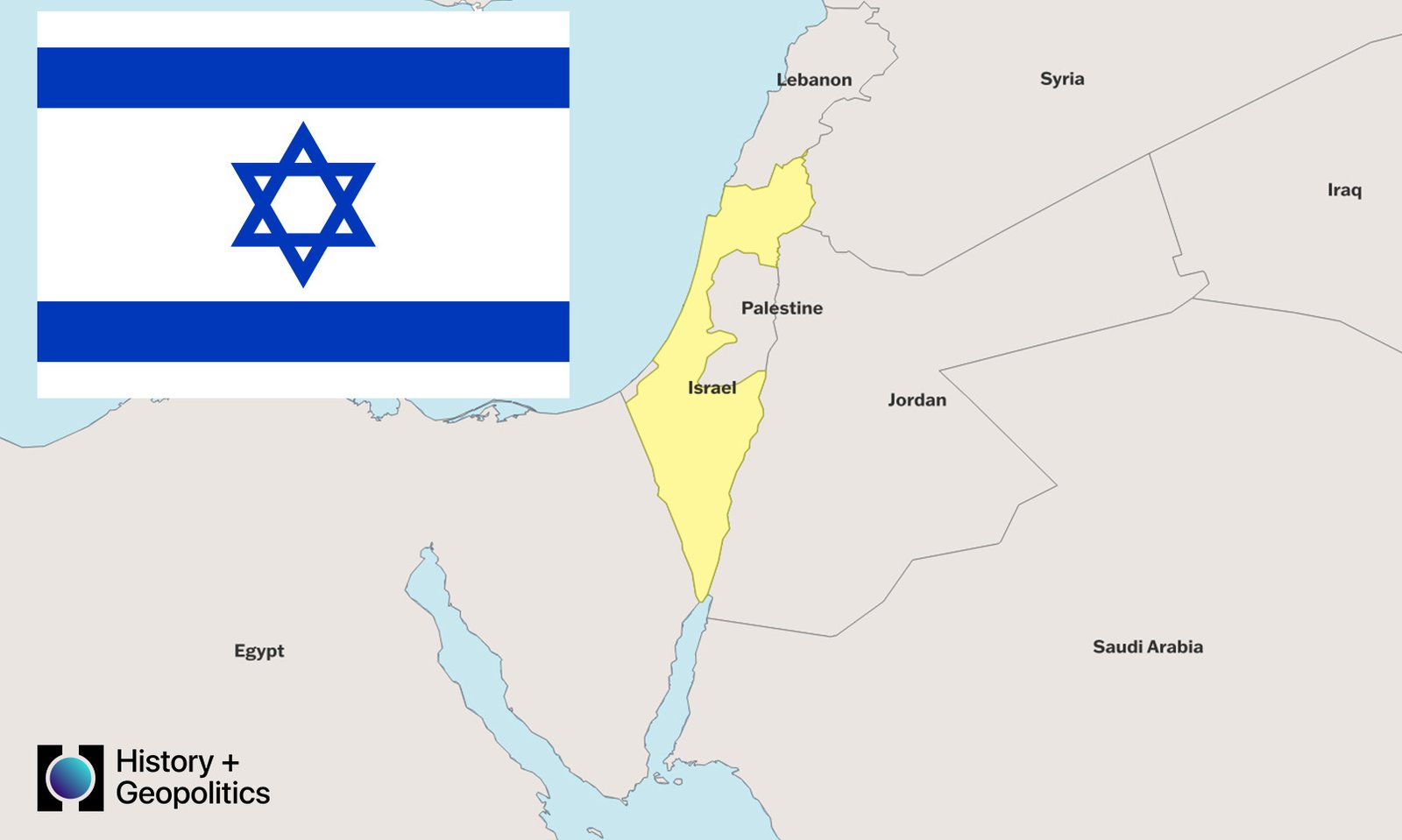
Israel is located in the Middle East, at the eastern end of the Mediterranean Sea. It is bordered by Lebanon to the north, Syria to the northeast, Jordan to the east, Egypt to the southwest, and the Mediterranean Sea to the west. Israel also borders the Palestinian territories of the West Bank to the east and the Gaza Strip to the southwest.
Israel Facts
- OFFICIAL NAME: State of Israel
- CAPITAL: Jerusalem (though Tel Aviv is recognized as the capital by most countries)
- POPULATION: 10,178,000 (2026, Israeli Central Bureau of Statistics)
- AREA: 20,770 square kilometers
- OFFICIAL LANGUAGES: Hebrew, Arabic
- CURRENCY: Israeli New Shekel (ILS)
Israel Flag
The flag of Israel has a white background with two horizontal blue stripes near the top and bottom edges, and a blue Star of David, known in Hebrew as the Magen David, centered between the two stripes. The design is based on the traditional Jewish prayer shawl, known as a tallit, which is typically white with blue stripes. The Star of David, a six-pointed star formed by two overlapping triangles, is one of the most universally recognized symbols of Judaism and Jewish identity. The flag was adopted upon Israel’s declaration of independence in 1948 and has become one of the most recognized national flags in the world.
Israel Geography
- Located in the Middle East, at the eastern end of the Mediterranean Sea.
- Borders: Lebanon to the north, Syria to the northeast, Jordan to the east, Egypt to the southwest.
- Also borders the Palestinian territories of the West Bank to the east and the Gaza Strip to the southwest.
- The Mediterranean Sea forms the entire western coastline.
- Israel also has a short coastline on the Red Sea at the Gulf of Aqaba in the far south.
- Despite its small size, Israel has remarkable geographic diversity, from the fertile coastal plain to the Negev Desert.
- The Jordan River runs along the eastern border, flowing from the Sea of Galilee southward into the Dead Sea.
- The Dead Sea, on the border with Jordan, is the lowest point on Earth at approximately 430 meters below sea level, and one of the saltiest bodies of water in the world.
- The Negev Desert covers approximately half of Israel’s land area in the south.
- The northern regions, including the Galilee and Golan Heights, are the most fertile and well-watered parts of the country.
Israel Government
- Israel is a parliamentary democracy.
- The President serves as a largely ceremonial head of state.
- The Prime Minister serves as head of government, holding executive authority.
- Israel has a unicameral parliament called the Knesset, consisting of 120 members.
- Benjamin Netanyahu has served as Prime Minister since 2022, leading a coalition government.
- Israel does not have a formal written constitution but is governed by a series of Basic Laws.
- Israel crossed the 10 million population mark in 2024, according to its Central Bureau of Statistics.
History of Israel
- The region known historically as Canaan or the Land of Israel has been inhabited for hundreds of thousands of years and is one of the most archaeologically rich areas in the world.
- Ancient Israelites established kingdoms in the region, including the united Kingdom of Israel under Kings Saul, David, and Solomon, around 1000 B.C.
- Jerusalem became the capital of the Kingdom of Israel under King David and the site of Solomon’s Temple, the holiest site in Judaism.
- The region came under successive foreign dominations including the Assyrians, Babylonians, Persians, Greeks, and Romans.
- Jesus of Nazareth lived and preached in the region in the 1st century A.D., making it central to Christianity.
- The Roman suppression of Jewish revolts led to the destruction of the Second Temple in 70 A.D. and the dispersal of Jewish communities across the world, known as the Diaspora.
- Arab Muslim armies conquered the region in the 7th century A.D., followed by the Crusaders, Mamluks, and the Ottoman Empire.
- The Zionist movement, founded by Theodor Herzl in the late 19th century, advocated for the establishment of a Jewish homeland in the historic land of Israel.
- Britain controlled the region as the British Mandate for Palestine following World War I.
- The Holocaust, in which six million Jews were systematically murdered by Nazi Germany, intensified international support for the establishment of a Jewish state.
- Israel declared independence on May 14, 1948, immediately followed by the first Arab-Israeli War in which surrounding Arab states attacked the new state.
- Israel has fought several major wars with Arab neighbors, including the 1956 Suez Crisis, the 1967 Six-Day War, and the 1973 Yom Kippur War.
- The 1967 Six-Day War resulted in Israel capturing the West Bank, Gaza Strip, Sinai Peninsula, and Golan Heights.
- Israel signed peace treaties with Egypt in 1979 and Jordan in 1994.
- The Oslo Accords of 1993 established the Palestinian Authority and outlined a framework for Palestinian self-governance in parts of the West Bank and Gaza.
- The Hamas attack of October 7, 2023 was the deadliest attack on Jewish people since the Holocaust, triggering a major Israeli military campaign in Gaza that continued through 2024 and 2025.
People and Culture of Israel
- Jewish Israelis make up approximately 73.5% of the population, with Arab Israelis making up approximately 21%, and other groups forming the remainder.
- Hebrew is the primary official language, a Semitic language revived from near extinction as a spoken language in the 19th and early 20th centuries in one of the most remarkable linguistic revivals in history.
- Arabic is also an official language, reflecting the significant Arab minority population.
- Judaism is the religion of the majority, with Islam practiced by most Arab Israelis, and Christianity and the Druze faith also present.
- Falafel, deep-fried balls of ground chickpeas served in pita bread with salad and tahini, is one of Israel’s most iconic street foods and is considered a national dish.
- Shakshuka, eggs poached in a spiced tomato sauce, is a beloved breakfast and brunch dish with North African Jewish origins.
- Israel has one of the highest fertility rates among developed nations, with a total fertility rate of approximately 2.9 children per woman, driven partly by the high fertility of the ultra-Orthodox Haredi community.
Economy of Israel
- Israel has a highly developed, technology-driven economy and is often referred to as the “Start-Up Nation” for its extraordinary density of technology companies and innovation.
- The technology sector, including software, cybersecurity, and medical technology, is the most important driver of economic growth and exports.
- Israel has more companies listed on the NASDAQ stock exchange than any country outside the United States and China.
- The diamond industry, centered in Tel Aviv, is one of the world’s most important centers for diamond cutting and trading.
- Agriculture, though employing a small share of the workforce, is highly advanced, with Israel being a world leader in drip irrigation, desalination, and agricultural technology.
- The ongoing conflict with Hamas in Gaza has imposed significant economic costs and security challenges.
Israel Resources
- Israel has limited conventional natural resources but significant offshore natural gas reserves in the Mediterranean, particularly the Leviathan and Tamar fields, which have transformed Israel into a natural gas exporter.
- The Dead Sea contains vast deposits of potash, bromine, and other minerals, making it an important industrial resource.
- Israel has developed world-leading expertise in water technology, including desalination and wastewater recycling, making water a managed rather than scarce resource.
- Fertile agricultural land in the coastal plain, Jezreel Valley, and Jordan Valley supports intensive farming despite the country’s small size.
- Solar energy potential is significant given Israel’s sunny climate, and the country is investing heavily in solar power development.
Israel Wildlife
- Israel’s diverse landscapes, from Mediterranean coast to desert, support a remarkable range of wildlife for such a small country.
- The country lies along one of the world’s most important bird migration routes, the Syrian-African Rift Valley flyway, with hundreds of millions of birds passing through Israel each year.
- The Persian fallow deer, once extinct in Israel, has been successfully reintroduced and is breeding in the Carmel and Galilee regions.
- The Arabian oryx was also reintroduced into the Negev Desert and is now breeding in protected areas.
- The Israeli painted frog, the only member of its genus and once thought extinct, was rediscovered in the Hula Valley in 2011.
- The Mediterranean monk seal was once common along Israel’s coast but is now extremely rare, with occasional sightings.
- Israel has established several nature reserves and national parks, and its small size relative to its biodiversity makes conservation both challenging and internationally significant.