Jordan Country Profile
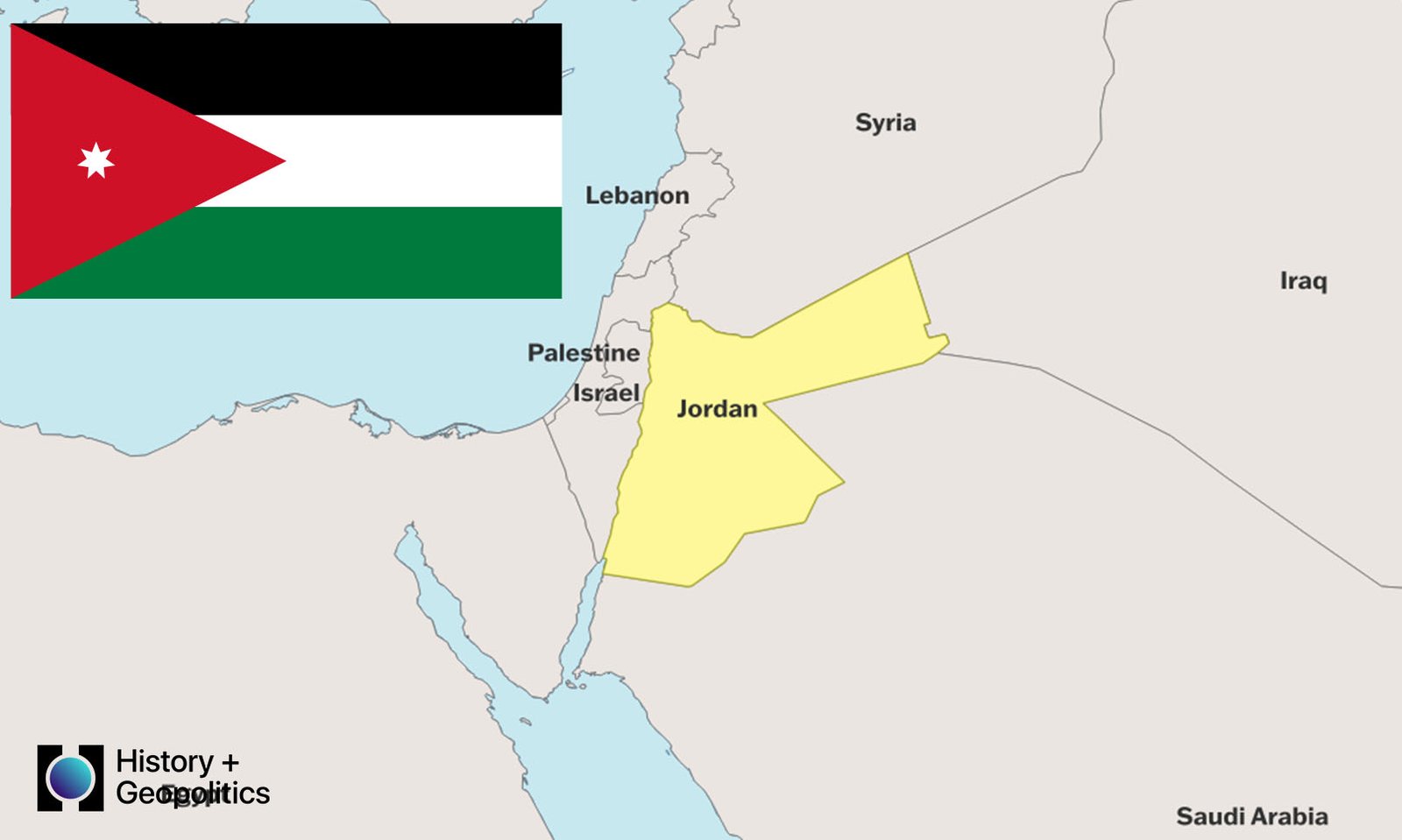
Jordan is located in the Middle East, a country in Western Asia bordered by Syria to the north, Iraq to the northeast, Saudi Arabia to the east and south, and Israel and the Palestinian West Bank to the west. To the southwest lies a short coastline on the Red Sea at the Gulf of Aqaba.
Jordan Facts
- OFFICIAL NAME: Hashemite Kingdom of Jordan
- CAPITAL: Amman
- POPULATION: 11,589,532 (2026)
- AREA: 89,342 square kilometers
- OFFICIAL LANGUAGE: Arabic
- CURRENCY: Jordanian Dinar (JOD)
Jordan Flag
The flag of Jordan has three equal horizontal stripes — black on top, white in the middle, and green on the bottom — with a red triangle on the hoist side containing a small white seven-pointed star. The black stripe represents the Abbasid Caliphate, the white represents the Umayyad Caliphate, and the green represents the Fatimid Caliphate and the Hashemite dynasty. The red triangle represents the Great Arab Revolt of 1916 and the Hashemite dynasty’s role in uniting the Arab peoples. The white star represents the unity of the Arab people, and its seven points symbolize the seven verses of the opening chapter of the Quran, the seven hills of Amman, and the unity of Arab nations.
Jordan Geography
- Located in Western Asia, at the heart of the Middle East.
- Borders: Syria to the north, Iraq to the northeast, Saudi Arabia to the east and south, Israel and the Palestinian West Bank to the west.
- Has a short coastline of approximately 26 kilometers along the Gulf of Aqaba on the Red Sea to the southwest.
- Jordan is a predominantly arid country, with the Jordan Rift Valley running along the western edge.
- The Jordan River flows along the western border, forming the boundary with Israel and the West Bank.
- The Dead Sea, the lowest point on Earth, lies on the border with Israel in the northwest.
- The eastern and southern parts of the country are covered by the Syrian Desert and the Arabian Desert.
- The highlands of the west receive more rainfall and support most of the country’s agriculture and population.
- The Wadi Rum desert in the south is one of the most spectacular desert landscapes in the world, a UNESCO World Heritage Site.
- Jordan experiences a Mediterranean climate in the northwest and an arid desert climate in the south and east.
Jordan Government
- Jordan is a constitutional monarchy.
- King Abdullah II has ruled since 1999, following the death of his father King Hussein.
- The Prime Minister serves as head of government, appointed by the King.
- Jordan has a bicameral National Assembly consisting of the Senate and the House of Representatives.
- Members of the House of Representatives are elected, while senators are appointed by the King.
- Jordan is widely regarded as one of the more stable and moderate states in the Middle East.
History of Jordan
- The region has been inhabited since prehistoric times, with some of the oldest known human settlements in the world located in present-day Jordan.
- The area was home to various ancient civilizations including the Nabataeans, who built the magnificent rock city of Petra.
- Petra served as the capital of the Nabataean Kingdom and became a major trading hub connecting Arabia, Egypt, and the Mediterranean world.
- The region came under Roman rule in 106 A.D. and later became part of the Byzantine Empire.
- Arab Muslim armies conquered the territory in the 7th century A.D., bringing Islam to the region.
- The Crusaders established a presence in parts of the region in the medieval period before being expelled by Saladin.
- The Ottoman Empire controlled the territory for approximately 400 years until the early 20th century.
- The Great Arab Revolt of 1916, led by Sharif Hussein of Mecca with British support, helped drive the Ottomans out of the region.
- The Emirate of Transjordan was established in 1921 under the Hashemite Emir Abdullah.
- Jordan gained full independence from British control on May 25, 1946, a date celebrated as Independence Day.
- Jordan fought in the Arab-Israeli wars of 1948 and 1967, losing the West Bank in the latter conflict.
- Jordan signed a peace treaty with Israel in 1994, only the second Arab country to do so after Egypt.
- Jordan has hosted enormous numbers of refugees from Palestinian territories, Iraq, and Syria, making it one of the highest per capita refugee-hosting countries in the world.
People and Culture of Jordan
- Jordanians make up the majority of the population, with a significant Palestinian community and large numbers of Syrian and Iraqi refugees also resident in the country.
- Arabic is the official and universally spoken language, with English widely used in business, education, and tourism.
- Sunni Islam is practiced by approximately 97% of the population, with a small Christian minority, one of the oldest Christian communities in the world, concentrated mainly in Amman and other cities.
- Mansaf, a dish of lamb cooked in fermented dried yogurt sauce and served over rice with flatbread, is considered the national dish of Jordan and is central to celebrations and hospitality.
- Jordanian culture places enormous importance on hospitality, with guests traditionally offered coffee, tea, and food upon arrival.
- The ancient city of Petra, carved into rose-red sandstone cliffs by the Nabataean people over 2,000 years ago, is Jordan’s most iconic landmark and one of the New Seven Wonders of the World.
- Jordan has a strong tradition of handicrafts, including mosaic art, pottery, and embroidery, which have been practiced in the region for centuries.
Economy of Jordan
- Jordan has a lower-middle-income economy with limited natural resources, relying significantly on foreign aid, remittances, and services.
- The tourism sector is one of the most important, with Petra, Wadi Rum, the Dead Sea, and Jerash attracting significant international visitor numbers.
- Phosphate and potash are Jordan’s most important mineral exports, with the country holding some of the world’s largest phosphate reserves.
- Remittances from Jordanians working abroad, particularly in Gulf countries, are a significant source of national income.
- Jordan has a relatively well-educated workforce and a developed services sector, including finance and information technology.
- The country faces ongoing economic challenges including high public debt, significant unemployment particularly among youth, and the economic strain of hosting large refugee populations.
Jordan Resources
- Jordan holds some of the world’s largest phosphate reserves, making phosphate one of the country’s most valuable mineral resources.
- Potash is extracted from the Dead Sea and is a major export commodity.
- The Dead Sea itself contains vast mineral resources, including bromine, potassium, and magnesium.
- Limited freshwater resources are a critical challenge, with Jordan being one of the most water-scarce countries in the world.
- The desert landscapes of Wadi Rum and the ancient sites including Petra are among Jordan’s most economically valuable resources through tourism.
Jordan Wildlife
- Jordan’s varied landscapes, from the Jordan Valley to the eastern desert and the mountains of the west, support a diverse range of wildlife for a relatively small and arid country.
- The Arabian oryx, once extinct in the wild across the Middle East, has been successfully reintroduced into Wadi Rum and the Shaumari Wildlife Reserve.
- The Asiatic wildcat and the striped hyena inhabit the more remote parts of the country.
- The Jordan Valley and the Azraq Wetland Reserve are important stopover points for millions of migratory birds traveling between Africa and Europe along the Great Rift Valley flyway.
- The Gulf of Aqaba, Jordan’s short stretch of Red Sea coastline, contains spectacular coral reefs supporting a diverse range of tropical marine life.
- The sand gazelle and Nubian ibex are among the native desert mammals found in Jordan’s protected areas.
- Conservation efforts focus on the Arabian oryx reintroduction program, protecting the Azraq wetlands, and preserving the coral reefs of the Gulf of Aqaba from coastal development and tourism pressure.